
CFDs and Spread Bets are complex instruments and come with a high risk of losing money rapidly due to leverage. 72.65% of retail investor accounts lose money when trading CFDs and Spread Bets with this provider. You should consider whether you understand how CFDs and Spread Bets work and whether you can afford to take the high risk of losing your money.


 Login


SEARCH
-
Search query too short. Please enter a full word or phrase.
-

Keywords
Popular Search


SEARCH
-
Search query too short. Please enter a full word or phrase.
-
Keywords
Popular Search



 Academy All Articles Alphabet (GOOGL) Stock in Q3 2026: Latest Results, Analyst Targets and How UK Traders Trade It
Alphabet (GOOGL) Stock in Q3 2026: Latest Results, Analyst Targets and How UK Traders Trade It

Vantage Editorial Team >
11 November 2026 | Academy | 36 min read
Vantage Editorial Team >
Vantage is a global, multi-asset broker with a team of in-house writers and market analysts who produce educational and insightful trading content for traders of all levels.

Alphabet (GOOGL) shares fell about 12.6% on 29 October 2026, the day after Q3 results paired 25% revenue growth with negative free cash flow of $9.07 billion.3,12 Average analyst price targets were about $398 to $413 on 8 November 2026, depending on the source, but a price target is an opinion, not a Google stock forecast.15,16
Why would a quarter with 103% Cloud growth send the stock sharply lower?
The short answer is spending. Alphabet’s capital expenditure rose 114% year over year and exceeded its operating cash flow, and a large loss on equity investments pulled reported earnings per share down.
In this guide, Google stock primarily refers to Alphabet’s Class A shares listed on Nasdaq under the ticker symbol GOOGL. Alphabet also has publicly traded Class C shares under GOOG, and the distinction matters because only GOOGL carries ordinary voting rights.
This Google stock outlook covers the latest price reference, Alphabet’s Q3 2026 results, analyst price targets, the difference between GOOG and GOOGL, the dividend, the main drivers and risks, and how share spread bets and CFDs work for UK traders.
Market data and company figures in this guide are as of 6 November 2026, and analyst ratings and targets as of 8 November 2026, unless stated otherwise. Company figures come from Alphabet’s Q3 2026 earnings release, and market data and analyst targets from the sources named in each table.
Disclaimer: Readers should note that forecasts and analyst targets are estimates rather than guarantees, and this article is for informational purposes only and does not constitute investment advice.
CFDs and Spread Bets are complex instruments and come with a high risk of losing money rapidly due to leverage. 72.65% of retail investor accounts lose money when trading CFDs and Spread Bets with this provider. You should consider whether you understand how CFDs and Spread Bets work and whether you can afford to take the high risk of losing your money.
Key Points
- Alphabet’s Q3 2026 revenue rose 25% year over year to $127.58 billion and Google Cloud revenue more than doubled to $30.71 billion, but capital expenditure of $51.36 billion exceeded operating cash flow of $42.29 billion.3
- Reported diluted EPS was $2.12, down from $2.87, after an $8.66 billion loss on equity securities that Alphabet said reduced diluted EPS by $0.55.3
- Analyst targets differ by source and change quickly, and they are not forecasts. The Google stock outlook depends heavily on whether Search and Cloud growth can justify the scale of AI infrastructure spending without prolonged pressure on cash generation.1,2
Google Stock at a Glance
The table below collects the latest available figures. Market data is from MarketBeat and TipRanks, and company data is from Alphabet’s Q3 2026 earnings release of 28 October 2026.1,2,3
| Metric | Latest available figure |
| Lead ticker | GOOGL (Alphabet Class A voting shares) |
| Share price reference | GOOGL (Class A) closed at $284.78 and GOOG (Class C) at $283.93 on 6 November 202617 |
| Market capitalisation | About $3.50 trillion on 6 November 202617 |
| Reaction to Q3 results | Fell about 12.6% on 29 October 202612 |
| Latest reported quarter | Q3 2026, released 28 October 2026 |
| Q3 revenue | $127.58 billion, up 25% year over year |
| Q3 diluted EPS | $2.12, including a $0.55-per-share reduction from losses on equity securities |
| Cash, cash equivalents and marketable securities | $265.10 billion at 30 September 2026 |
| Long-term debt | $125.10 billion at 30 September 2026, against $46.55 billion at 31 December 2025 |
| Quarterly common dividend | $0.22 per Class A, Class B, and Class C share; record date 7 December 2026 and payment date 14 December 2026 |
| Analyst ratings | MarketBeat (8 November): 55 ratings, with five Strong Buy, 45 Buy, and five Hold. TipRanks (8 November): 30 Buy and four Hold ratings over the past three months15,16 |
| Average 12-month analyst target | $412.51 (MarketBeat, 8 November) and $398.48 (TipRanks, 8 November)15,16 |
| Next earnings date | Not announced by Alphabet as of 5 November 2026 |
Table 1: Alphabet stock at a glance. Prices, ratings and targets change quickly, and each source calculates them differently.
What Is Google Stock, and Why Is the Company Called Alphabet?
Did you know that Google stock is the retail-market name commonly used for shares in Alphabet Inc., Google’s parent company? Alphabet actually became the listed holding company in 2015, allowing the core Google business and a collection of longer-horizon ventures to be reported within a broader corporate structure.
Alphabet reports three principal operating areas:
- Google Services includes Search, YouTube, Android, Chrome, Google Play, subscriptions, and devices.
- Google Cloud provides cloud infrastructure, data, security, workspace, and AI services to organisations.
- Other Bets includes earlier-stage businesses like Waymo.
The distinction between the consumer brand (Google) and the corporate name (Alphabet) explains why many readers encounter terms like “Google Alphabet stock”, “Alphabet stock”, and “Google stock” when searching for the same listed company. For broader mega-cap context, read Vantage Markets’ guide to the Magnificent Seven stocks.
The business remains meaningfully exposed to advertising. In Q3 2026, Google Services, which includes advertising, generated $96.30 billion of Alphabet’s $127.58 billion in revenue, about 75% of the total, and Google Search and other contributed $63.35 billion, about 50%.3 Cloud adds a growing source of diversification, but Search and advertising still have an outsized influence on Alphabet’s earnings and valuation.
GOOG vs GOOGL: What Is the Difference?
GOOGL is Alphabet’s Class A stock and carries one vote per share. GOOG is its Class C stock and carries no ordinary voting rights. Both receive the same declared dividend per share and give economic exposure to the same company, though their prices can differ slightly.
Some wonder whether the two tickers represent different businesses—they do not. The recurring GOOG vs GOOGL question comes from Alphabet’s three-class share structure, and GOOGL is the lead ticker in this guide because it is Alphabet’s publicly traded Class A stock.
| Share class | Ticker | Publicly traded? | Voting rights |
| Class A | GOOGL | Yes | One vote per share |
| Class B | None | No | Ten votes per share; mainly held by founders and insiders |
| Class C | GOOG | Yes | No ordinary voting rights |
Table 2: Alphabet share classes. Source: Alphabet Investor Relations.6,7
Alphabet’s 2026 annual-meeting disclosure confirms that Class A shares carried one vote each and Class B shares carried ten votes each. Alphabet’s certificate of incorporation sets out the rights of the three classes, including the non-voting status of Class C stock.6,7
GOOGL and GOOG participate in the same underlying company, and Alphabet declares the same common dividend per share across Classes A, B, and C. Their market prices can nevertheless differ slightly because of voting rights, supply, demand, and trading flows.
In essence, if you’re searching for Google stock Class A, use GOOGL. For Google stock Class C, it’s GOOG. Take note that Class B shares are not available on a public exchange.
Google Stock Price History
Google’s IPO (initial public offering) became effective on 18 August 2004. Back then, the company sold Class A shares to the public at $85 each, according to its SEC offering circular, and trading began the following day.8
The long-term Google stock price history includes the 2014 creation of Class C shares, the 2015 formation of Alphabet as Google’s parent, and the 20-for-1 stock split in July 2022. In 2004 the Class A shares traded as GOOG, and GOOGL arrived with the 2014 share-class change. These events changed the share structure and nominal price, so older quoted prices should be interpreted on a split-adjusted basis.
The shares can also move fast. Alphabet fell about 12.6% on 29 October 2026 after the Q3 report,12 a reminder of how quickly volatility can reset expectations. Bear in mind that historical price performance does not establish the direction of the next move.
For a dated market view rather than this evergreen overview, see Vantage Markets’ 22 July 2026 Google stock analysis.
Alphabet Q3 2026 Results: What Moved the Stock
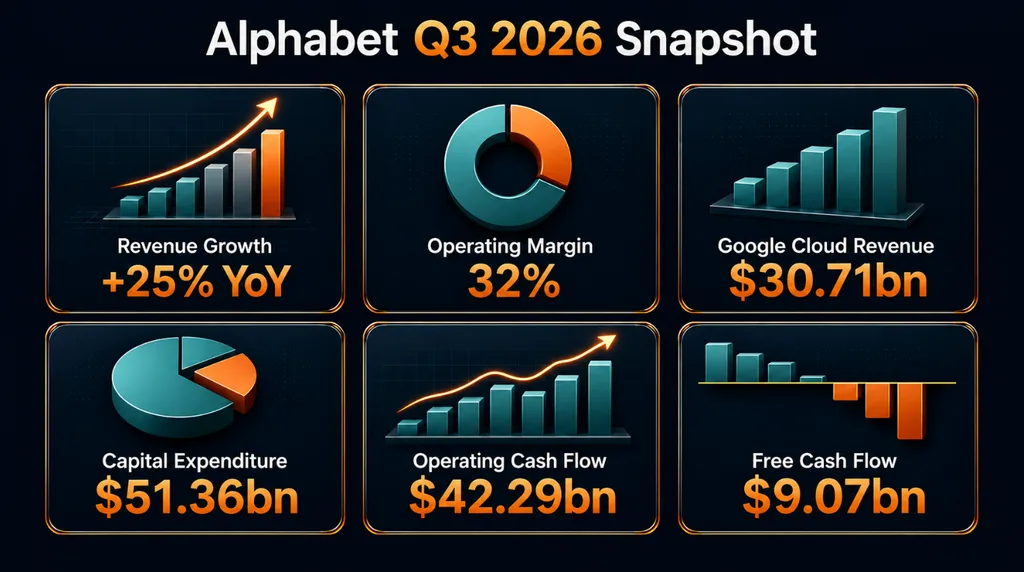
Alphabet reported Q3 2026 results on 28 October 2026. Here’s the thing: the headline growth was strong, but the cash picture and the equity loss drew most of the attention.3
| Metric | Q3 2026 | Q3 2025 | Year-over-year change | Q2 2026 |
| Revenue | $127.58bn | $102.35bn | +25% | $119.80bn |
| Google Services revenue | $96.30bn | $87.05bn | +11% | $94.54bn |
| Google Search and other revenue | $63.35bn | $56.57bn | +12% | $63.27bn |
| Google Cloud revenue | $30.71bn | $15.16bn | +103% | $24.77bn |
| Google Cloud operating income | $11.12bn | $3.59bn | +209% | $8.81bn |
| Operating income | $40.58bn | $31.23bn | +30% | $40.77bn |
| Operating margin | 32% | 31% | +1 percentage point (rounded) | 34% |
| Diluted EPS | $2.12 | $2.87 | -26% | $9.11 |
| Capital expenditure | $51.36bn | $23.95bn | +114% | $44.92bn |
| Operating cash flow | $42.29bn | $48.41bn | -13% | $39.07bn |
| Free cash flow | -$9.07bn | $24.46bn | Turned negative | -$5.86bn |
Table 3: Alphabet Q3 2026 results against Q3 2025 and Q2 2026. Source: Alphabet Q3 2026 and Q2 2026 earnings releases.3,5 Free cash flow is operating cash flow less purchases of property and equipment. Q3 2025 free cash flow and the growth rates for Cloud operating income, EPS, capital expenditure and operating cash flow are calculated from the released figures.
1. Revenue Growth Was Broad, but Cloud Grew Fastest
Google Services revenue rose 11% to $96.30 billion, and Search and other revenue grew 12% to $63.35 billion. YouTube advertising revenue was $11.2 billion, up 9%, according to XTB’s coverage of the release.3,4 Both growth rates were lower than in Q2, when Search and other grew 17%.
Google Cloud revenue more than doubled to $30.71 billion, and segment operating income rose to $11.12 billion from $3.59 billion. That works out to a Cloud operating margin of about 36%, calculated from the released figures. Cloud is therefore becoming more important to the Google stock forecast, because it gives Alphabet a way to monetise the computing infrastructure, models, and security tools developed for AI.
2. Headline EPS Included an $8.66 Billion Equity Loss
Alphabet reported diluted earnings per share (EPS) of $2.12, compared with $2.87 a year earlier. The company recorded an $8.66 billion net loss on equity securities, and it said the net effect of that loss reduced net income by $6.7 billion and diluted EPS by $0.55.3
Adding back that disclosed effect gives roughly $2.67 per share. This is a useful analytical comparison, but it is not an Alphabet-reported adjusted EPS measure. For context, analysts had expected EPS of about $3.01 to $3.02, depending on the source.1,2
Alphabet’s release does not name the investments behind the loss, and management commentary on the earnings call linked the net other expense mainly to an unrealised loss on its SpaceX investment.
3. Capital Expenditure Exceeded Operating Cash Flow Again
Operating cash flow was $42.29 billion, while purchases of property and equipment reached $51.36 billion. Alphabet therefore reported negative quarterly free cash flow of $9.07 billion, even though trailing-12-month free cash flow remained positive at $19.75 billion.3 The Q3 release does not restate Alphabet’s full-year 2026 capital expenditure guidance, so check the latest company commentary for the current range.
Funding the gap involved both debt and equity.
Alphabet raised $28.7 billion in net proceeds from senior unsecured notes and issued Class A and Class C shares under its at-the-market programme for about $12.4 billion in net proceeds, leaving $27.6 billion available at 30 September 2026. Cash, cash equivalents and marketable securities stood at $265.10 billion, while long-term debt reached $125.10 billion, against $46.55 billion at the end of 2025.3
Why Did Google Stock Fall After Q3 Earnings?
Alphabet shares fell about 12.6% on 29 October 2026.12 GOOGL closed at $283.82 against $324.89 the previous session.12 Press coverage summarised by Gotrade said Search and other revenue missed analyst expectations, free cash flow was negative for a second straight quarter, and an $8.7 billion loss on equity securities cut diluted EPS by $0.55.12
XTB reported an after-hours decline of 8.25% on the evening of the release and tied the reaction to EPS of $2.12 against expectations of nearly $3.00, deteriorating cash flow, and the risk of further increases in capital expenditure.4 These are outlets’ readings of the move, not a single confirmed cause.
Event-driven trading, such as around earnings releases, carries higher risk because prices can move sharply. For dated, event-specific coverage, explore Vantage Markets’ Google stock news and earnings news today.
Google Stock Forecast and Analyst Price Targets
A search for a Google stock forecast usually surfaces analyst price targets. These are published by banks and brokers, they change after each results report, and they differ by source.
MarketBeat rated the stock Buy and TipRanks rated it Strong Buy, but their averages differed: $412.51 at MarketBeat and $398.48 at TipRanks on 8 November 2026.15,16 TipRanks put the implied upside at 39.9% from the 6 November close.16
| Firm | Rating (as stated by source) | New target | Prior target | Reported |
| BMO Capital | Buy | $425 | $480 | By 2 November 2026 |
| KeyCorp | Overweight | $385 | Not stated | 29 October 2026 |
| Scotiabank | Sector Outperform | $375 | $450 | 29 October 2026 |
| Wells Fargo | Buy | $371 | $417 | By 2 November 2026 |
| Cantor Fitzgerald | Buy | $350 | $420 | By 2 November 2026 |
| Piper Sandler | Overweight | $345 | Not stated | 29 October 2026 |
Table 4: Selected analyst price targets for Alphabet issued after the Q3 2026 results. Sources: MarketBeat (4 November 2026) and TipRanks (2 November 2026).1,2 The sources do not say whether each target refers to GOOGL or GOOG, and the list is a selection, not every target published.
Where a prior target is stated, every one of these four firms cut it. The new targets range from $345 to $425. Targets are inputs that can be considered alongside the company’s results, not calls to act on.
How to Read a Price Target
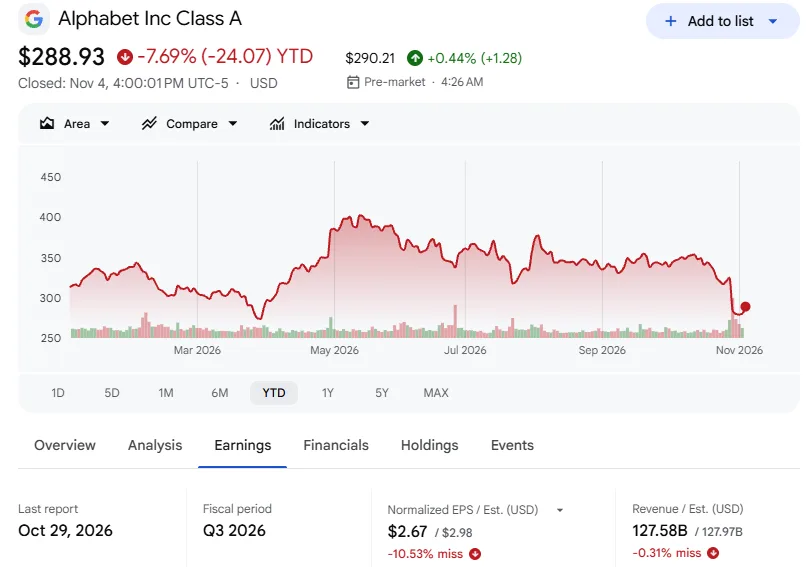
A price target depends on assumptions about revenue, operating margins, capital expenditure, non-operating gains, share issuance, and valuation multiples. Two trackers can show different averages on the same day because they include different analysts and update at different times. Targets can also change immediately after new information becomes available.
This is not a forecast or a prediction of Alphabet’s share price.
Hypothetical Scenarios
The scenarios below show how different combinations of outcomes could be read. These examples are hypothetical and for illustrative purposes only. They do not reflect actual trading results.
| Scenario | Operating picture | Cash flow and capital | Other conditions |
| Bull case | Search and YouTube keep growing at double-digit rates, and Cloud converts its infrastructure demand into higher operating income. | Capex stays high, but operating cash flow rises enough to restore positive quarterly free cash flow. | Regulatory outcomes are manageable, and the market keeps a premium valuation for Alphabet’s growth. |
| Base case | Revenue keeps growing, but Cloud growth moderates from its unusually high Q3 rate. | AI spending keeps depreciation and cash expenditure elevated, limiting near-term free-cash-flow expansion. | Investors wait for clearer evidence of returns, and the stock trades in a range consistent with other mega-cap technology companies. |
| Bear case | Search growth slows as competition and changing user behaviour pressure advertising economics. | Spending stays above operating cash flow for longer than expected, and funding adds to debt or share count. | Legal remedies or weaker margins reduce per-share earnings expectations, and the market assigns a lower valuation multiple. |
Table 5: Hypothetical scenarios for Alphabet. These are illustrations of how outcomes could combine, not forecasts, and they are not a reliable indicator of future performance.
What Drives Alphabet Stock?

Six areas are likely to shape the next phase of the Google stock outlook. Each depends on execution, competition, and market conditions.
1. AI Features in Search and Gemini
Alphabet’s Q3 release says Gemini 4 Argon and Carbon are “now leading at the frontier”, and that its first-party model APIs process nearly 32 billion tokens per minute, more than four times a year earlier.3 In Q2, management said the Gemini app had 950 million monthly active users and models were processing approximately 22 billion API tokens per minute.13 The Q3 release says the Gemini app has reached one billion users, although it does not describe that figure as monthly active users, which was the Q2 metric.3
The key commercial question is whether AI-enhanced Search can protect user engagement and advertising economics while managing the additional cost of generating answers. Higher query activity, effective ad formats, and stable margins would support the case, while weaker monetisation or higher serving costs would complicate it.
2. Google Cloud’s Growth and Margins
Cloud revenue grew 103% to $30.71 billion in Q3, and its operating margin was about 36%. Future quarters should show whether growth can stay elevated as comparisons become harder and whether operating income keeps scaling alongside infrastructure spending.3
Demand for enterprise AI infrastructure, AI solutions, cybersecurity, and core cloud services could broaden Alphabet’s revenue mix. Customer concentration, pricing, capacity utilisation, and the cost of long-duration data-centre commitments are among the factors that can matter.
Related Article: Artificial Intelligence Stocks to Watch
3. Search, YouTube, and Subscriptions
Search and other revenue grew 12% in Q3, down from 17% in Q2, and YouTube advertising grew 9%.3,4 Monetisation through advertising, subscriptions, connected television, and creator tools could add resilience outside Search, although these businesses also face competition for attention and content costs.
4. Waymo and Other Bets
Other Bets generated $372 million of Q3 revenue and an operating loss of $2.05 billion, compared with $344 million and a $1.43 billion loss a year earlier.3 Waymo may provide longer-term optionality if autonomous ride-hailing scales across more markets, but the segment remains small relative to Alphabet’s core operations and continues to consume capital.
A precise value for early-stage projects depends on regulatory approval, safety, competition, unit economics, and the time needed to reach commercial scale.
5. Equity Investments and Reported Earnings
Changes in the value of Alphabet’s equity holdings flow through other income and expense, so reported EPS can swing with investments outside its operating business. Q2 2026 included $99.03 billion of gains on equity securities that added $6.26 to diluted EPS, while Q3 2026 included an $8.66 billion loss that reduced it by $0.55.3,5 Operating income and cash flow are therefore the steadier points of comparison.
6. Capital Spending, Funding, and Capital Returns
The pace of capital expenditure relative to operating cash flow, further debt or equity issuance, and decisions on dividends and repurchases can all influence how the market values the stock. If you’re interested to learn more about how share structure affects these questions, the GOOG vs GOOGL section above explains the three classes.
Google Stock Dividend and Split History
Yes, Google stock pays a dividend. Alphabet’s Q3 2026 earnings release states that the board declared a quarterly cash dividend of $0.22 per Class A, Class B, and Class C share, payable on 14 December 2026 to shareholders of record on 7 December 2026.3
At the $283.93 GOOG close on 6 November 2026, four quarterly payments at that rate would equal $0.88 per year and an indicative yield of approximately 0.31%.17 Take note that this calculation is backward-looking, and future dividend declarations could differ.
Alphabet began paying a common dividend in 2024. The Google stock dividend yield remains modest, so the case for owning the shares is still tied more closely to earnings growth, cash generation, valuation, and capital allocation than to dividend income.
Alphabet’s official Additional Information page provides the tax documentation for its share-class changes and 2022 split. The key events are summarised below.11
| Date | Event | Practical effect |
| April 2014 | Class C distribution | Existing holders received non-voting Class C shares, which began trading under GOOG on 3 April 2014; the Class A shares trade as GOOGL. |
| 2015 | Class C adjustment distribution | A further Class C stock distribution adjusted the arrangement; see Alphabet’s tax documentation for the exact dates and treatment. |
| July 2022 | 20-for-1 stock split | Each pre-split share became 20 shares of the same class, with split-adjusted trading from 18 July 2022 and the nominal price adjusted proportionally. |
Table 6: Alphabet share-class and stock-split history. Source: Alphabet Investor Relations.11
The split changed the number and nominal price of shares but did not by itself change Alphabet’s total market value. Vantage Markets’ stock-split explainer covers how forward splits generally work, while this guide retains only the Alphabet-specific history.
Is Google a Good Stock to Buy? What to Weigh Before Trading Alphabet Shares
There is no single answer to whether Google stock is a good stock to buy, and this guide does not make a recommendation. It depends on a reader’s objectives, time horizon, valuation discipline, and tolerance for volatility. The Q3 results give evidence for both a more positive and a more cautious reading.
| Factors That Support a More Positive Reading | Factors That Support a More Cautious Reading |
| 25% Q3 revenue growth | Capital expenditure up 114% and above operating cash flow |
| 103% Google Cloud revenue growth and a margin of about 36% | Quarterly free cash flow turned negative at -$9.07bn |
| 30% growth in operating income | Reported EPS fell 26%, partly on an $8.66bn equity-security loss |
| Continued Search and YouTube growth | Long-term debt of $125.10bn, against $46.55bn at the end of 2025 |
| $265.10bn in cash and marketable securities | Equity issuance can dilute existing shareholders |
| Quarterly dividend across all common share classes | Antitrust, regulatory, and execution risks remain material |
Table 7: Factors that can support a more positive or a more cautious reading of Alphabet’s Q3 2026 results. Source: Alphabet Q3 2026 earnings release.3
The central issue is not whether Alphabet owns strong businesses, because it does. The harder question is whether future operating cash flows can compensate for the scale, timing, and financing of its AI investment cycle at the valuation paid for the shares.
Factors that can be weighed include the time horizon, the evidence being tracked (Search revenue, Cloud growth, operating margin, capital expenditure, free cash flow, and the share count), the share class, the valuation, concentration in one company or earnings event, and the full range of bull, base, and bear cases rather than a single analyst target.
None of these removes the risk of loss. Vantage Markets’ guide to risk management techniques provides additional context on defining exposure and loss capacity.
3 Key Dates to Watch
| Date | Event | Status |
| 7 December 2026 | Record date for the $0.22 quarterly common dividend | Confirmed by Alphabet’s Q3 release3 |
| 14 December 2026 | Payment date for the $0.22 quarterly common dividend | Confirmed by Alphabet’s Q3 release3 |
| Q4 2026 results | Next Alphabet earnings report | Date not announced as of 5 November 2026 |
Table 8: Key dates for Alphabet shareholders. Dates can change, so check Alphabet Investor Relations for the latest announcement.10
The Q4 report should provide more evidence on Search growth, Cloud demand, capital expenditure, free cash flow, equity issuance, and the relationship between reported EPS and non-operating gains or losses.
What Are the Main Risks to Alphabet Stock?
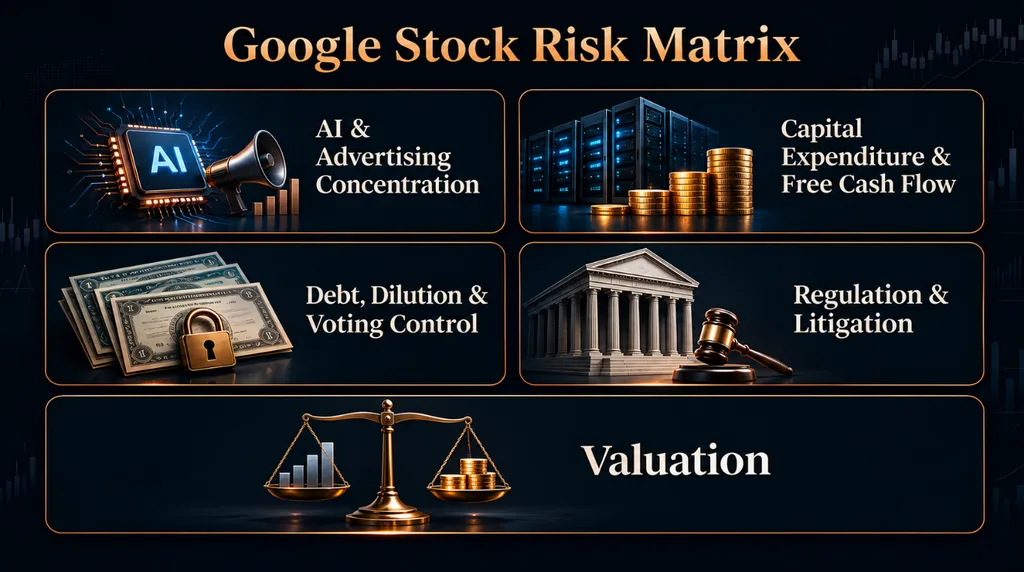
Bear in mind that the following risks should be considered alongside the potential catalysts. They can affect both the operating business and the valuation placed on Alphabet stock.
1. AI and Advertising Concentration
Generative AI may increase engagement, but it may also change how users interact with links and advertising. If AI-generated answers reduce commercial clicks or require materially more computing resources per query, Search margins could come under pressure even if usage remains high.
Google Services, which includes advertising, generated about 75% of Q3 revenue, so a downturn in marketing budgets, weaker ad pricing, privacy changes, or competitive pressure could have a material effect even as Cloud expands.3
2. Capital Expenditure and Free Cash Flow
Alphabet’s Q3 capital expenditure of $51.36 billion more than doubled from a year earlier and exceeded operating cash flow, leaving free cash flow at -$9.07 billion.3 Large infrastructure commitments can support future growth, but they can also create depreciation, financing, energy, and maintenance costs before utilisation reaches an efficient level.
Alphabet’s SEC filings warn that AI and infrastructure investments may not be commercially viable or may fail to generate an adequate return of capital.9
3. Debt, Dilution, and Voting Control
Long-term debt rose to $125.10 billion from $46.55 billion at the end of 2025, and Alphabet issued new Class A and Class C shares in Q3.3 Dilution may be acceptable if new capital earns attractive returns, but it can reduce per-share participation if outcomes disappoint.
Alphabet’s Class B shares also carry ten votes each, giving founders and insiders substantial influence. Public GOOGL holders receive one vote per share, while GOOG holders generally have no voting rights.
4. Regulation and Litigation
Alphabet continues to face antitrust and regulatory proceedings involving Search, advertising technology, Android, Google Play, privacy, and the use of AI. Its fiscal 2025 Form 10-K states that possible outcomes include substantial fines and penalties, injunctive relief, changes to products and services, and alterations to business models and operations, including divestiture.9
The outcome and timing of these cases remain uncertain. A favourable ruling can reduce an overhang, while a restrictive remedy may alter distribution agreements, economics, or product design.
5. Valuation Can Reset Quickly
A one-day fall of about 12.6% on 29 October 2026 shows how rapidly expectations can change.12 A strong company result does not necessarily produce a higher share price if the outcome falls short of what was already reflected in the valuation. Interest rates, market risk appetite, earnings estimates, and the valuation of comparable technology companies can all affect GOOGL even without a major company-specific driver.
Does Vantage Offer Alphabet Share Spread Bets and CFDs?
With Vantage UK, Alphabet can be traded as a spread bet or a share CFD, so you don’t own Alphabet shares. Our Trading Instruments page lists Alphabet (GOOG) among the share CFDs on offer.
A spread bet is staked in pounds per point, while a CFD is sized in contracts, and the two are taxed differently; tax treatment depends on individual circumstances and may change in future.
- A CFD is a contract with the provider rather than a purchase of shares on the exchange, so it does not give ownership of the underlying shares or direct access to the exchange.
- A share CFD allows a position on price movements to be taken long or short.
Share spread bets and CFDs are leveraged products and can lead to rapid losses. For UK retail clients, FCA rules cap leverage on individual shares at 5:1, a 20% margin.14 Leverage magnifies both potential gains and losses relative to the capital committed, and spreads, commissions, price gaps, and execution risk can add to the cost. Holding a position overnight may also incur overnight funding charges or credits. Alphabet is priced in US dollars, so results on a GBP account also move with GBP/USD.
Trading around earnings releases is higher risk because prices can move sharply. Nasdaq’s regular session runs from 14:30 to 21:00 UK time for most of the year, and Alphabet reports after the US close, so the reaction to results usually comes after 21:00 UK time.
One way to see how share spread bets and CFDs behave is to observe them on a Vantage demo account. A demo account is simulated, so prices and fills can differ from live trading.
Vantage Global Prime LLP, trading as Vantage, is authorised and regulated by the Financial Conduct Authority. FRN: 590299.
FAQs on Google Stock
What Is Google’s Stock Symbol?
Google’s parent company, Alphabet, has two publicly traded stock symbols. GOOGL is Class A stock with one vote per share, while GOOG is Class C stock without ordinary voting rights. Alphabet also has Class B shares with ten votes each, but those shares are not publicly traded.
What Is the Difference Between GOOG and GOOGL Stock?
The primary difference is voting rights: GOOGL generally carries one vote per share, while GOOG generally carries none. Both classes represent economic exposure to Alphabet and receive the same declared common dividend per share, although their market prices can differ slightly.
Are Alphabet and Google the Same Company?
Alphabet is the listed parent company, while Google is its largest operating subsidiary. People commonly use Google stock to refer to Alphabet shares because Google’s products generate most of the group’s revenue and brand recognition.
How Much Is Google Stock?
GOOGL closed at $284.78 and GOOG at $283.93 on 6 November 2026, according to Yahoo Finance.17 The price changes throughout regular and extended trading hours, and a live share or CFD quote can differ because of timing, spreads, and data sources.
What Is Google’s Stock Price Target?
Average 12-month targets were $412.51 at MarketBeat and $398.48 at TipRanks on 8 November 2026.15,16 Targets differ by source and analyst, and they are opinions rather than forecasts.
Will Google Stock Go Up?
Nobody can say. Alphabet’s share price depends on earnings, cash flow, valuation, interest rates, and market sentiment, and it can fall as well as rise: the shares fell about 12.6% on 29 October 2026.12 Analyst ratings and price targets are views, not predictions.
Can Google Stock Reach $500?
Reaching $500 is possible as a scenario, but it is not a fixed destination. It would be about 76% above the $283.93 GOOG close on 6 November 2026, and the highest target in Table 4 is $425.1,2 A move of that size would depend on sustained Search growth, profitable Cloud expansion, visible returns from AI spending, and a supportive valuation.
Does Google Stock Pay a Dividend?
Yes. Alphabet declared a $0.22 quarterly common dividend for each Class A, Class B, and Class C share, payable on 14 December 2026 to shareholders of record on 7 December 2026. Future payments remain subject to board approval.3
When Did Google Stock Split?
Alphabet completed a 20-for-1 stock split in July 2022, with split-adjusted trading from 18 July 2022. It also used a 2014 distribution to create non-voting Class C shares, which is why the company now has the public tickers GOOGL and GOOG.
When Is Alphabet’s Next Earnings Report?
Alphabet had not announced its Q4 2026 earnings date as of 5 November 2026. Check Alphabet Investor Relations for the announcement.10
Why Did Google Stock Fall After Q3 Earnings?
The shares fell about 12.6% on 29 October 2026.12 XTB tied the reaction to EPS of $2.12 against expectations of nearly $3.00, negative free cash flow, and concern about further capital expenditure increases, though no single cause is confirmed.4
Does Vantage Offer Alphabet Share Spread Bets and CFDs?
With Vantage UK, Alphabet can be traded as a spread bet or a share CFD rather than as Alphabet shares. Both are leveraged, UK retail leverage on shares is capped at 5:1, and losses can build quickly.
What Time Does Google Stock Trade in the UK?
Nasdaq’s regular session runs from 14:30 to 21:00 UK time for most of the year. For about three weeks in March and about one week from late October to early November, when the US and UK change their clocks on different dates, it runs from 13:30 to 20:00 UK time. Spread bet and CFD trading hours can differ from exchange hours.
RISK WARNING: CFDs and Spread Bets are complex instruments and come with a high risk of losing money rapidly due to leverage. 72.65% of retail investor accounts lose money when trading CFDs and Spread Bets with this provider. You should consider whether you understand how CFDs and Spread Bets work and whether you can afford to take the high risk of losing your money.
Disclaimer: The information has been prepared as of 6 November 2026 and is subject to change thereafter. The information is provided for educational purposes only and doesn’t take into account your personal objectives, financial circumstances, or needs. It does not constitute investment advice. We encourage you to seek independent advice if necessary. The information has not been prepared in accordance with legal requirements designed to promote the independence of investment research. No representation or warranty is given as to the accuracy or completeness of any information contained within. This material may contain historical or past performance figures and should not be relied on. Furthermore, estimates, forward-looking statements, and forecasts cannot be guaranteed. The information on this site and the products and services offered are not intended for distribution to any person in any country or jurisdiction where such distribution or use would be contrary to local law or regulation.
References
- “Alphabet (NASDAQ:GOOG) Shares Up 3.2% – Still a Buy? – MarketBeat”. https://www.marketbeat.com/instant-alerts/price-alphabet-nasdaq-goog-shares-up-32-still-a-buy-2026-11-04/. Accessed on 5 November 2026.
- “Alphabet (GOOGL) Lost Hundreds of Billions Last Week. Here’s Why 15 Analysts Still Say Buy – TipRanks”. https://www.tipranks.com/news/alphabet-googl-lost-hundreds-of-billions-last-week-heres-why-15-analysts-still-say-buy. Accessed on 5 November 2026.
- “Alphabet Announces Third Quarter 2026 Results – Alphabet Investor Relations”. https://s206.q4cdn.com/479360582/files/doc_financials/2026/q3/2026q3-alphabet-earnings-release.pdf. Accessed on 5 November 2026.
- “Alphabet disappoints Wall Street despite record results, shares plunge over 8% and test $300 – XTB”. https://www.xtb.com/en/market-analysis/news-and-research/alphabet-disappoints-wall-street-despite-record-results-shares-plunge-over-8-and-test-300. Accessed on 5 November 2026.
- “Alphabet Announces Second Quarter 2026 Results – US Securities and Exchange Commission”. https://www.sec.gov/Archives/edgar/data/1652044/000165204426000066/googexhibit991q22026.htm. Accessed on 3 August 2026.
- “2026 Annual Meeting of Shareholders – Alphabet Investor Relations”. https://abc.xyz/investor/annual-meeting/default.aspx. Accessed on 3 August 2026.
- “Certificate of Incorporation – Alphabet Investor Relations”. https://abc.xyz/investor/board-and-governance/certificate-of-incorporation/. Accessed on 3 August 2026.
- “Google Inc. Offering Circular – US Securities and Exchange Commission”. https://www.sec.gov/Archives/edgar/data/1288776/000119312504204864/d424b3.htm. Accessed on 3 August 2026.
- “Alphabet Fiscal 2025 Form 10-K – US Securities and Exchange Commission”. https://www.sec.gov/Archives/edgar/data/1652044/000165204426000018/goog-20251231.htm. Accessed on 5 November 2026.
- “Alphabet Investor Relations – Alphabet”. https://abc.xyz/investor/. Accessed on 3 August 2026.
- “Additional Information and Alphabet Stock-Split Tax Forms – Alphabet Investor Relations”. https://abc.xyz/investor/additional-information/default.aspx. Accessed on 3 August 2026.
- “Google Stock (GOOGL) Falls 12.6% After Q3 Earnings Report (Oct 29) – Gotrade”. https://www.heygotrade.com/en/news/google-googl-stock-news-october-30-2026/. Accessed on 5 November 2026.
- “Alphabet Earnings Call Q2 2026: Sundar Pichai Remarks – Google”. https://blog.google/company-news/inside-google/message-ceo/alphabet-earnings-q2-2026/. Accessed on 3 August 2026.
- “COBS 22.5 Restrictions on the retail marketing, distribution and sale of contracts for differences and similar speculative investments – FCA Handbook”. https://handbook.fca.org.uk/handbook/cobs22/cobs22s5. Accessed on 8 November 2026.
- “Alphabet (GOOGL) Stock Forecast and Price Target – MarketBeat”. https://www.marketbeat.com/stocks/NASDAQ/GOOGL/forecast/. Accessed on 8 November 2026.
- “Alphabet Class A (GOOGL) Stock Forecast & Analyst Price Targets – TipRanks”. https://www.tipranks.com/stocks/googl/forecast. Accessed on 8 November 2026.
- “Alphabet Inc. (GOOGL) and (GOOG) historical data – Yahoo Finance”. https://finance.yahoo.com/quote/GOOGL/history/. Accessed on 8 November 2026.
Key Points In This Article

Latest Academy Articles


Market News Tags
- # Asian Markets News Today
- # Crude Oil News Today
- # Earnings News Today
- # Economic News Today
- # Featured News
- # Federal Reserve News
- # Commodity Market News
- # Interest Rate News
- # Financial News
- # Forex News Today
- # Gold News Today
- # Market News Today
Related Articles
- Largest Stock Exchanges in the World: Top 10 by Market Capitalisation in 2026
- Amazon (NASDAQ: AMZN) Shares Q3 2026 Earnings: What It Might Mean For UK Traders & Investors
- CFD Trading Explained: What It Is and How to Trade CFDs in the UK
- Negative Balance Protection in the UK: How It Works and What It Doesn’t Cover
- 10 CFD Trading Strategies UK Traders Should Know
- Candlestick Patterns: How to Read 18 Patterns on Price Charts
- Best Trading App in the UK: Six Broker Apps for Trading on Your Phone
- Spread Betting vs. CFDs: What’s The Difference?