
CFDs and Spread Bets are complex instruments and come with a high risk of losing money rapidly due to leverage. 72.65% of retail investor accounts lose money when trading CFDs and Spread Bets with this provider. You should consider whether you understand how CFDs and Spread Bets work and whether you can afford to take the high risk of losing your money.


 Login


SEARCH
-
Search query too short. Please enter a full word or phrase.
-

Keywords
Popular Search


SEARCH
-
Search query too short. Please enter a full word or phrase.
-
Keywords
Popular Search



Spread Betting vs. CFDs: What’s The Difference?

Vantage Editorial Team >
11 August 2026 | Academy | 12 min read
Vantage Editorial Team >
Vantage is a global, multi-asset broker with a team of in-house writers and market analysts who produce educational and insightful trading content for traders of all levels.
CFD trading and spread betting are similar. Both let you trade on price movements without owning the underlying asset, giving you access to markets like forex, commodities, indices, and shares.
But what’s the difference between CFD trading and spread betting?
While the trading experience appears similar, there are differences in some areas including taxation, trading cost, position sizing, and availability. These may affect how you trade and how you decide which product suits your goals better.
This article seeks to explain the key differences between CFDs and spread betting in simple terms, including how each product works, what’s different between the two, and what to consider before deciding which one is right for you.
Key Takeaways
- CFDs and spread betting both let you trade on price movements without owning the underlying asset.
- The main differences are tax treatment, trading costs, position sizing, and country availability.
- The trading experience is very similar, but the way trades are structured and priced is different.
- Neither product is better for everyone. The right choice depends on each individual trading goal, preferred trading style, and the features offered by different brokers.
Why Do CFD Trading and Spread Betting Seem So Similar?
In practice, CFD trading and spread betting share the same features, which is why on some trading platforms, the overall trading experience feels remarkably similar.
Both products are leveraged derivatives, meaning you speculate on whether the price of an asset will rise or fall without taking ownership of the underlying asset. Instead of buying shares outright or exchanging physical commodities, you’re trading based on price movements in the market.
With CFDs and spread betting, you can typically:
- Trade rising and falling markets by taking long or short positions.
- Access a wide range of markets, including forex, commodities, indices, and shares.
- Use leverage to gain greater market exposure with a smaller initial deposit (known as margin).
- Pay overnight financing charges when holding leveraged positions beyond the trading.
From a day-to-day trading perspective, the differences may not be immediately obvious. You may use the same charts, place similar orders, and analyse the market in exactly the same way, regardless of which product you choose.
The key differences lie behind the scenes. CFDs and spread betting are structured differently, which affects how trades are priced, how positions are sized, where each product is available, and how profits may be treated for tax purposes. Understanding these distinctions can help you choose the product that best fits your trading objectives.
What Are The Biggest Differences Between CFDs And Spread Betting?
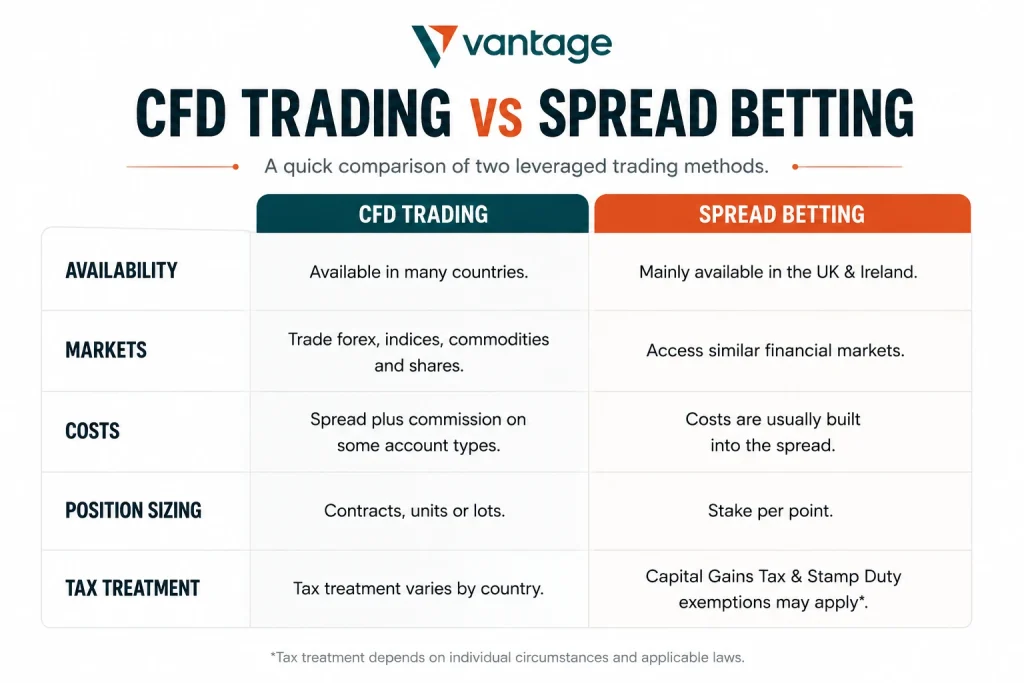
CFDs and spread betting may look similar, but there are a few key differences that can affect which product is right for your trading goals. The main ones are tax treatment, trading costs, position sizing, and availability.
1. Tax Treatment
One of the biggest differences between CFDs and spread betting is how profits are taxed.
Spread betting profits are generally exempt from Capital Gain Tax and Stamp Duty, making it a popular choice for many traders. CFDs are also exempt from Stamp Duty because you don’t own the underlying asset, but do note that profits may be subject to Capital Gain Tax.
Tax treatment depends on your personal circumstances and can change over time. If you’re unsure how it applies to you, consider seeking independent tax advice from a licensed professional.
2. Trading Costs
Both CFDs and spread betting involve trading costs, but they’re charged differently.
With CFDs, you’ll usually pay the spread. Depending on the market, such as share CFDs, you may also pay a commission. Overnight financing charges can also apply if you keep a leveraged position open beyond the trading day.
With spread betting, costs are usually built into the spread, so there’s often no separate commission. However, overnight financing charges may still apply to positions held overnight.
When comparing products, look at the overall cost of trading rather than focusing on a single fee.
3. Position Sizing
The way you size a trade also differs. With CFDs, positions are usually measured in contracts, units, or lots. For example, you might buy 100 share CFDs or trade one forex lot.
With spread betting, you choose how much you want to stake for every basis point the market moves. If your stake is £5 per point, you’ll make or lose £5 for each point the market rises or falls.
Both approaches provide similar market exposure. The difference is simply how your position is measured.
4. Product Availability
CFDs are widely available in many countries, subject to local regulations.
Spread betting is mainly available in the UK and Ireland because of its legal and tax treatment. As a result, not every broker offers both products.
If you have access to both, your decision will often come down to your trading goals, preferred pricing structure, and tax considerations rather than the markets you want to trade.
What Does the Same Trade Look Like as a CFD vs. as a Spread Bet?
A side-by-side example makes the differences easier to understand. Imagine you expect the FTSE 100 to rise.
CFD Example
You open a CFD position worth £2,000. If the FTSE 100 increases by 2%, your position gains around 2% in value. Ignoring spreads, commissions, and overnight financing, your gains would be about £40.
Spread Betting Example
Instead, you place a spread bet at £10 per point. If the FTSE 100 moves 4 points in your favour, you make £40. If it moves 4 points against you, you lose £40.
In both examples, you’re trading the same market and aiming to profit from the same price movement. The main difference is how the trade is structured. CFDs use contracts or units, while spread betting is based on your chosen stake per basis point.
CFD Trading vs. Spread Betting: Pros and Cons
Both leveraged products offer access to the same financial markets, but each has its own advantages and drawbacks.
Table 1: Pros and Cons of CFD Trading
| CFD Trading | |
| Pros | Cons |
| Available in many countries where CFD trading is allowed. | Profits may be subject to Capital Gains Tax. |
| Widely offered across forex, indices, commodities, shares, and more. | Some markets may include commission charges, transaction fees, and other costs. |
| Familiar position sizing using contracts, units, or lots. | Overnight financing charges may apply. |
| May offer different tax treatment for trading gains and losses. | Leverage increases both potential gains and potential losses. |
Table 1 breaks down the ins and outs of CFD trading, covering everything from its global reach to how positions are sized. To help you decide which approach aligns best with your goals, let’s look at the next table to compare how these factors differ when it comes to spread betting.
Table 2: Pros and Cons of Spread Betting
| Spread Betting | |
| Pros | Cons |
| Profits are generally exempt from Capital Gains Tax and Stamp Duty. | Only available in the UK and Ireland. |
| Costs are often included in the spread, with no separate commission on many markets. | Position sizing may feel unfamiliar if you’re used to trading shares or lots. |
| Simple stake-per-point sizing. | Overnight financing charges may apply. |
| Popular among traders looking for a straightforward way to speculate on price movements. | Leverage increases both potential gains and potential losses. |
Spread Betting vs. CFDs: Which One Might Suit You?
Whether spread betting and/or CFDs are suitable for you would depend on what matters most to you.
Spread betting may be a good fit if you:
- Value favourable tax treatment as part of your trading strategy.
- Prefer sizing trades as a stake per basis point.
- Want trading costs to be built into the spread rather than paying separate commissions on some markets.
CFD trading may be a good fit if you:
- Prefer trading in contracts, units, or lots.
- Want a product that’s widely available across international markets.
- Already trade shares, forex, or other leveraged products using a more traditional trading structure.
Whichever you choose, compare the pricing, available markets, and trading tools offered by your broker before opening an account.
Frequently Asked Questions
What’s the main difference between CFDs and spread betting?
Both products let you speculate on price movements without owning the underlying asset. The biggest differences are tax treatment, trading costs, position sizing, and availability.
Is spread betting tax-free?
Spread betting profits are generally exempt from Capital Gains Tax and Stamp Duty. However, tax treatment depends on your personal circumstances and may change over time.
Which is cheaper: CFDs or spread betting?
Whether CFD trading or spread betting is cheaper would depend on the market and your broker’s pricing. CFDs may include commissions, while spread betting costs are usually built into the spread. Both may also charge overnight financing fees.
Can I trade the same markets with CFDs and spread betting?
In many cases, yes. Both products commonly offer access to forex, indices, commodities, and shares, although the exact range of markets varies by broker.
Do I own the underlying asset?
No. Both CFDs and spread betting are leveraged derivatives, so you’re trading on price movements rather than buying the underlying asset.
Can beginners trade CFDs or spread betting?
Yes, but both products use leverage, which increases both potential gains and losses. Before trading, make sure you understand the risks and use appropriate risk management tools.
Disclaimer: The information is provided for educational purposes only and doesn’t take into account your personal objectives, financial circumstances, or needs. It does not constitute investment advice. We encourage you to seek independent advice if necessary. The information has not been prepared in accordance with legal requirements designed to promote the independence of investment research. No representation or warranty is given as to the accuracy or completeness of any information contained within. This material may contain historical or past performance figures and should not be relied on. Furthermore estimates, forward-looking statements, and forecasts cannot be guaranteed. The information on this site and the products and services offered are not intended for distribution to any person in any country or jurisdiction where such distribution or use would be contrary to local law or regulation.
Key Points In This Article

Latest Academy Articles


Market News Tags
- # Asian Markets News Today
- # Crude Oil News Today
- # Earnings News Today
- # Economic News Today
- # Featured News
- # Federal Reserve News
- # Commodity Market News
- # Interest Rate News
- # Financial News
- # Forex News Today
- # Gold News Today
- # Market News Today
Related Articles
- Largest Stock Exchanges in the World: Top 10 by Market Capitalisation in 2026
- Alphabet (GOOGL) Stock in Q3 2026: Latest Results, Analyst Targets and How UK Traders Trade It
- Amazon (NASDAQ: AMZN) Shares Q3 2026 Earnings: What It Might Mean For UK Traders & Investors
- CFD Trading Explained: What It Is and How to Trade CFDs in the UK
- Negative Balance Protection in the UK: How It Works and What It Doesn’t Cover
- 10 CFD Trading Strategies UK Traders Should Know
- Candlestick Patterns: How to Read 18 Patterns on Price Charts
- Best Trading App in the UK: Six Broker Apps for Trading on Your Phone