
CFDs and Spread Bets are complex instruments and come with a high risk of losing money rapidly due to leverage. 72.65% of retail investor accounts lose money when trading CFDs and Spread Bets with this provider. You should consider whether you understand how CFDs and Spread Bets work and whether you can afford to take the high risk of losing your money.


 Login


SEARCH
-
Search query too short. Please enter a full word or phrase.
-

Keywords
Popular Search


SEARCH
-
Search query too short. Please enter a full word or phrase.
-
Keywords
Popular Search



Gold Trading for Beginners: How to Trade Gold Step by Step in the UK

Vantage Editorial Team >
17 November 2026 | Academy | 22 min read
Vantage Editorial Team >
Vantage is a global, multi-asset broker with a team of in-house writers and market analysts who produce educational and insightful trading content for traders of all levels.

Gold trading for beginners starts with four basics: knowing how the gold price is quoted, choosing how you want to trade it, understanding what moves the price, and having a plan for risk before you place a trade. This guide shows how to trade gold step by step, from reading the XAU/USD quote to placing and closing your first gold spread bet or CFD position.
Gold was trading near $4,090 per ounce on 22 October 2026, after setting a record high of about $5,608 in January 20261. Moves of that size are one reason gold draws attention, and also why beginners need to understand the risks before trading it.
Last reviewed: 8 November 2026. Market commentary is as of 22 October 2026 unless stated otherwise.
CFDs and Spread Bets are complex instruments and come with a high risk of losing money rapidly due to leverage. 72.65% of retail investor accounts lose money when trading CFDs and Spread Bets with this provider. You should consider whether you understand how CFDs and Spread Bets work and whether you can afford to take the high risk of losing your money.
Key Points
- Gold is typically quoted against the US dollar as XAU/USD, and you can trade it through physical bullion, exchange-traded funds (ETFs), futures, options, spread bets, or Contracts for Difference (CFDs).
- The gold price responds to factors such as the US dollar, interest rates, inflation, central bank demand, and geopolitical risk, and each of these will be worth watching through 2027.
- Gold spread bets and CFDs are leveraged products and can lead to rapid losses; UK retail leverage on gold is capped at 20:1, so plan your leverage, position size, and stop-loss before choosing a strategy, and consider practising on a demo account first to learn how gold moves.
What Is Gold Trading and How Does the Gold Market Work?
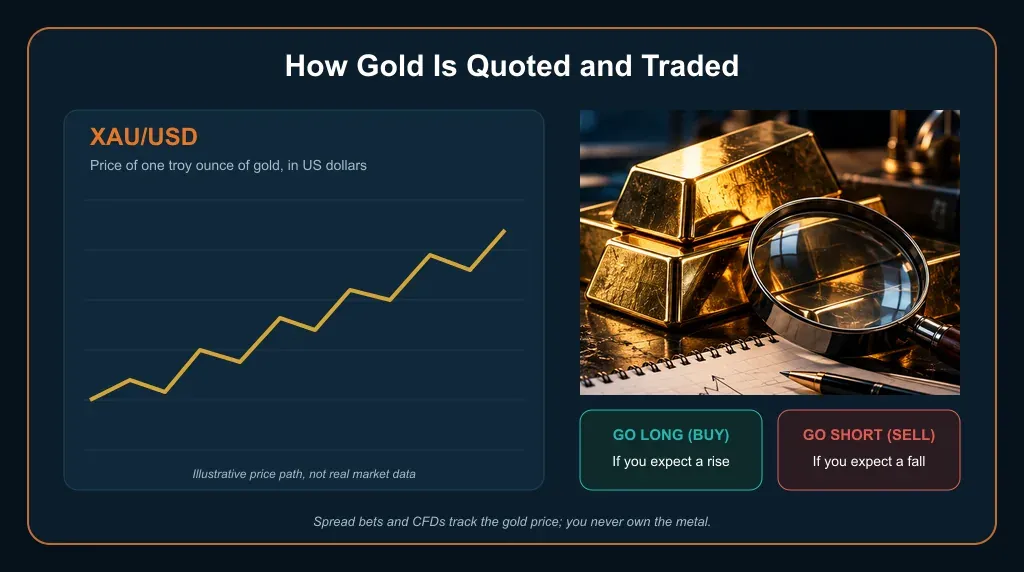
Gold trading means buying or selling gold, or a product linked to its price, to take a position on where the price will go next. Gold is typically priced in US dollars, which is why the price you see quoted is usually XAU/USD: the number of US dollars needed to buy one troy ounce of gold. For UK traders, the XAU/GBP pair (gold priced against the British Pound sterling) and XAU/EUR (gold priced against the Euro), are widely considered too. In this article, we’d focus mainly on XAU/USD.
The physical market is centred on London, where the LBMA Gold Price is set as a global benchmark2, while futures trade on exchanges such as CME Group’s COMEX in New York3. Central banks, jewellers, ETF providers, banks, and individual traders all take part, so gold trades almost around the clock on weekdays.
For beginners, the key point is that online gold trading is often done through derivatives. In the UK, the two most common are spread bets and CFDs, and with either one you never own the underlying metal. Instead, you trade the difference between the opening and closing price. In other words, you can go long if you expect the price to rise or short if you expect it to fall4.
Why Do Traders Watch Gold? 4 Traits Beginners Should Know
- High Liquidity: Gold is an actively traded commodity, so prices update constantly and spreads on major gold products can be relatively narrow in normal market conditions. Liquidity can still thin out around holidays and late in the trading day.
- US Dollar Link: As gold is priced in dollars, it often moves in the opposite direction to the US dollar. This lets traders express a view on the dollar, but it also means US data can move gold sharply.
- Volatility: Gold can move several per cent in a week. That can give rise to trading opportunities, but it also means losses can build quickly, especially with leverage.
- Diversification: Gold does not always move in line with shares or bonds, so some traders watch it alongside other markets. That relationship is not fixed and can break down in a crisis.
6 Ways to Trade Gold in the UK: Bullion, ETFs, Futures, Options, Spread Bets, and CFDs
Did you know there is more than one way to trade gold? The right one depends on whether you want to own the metal, how long you plan to hold it, and how much risk you can take.
| Method | Own the Gold? | Leverage? | Main Costs | When It Trades |
| Physical bullion (bars and coins) | Yes | No | Dealer premium, storage, and insurance | Dealer hours |
| Gold ETFs (see best gold ETFs) | Indirectly, through fund shares | No, unless traded on margin | Fund fees and brokerage | Stock exchange hours |
| Gold futures | No, unless held to delivery | Yes, through margin | Commissions and rolling costs | Nearly 24 hours, Sunday to Friday3 |
| Gold options | No | Yes, through the premium | Option premium and commissions | Exchange hours |
| Gold spread bets (pounds per point) | No | Yes, through margin | Spread, plus overnight funding on daily funded bets | Nearly 24 hours, Monday to Friday |
| Gold CFDs (such as XAUUSD) | No | Yes, through margin | Spread and overnight swap | Nearly 24 hours, Monday to Friday |
Table 1: 6 Ways to Trade Gold Compared
Spread bets and CFDs are used by some active traders because positions can be small and can be opened in either direction. A gold spread bet is staked in pounds per point of price movement, while a CFD is sized in lots.
For our XAUUSD CFD in the UK, one lot is 100 ounces and the minimum trade is 0.01 lots, or 1 ounce. The two instruments are taxed differently; tax treatment depends on individual circumstances and may change in future. See spread betting vs CFDs for the differences.
How to Trade Gold for Beginners in 7 Steps
If you’re learning how to trade gold as a beginner, check out our step-by-step guide below:
- Get the Quote: XAU/USD shows the price of one ounce in US dollars. A move from $4,090.00 to $4,090.01 is one pip.
- Choose How to Trade: Decide between owning gold (bullion or ETFs) and trading its price (futures, gold spread bets, or gold CFDs).
- Pick a Platform: Gold spread bet and CFD traders can use MetaTrader 5, TradingView, or a broker app. Learn where the order ticket, stop-loss, and position size fields are.
- Practise on a Demo Account: A demo account lets you place gold trades with virtual funds, so you can see how fast the price moves without risking real money. Bear in mind that demo results do not reflect live trading conditions, such as spreads, slippage, and execution.
- Write a Simple Plan: Note your entry reason, stop-loss level, target, and position size before you trade. Work out what your stop-loss distance is worth: pips multiplied by the pip value, divided by the GBP/USD rate on a GBP account.
- Place the Trade: Buy if you expect the price to rise or sell if you expect it to fall, then consider setting stop-loss and take-profit orders straight away; a stop-loss does not guarantee the exit price, particularly during gaps or fast markets.
- Review and Record: Close the trade according to your plan and log the result, including costs, so you can learn from each trade.
How to Buy and Sell Gold With a CFD: 2 Worked Examples
Here is how to buy and sell gold with a CFD, using hypothetical trades at current price levels. Remember, one pip in XAU/USD is $0.01, and on a 0.10 lot each pip is worth $0.10.
| Example | Entry | Exit | Price Move | Size | Result (Before Costs) |
| Buy (long) gold | $4,090.00 | $4,110.00 | +$20.00 (2,000 pips) | 0.10 lot | +$200.00 |
| Sell (short) gold, stop-loss hit | $4,100.00 | $4,115.00 | −$15.00 (1,500 pips against) | 0.10 lot | −$150.00 |
Table 2: Hypothetical Gold CFD Examples. These are for illustration only and do not reflect actual trading results. Spreads and overnight swaps would reduce a gain or increase a loss. On a GBP account at a GBP/USD rate of about 1.34 (6 November 2026), the results are about +£149 and −£112.10
Spread bet version (hypothetical): With a stake of £1 per point, a 20-point gain is £20 and a 15-point loss is £15, before costs. How far the gold price has to move for one point depends on the point size set by the platform, so check it before you size a bet. Spread bets are leveraged, so losses can build quickly and can exceed the margin you put up for a position.
If you’re interested to learn more, check out Vantage’s guide to counting gold pips in £ and $.
How to Trade Gold in Forex: What Does XAU/USD Mean?
If you have searched for “how to trade gold in forex”, you have probably seen XAU/USD on a currency platform. XAU is the code for one troy ounce of gold, so gold is quoted like a currency pair and traded as a CFD on the same platforms as EUR/USD or GBP/USD. The main difference is the pip: gold uses $0.01, while most currency pairs use 0.0001.
What Moves the Gold Price? 5 Drivers to Watch in 2027
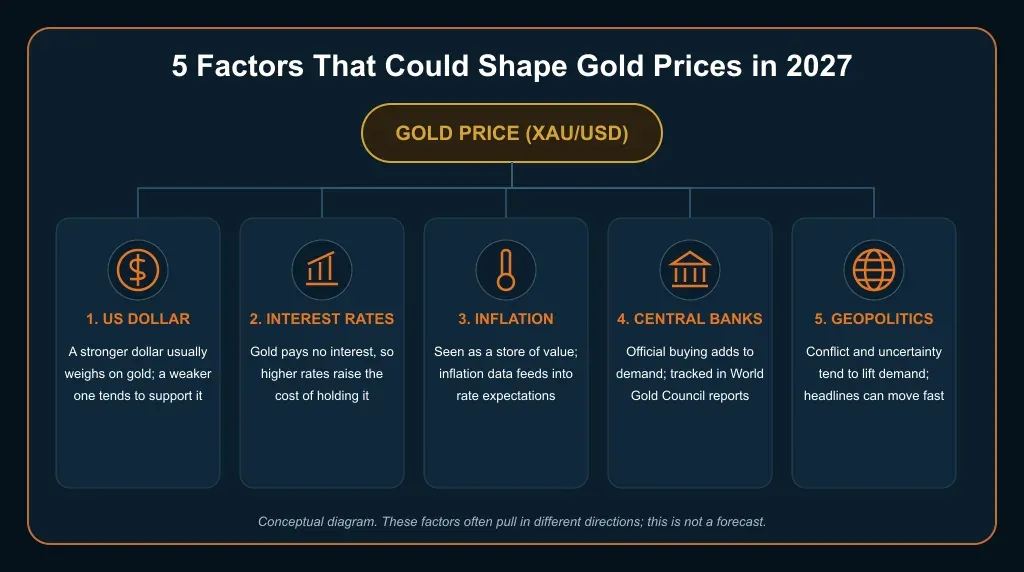
Gold reacts to a handful of forces, and they often pull in different directions. Here’s what each gold price driver might mean for beginners heading into 2027.
1. Will the US Dollar Stay Strong in 2027?
Gold is priced in dollars, so a stronger dollar usually weighs on gold and a weaker dollar tends to support it. In 2027, watch US jobs and growth data, because they shape the dollar and therefore the XAU/USD price.
2. Where Are Interest Rates Heading in 2027?
Gold pays no interest, so higher rates raise the cost of holding it in the eyes of some investors and traders.
In October 2026, markets expected the US Federal Reserve to hold rates in the short term, but were pricing in a possible hike in December1. In the UK, the Bank of England raised Bank Rate to 4% on 5 November 2026, and its 2027 announcements are scheduled for 4 February, 18 March, 29 April, 17 June, 29 July, 16 September, 4 November, and 16 December.9
For a UK trader, the pound’s move against the dollar also changes what a gold result is worth in pounds. The Fed’s 2027 meetings are also scheduled for 26 to 27 January, 16 to 17 March, 27 to 28 April, 8 to 9 June, 27 to 28 July, 14 to 15 September, 26 to 27 October, and 7 to 8 December5—and gold has historically moved sharply around each decision.
3. Will Inflation Pick Up Again?
Gold is often linked to inflation because it is seen as a store of value. Higher oil prices in October 2026 added to inflation concerns1. In 2027, monthly US inflation data will be a key event for gold traders because it feeds directly into rate expectations.
4. Will Central Banks Keep Buying Gold?
Central banks bought 289 tonnes of gold in Q2 2026, recovering sharply after a slower first quarter, while gold ETFs saw outflows of 45 tonnes6. The World Gold Council publishes this data every quarter, so its 2027 reports will show whether official buying is holding up.
5. How Could Geopolitics Shape Gold in 2027?
Conflict and uncertainty tend to lift demand for gold. In October 2026, tensions in the Middle East, including attacks on tankers in the Strait of Hormuz, pushed oil higher and kept markets on edge1. Sudden headlines can move gold hundreds of pips in minutes, which is why news trading gold needs extra care.
When Is Gold Most Active According to UK Time?
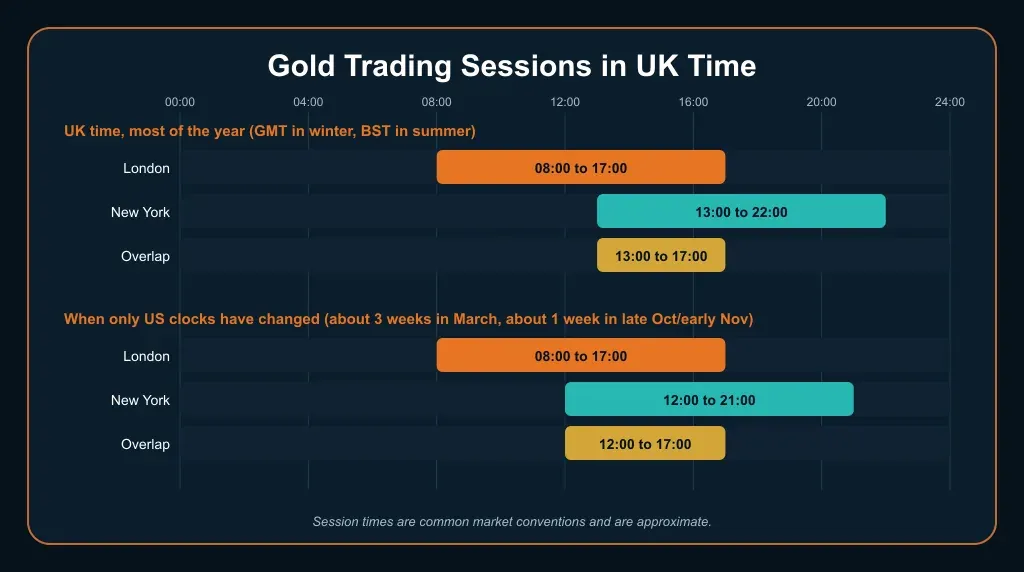
Gold trades almost 24 hours a day from Monday to Friday, but its activity is not even.
Many traders watch the London and New York overlap closely because liquidity is usually highest when both centres are open. That said, higher liquidity does not mean lower risk: volatility and spreads can also move sharply at the overlap and around scheduled releases.
The table below shows the main gold trading sessions in UK time.
| When | London Session | New York Session | London and New York Overlap |
| UK time, most of the year (GMT in winter, BST in summer) | 08:00 to 17:00 | 13:00 to 22:00 | 13:00 to 17:00 |
| UK time when only US clocks have changed (about three weeks in March, about one week in late October and early November) | 08:00 to 17:00 | 12:00 to 21:00 | 12:00 to 17:00 |
Table 3: Gold Trading Sessions in UK Time. Session times are common market conventions and are approximate.
The UK is on Greenwich Mean Time (GMT, UTC+0) in winter and British Summer Time (BST, UTC+1) from the last Sunday in March to the last Sunday in October: in 2027, from 28 March to 31 October. New York uses daylight saving time (DST) from the second Sunday in March to the first Sunday in November, so it changes its clocks on different dates from London.
For about three weeks in March and about one week from late October to early November, only New York has changed its clocks, so the New York session starts an hour earlier in UK time and the overlap runs for about five hours instead of four. US data that is usually released at 13:30 UK time comes out at 12:30 in those weeks.
Gold futures on CME Globex trade from Sunday evening to Friday afternoon US time, with a 60-minute break each day3. You can view the trading times for our gold CFD instrument on the XAUUSD instrument page in platform server time before you plan your trading day.
4 Gold Trading Strategies for Beginners to Explore First
These gold trading strategies for beginners are common starting points. Note that none of them is guaranteed to work all the time, and each one should be tested on a demo account with sufficient practice first.
- Trend Following: Trading in the direction of the main trend, often using moving averages to judge direction.
- Breakout Trading: Watching for the price to move beyond a clear support or resistance level, which can signal the start of a bigger move.
- News Trading: Some traders trade around scheduled events such as Fed and Bank of England decisions or US jobs data, which carries higher risk because spreads can widen and prices can jump at these times. Beginners may prefer to observe these moves on a demo account first.
- Range Trading: Buying near support and selling near resistance when gold is moving sideways rather than trending.
For worked examples, see our guides to XAU/USD trading strategies and gold trading strategies.
How Does Leverage Work When Trading Gold CFDs?
Leverage lets you control a larger position with a smaller deposit, called margin8. It works in both directions, so it magnifies losses as well as gains.
For example (hypothetical), a 0.10 lot of gold at $4,090 controls 10 ounces, worth $40,900. At 20:1 the margin needed would be about $2,045, or about £1,526 at a GBP/USD rate of 1.34.7,10
A 1% move in gold, about $40.90 or 4,090 pips, would change the value of that position by about $409, or about 20% of the margin, and a 5% move against the position would be about $2,045, the whole margin. In practice, a margin call or stop-out would normally happen before the full margin is lost, depending on your account terms.
6 Gold Trading Mistakes Many Beginners Make
Here are some common pitfalls for those new to gold trading that you can take note of:
- Trading Too Large: Using a position size that turns a normal daily move into a large loss.
- Skipping the Stop-Loss: Trading without a stop-loss means there is no predefined exit level when gold moves fast. A stop-loss does not guarantee the exit price, particularly during gaps or fast markets.
- Chasing Every Headline: Jumping into trades on breaking news, when spreads are wide and prices can reverse quickly.
- Ignoring Costs: Forgetting that spreads and overnight swap fees reduce results, especially on trades held for several days.
- Going Live Too Soon: Moving to a live account before practising on a demo account.
- Not Keeping a Journal: Without a record of each trade, it is hard to see what works and what does not.
2027 Gold Trading Calendar: 6 Key Events Beginners Should Track
- Federal Reserve Decisions: Eight meetings in 2027, starting 26 to 27 January5. Rate decisions and press conferences often bring the biggest moves of the month.
- US Jobs Report: Usually released on the first Friday of each month, and often a source of sharp gold moves.
- US Inflation Data: Monthly consumer price figures shape expectations for interest rates.
- World Gold Council Reports: Quarterly Gold Demand Trends updates show central bank, ETF, and jewellery demand6.
- Bank of England Decisions: Eight announcements in 2027, starting 4 February, usually at 12:00 UK time.9 They tend to move the pound, which can change what a gold result is worth on a GBP account.
- UK Inflation Data: The Office for National Statistics publishes monthly consumer price figures, usually at 07:00 UK time.
You can track these dates on our economic calendar.
How Can You Start Trading Gold With Vantage UK?
At Vantage UK, gold can be traded as a spread bet or a CFD, so you don’t own the metal. Gold CFDs on XAUUSD start from 0.01 lots, and gold spread bets are staked in pounds per point, with a minimum stake that is shown when you place the trade.
You can practise first with virtual funds on a demo account, which is simulated, so prices and fills can differ from live trading. You can then choose to trade on MetaTrader 5, TradingView, or the Vantage App via a Vantage Live Account.
Spread bets and CFDs are leveraged products and carry a high risk of losing money rapidly. Make sure you understand how they work before you trade. Vantage Global Prime LLP, trading as Vantage, is authorised and regulated by the Financial Conduct Authority. FRN: 590299.
Frequently Asked Questions
Is Gold Trading Good for Beginners?
How Much Money Do You Need to Start Trading Gold in the UK?
There is no fixed amount. With a CFD, the smallest XAUUSD trade on Vantage is 0.01 lots, or 1 ounce, worth about $4,090 at late-October 2026 prices, or about £3,052 at a GBP/USD rate of 1.34. At the 20:1 UK retail limit, the margin for that position would be about $205, or about £153, and you should also allow for price swings and costs—only trade with money you can afford to lose. A spread bet has a minimum stake per point instead, which varies by asset.
Can You Trade Gold 24 Hours a Day?
Almost. Gold trades nearly around the clock from Monday to Friday, with a short daily break. Gold spread bets, CFDs, and futures close at the weekend, and spreads can be wider and liquidity lower outside normal market hours.
Is Gold Trading Profitable?
Gold trading can lead to gains or losses, and many traders lose money, especially with leverage. Results depend on market conditions, costs, and risk management. Our article on whether gold trading is profitable looks at this question in more detail.
What Is the Difference Between XAU/USD and Gold Futures?
XAU/USD tracks the spot price of gold, while futures are contracts to buy or sell gold at a set price on a future date. A standard COMEX gold futures contract covers 100 troy ounces3, while the Vantage UK XAUUSD CFD can be traded from 0.01 lots. Futures also have expiry dates, while spot CFDs do not, although overnight swaps apply.
What Is a Gold CFD?
A gold CFD is a contract that pays the difference in the gold price between when you open and close the trade. You do not own any gold, and you can go long or short4. Because gold CFDs use leverage, both gains and losses are magnified. Compare providers in our guide to the best gold trading platforms.
Can You Spread Bet on Gold in the UK?
Yes. With a gold spread bet, you stake an amount in pounds per point of movement in the gold price, and you can go long or short without owning gold. Spread bets are leveraged, so losses can exceed the margin you put up, and they are taxed differently from CFDs; tax treatment depends on individual circumstances and may change in future. See how to spread bet.
RISK WARNING: CFDs and Spread Bets are complex instruments and come with a high risk of losing money rapidly due to leverage. 72.65% of retail investor accounts lose money when trading CFDs and Spread Bets with this provider. You should consider whether you understand how CFDs and Spread Bets work and whether you can afford to take the high risk of losing your money.
Disclaimer: The information has been prepared as of 22 October 2026 and is subject to change thereafter. The information is provided for educational purposes only and doesn’t take into account your personal objectives, financial circumstances, or needs. It does not constitute investment advice. We encourage you to seek independent advice if necessary. The information has not been prepared in accordance with legal requirements designed to promote the independence of investment research. No representation or warranty is given as to the accuracy or completeness of any information contained within. This material may contain historical or past performance figures and should not be relied on. Furthermore, estimates, forward-looking statements, and forecasts cannot be guaranteed. The information on this site and the products and services offered are not intended for distribution to any person in any country or jurisdiction where such distribution or use would be contrary to local law or regulation.
References
- “Gold – Price – Chart – Historical Data – News – Trading Economics” https://tradingeconomics.com/commodity/gold. Accessed on 22 October 2026.
- “LBMA Gold Price – LBMA” https://www.lbma.org.uk/prices-and-data/lbma-gold-price. Accessed on 22 October 2026.
- “Gold Futures Contract Specs – CME Group” https://www.cmegroup.com/markets/metals/precious/gold.contractSpecs.html. Accessed on 22 October 2026.
- “Understanding Contracts for Difference (CFDs): Uses and Examples – Investopedia” https://www.investopedia.com/terms/c/contractfordifferences.asp. Accessed on 22 October 2026.
- “Meeting calendars and information – Federal Reserve” https://www.federalreserve.gov/monetarypolicy/fomccalendars.htm. Accessed on 22 October 2026.
- “Gold Demand Trends: Q2 2026 – World Gold Council” https://www.gold.org/goldhub/research/gold-demand-trends/gold-demand-trends-q2-2026. Accessed on 22 October 2026.
- “COBS 22.5 Restrictions on the retail marketing, distribution and sale of contracts for differences and similar speculative investments – FCA Handbook” https://handbook.fca.org.uk/handbook/cobs22/cobs22s5. Accessed on 8 November 2026.
- “What Is Financial Leverage, and Why Is It Important? – Investopedia” https://www.investopedia.com/terms/l/leverage.asp. Accessed on 22 October 2026.
- “Upcoming MPC dates – Bank of England” https://www.bankofengland.co.uk/monetary-policy/upcoming-mpc-dates. Accessed on 8 November 2026.
- “GBP/USD (GBPUSD=X) – Yahoo Finance” https://uk.finance.yahoo.com/quote/GBPUSD%3DX/. Accessed on 8 November 2026.
Key Points In This Article

Latest Academy Articles


Market News Tags
- # Asian Markets News Today
- # Crude Oil News Today
- # Earnings News Today
- # Economic News Today
- # Featured News
- # Federal Reserve News
- # Commodity Market News
- # Interest Rate News
- # Financial News
- # Forex News Today
- # Gold News Today
- # Market News Today
Related Articles
- Herd Mentality in Trading: Worked Examples and How to Avoid It
- How to Calculate Gold Pips (XAUUSD) in the UK: Pip Value Guide With Examples
- Santa Claus Rally 2026: Key Dates, History, and What It Means If It Doesn’t Show
- Largest Stock Exchanges in the World: Top 10 by Market Capitalisation in 2026
- Alphabet (GOOGL) Stock in Q3 2026: Latest Results, Analyst Targets and How UK Traders Trade It
- Amazon (NASDAQ: AMZN) Shares Q3 2026 Earnings: What It Might Mean For UK Traders & Investors
- CFD Trading Explained: What It Is and How to Trade CFDs in the UK
- Negative Balance Protection in the UK: How It Works and What It Doesn’t Cover