Login





UK Autumn Budget 2026: What It Means for Gilts, the Pound and the FTSE 100

Vantage Editorial Team >
Vantage Editorial Team >
Vantage is a global, multi-asset broker with a team of in-house writers and market analysts who produce educational and insightful trading content for traders of all levels.
 Updated Thu, 2026 October 22 06:34

- The UK Budget is on Wednesday 28 October 2026, and the Office for Budget Responsibility (OBR) publishes its Economic and fiscal outlook the same day.[1]
- Bank Rate was 3.75% after the 17 September 2026 decision; the next decision is on 5 November 2026.[2,3]
- In the OBR’s November 2025 sensitivity analysis, a one percentage point rise in gilt yields and Bank Rate would cut 2029-30 headroom by £16 billion, against £22 billion.[4]
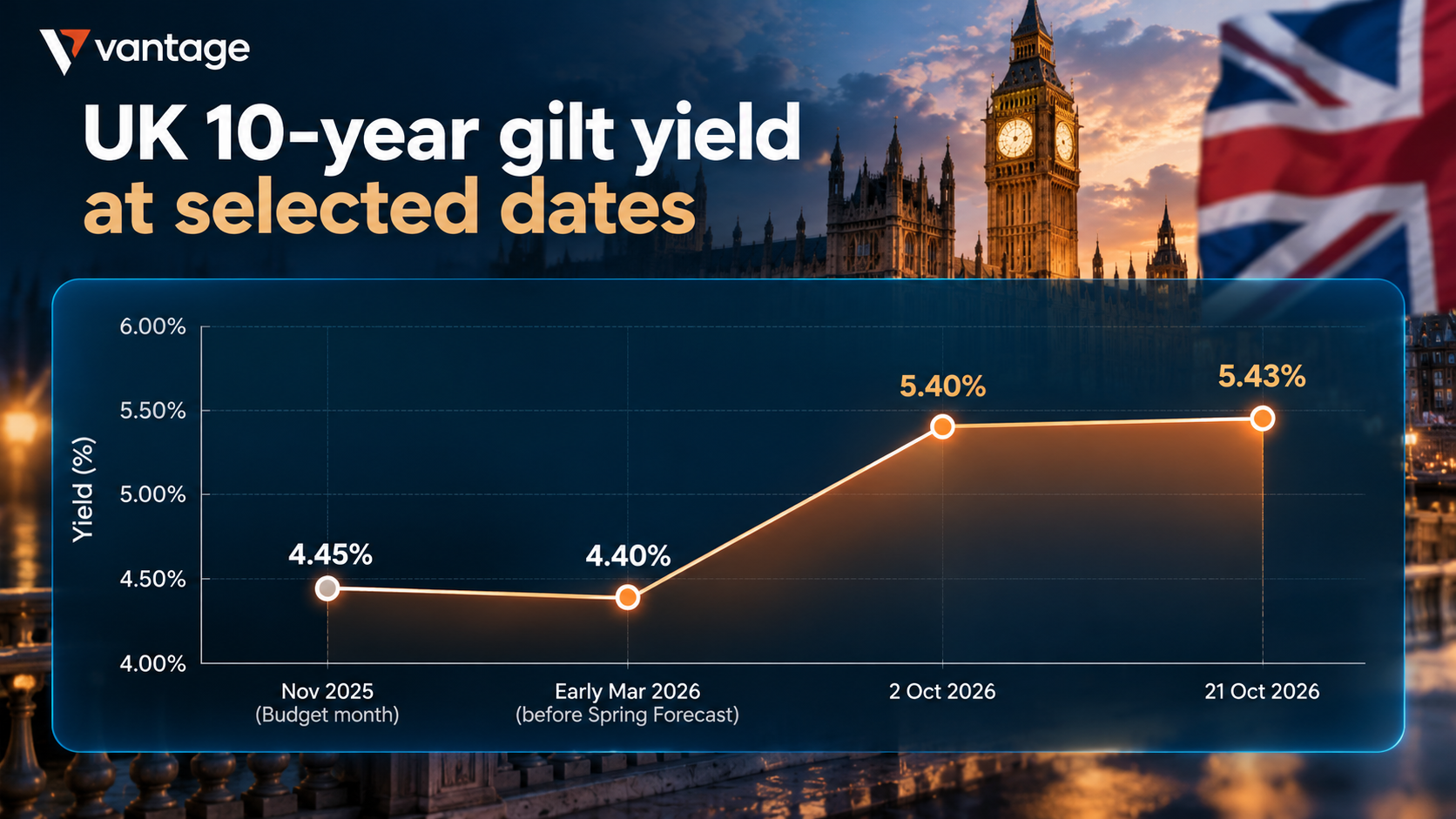
The UK 10-year gilt yield sat near 5.43% seven days before the Autumn Budget on Wednesday 28 October 2026.[5] It touched 5.53% on 8 October, its highest since July 2007, according to Vantage’s market news report, which cites Reuters. Levels here are as of 13:48 (GMT+8) on 21 October 2026 unless stamped otherwise.
So what will the market actually read when the Chancellor sits down? “Headroom” sounds like a car-park sign, but in fiscal terms it is the gap between projected borrowing and a rule. This guide is for anyone with exposure to pound sterling through GBPUSD or to UK shares through the FTSE 100 (UK100).
It tests the working view that the borrowing numbers outweigh the tax measures, and says where the evidence stops.
In short: Gilt markets appear to read the OBR’s borrowing numbers and headroom first, because those figures shape gilt supply and Bank Rate expectations. Tax measures matter mostly through what they do to those numbers. The evidence is directional, drawn from just two Budget days.
Budget-day checklist: what to read, in order
- OBR borrowing path: planned borrowing, year by year.[1]
- Headroom: the margin against the fiscal rules, £22 billion in November 2025.[4]
- Gilt yields: the 10-year near 5.43%, the 30-year near 5.89%.[5,6]
- Bank Rate: 3.75% now, with the next decision on 5 November 2026.[2,3]
What the Autumn Budget is and when it lands
When is the Autumn Budget? Wednesday 28 October 2026. That UK Budget date comes from the OBR’s published schedule.[1] The Chancellor, John Healey, took office on 20 July 2026.[7] The Autumn Budget announcement is the annual statement to Parliament on tax and spending, and Budget day is when the Treasury’s measures and the OBR’s numbers arrive together.
What time is the Budget? No start time appeared in the sources checked as of 21 October.
Any budget summary for Budget 2026 UK readers covers two documents. The first is the shopping list: the measures, including any tax rises, which are simply increases in the rate or base of a tax. The second is the receipt: the OBR’s outlook costs those measures and sets out borrowing, debt, and the margin against the fiscal rules.
Figure 1 sets the scene. The UK 10-year gilt yield rose from about 4.40% before the March 2026 Spring Forecast to 5.43% on 21 October.[8,5]
Budget day also carries the Federal Open Market Committee (FOMC) statement and the Bank of Canada decision.[9,10]
| Reference figure | Level | As of |
| Autumn Budget and OBR outlook | Wednesday 28 October 2026 | OBR schedule[1] |
| Bank Rate | 3.75%, held at the 17 September 2026 decision | 21 October 2026[2] |
| UK 10-year gilt yield | About 5.43% | 13:48 (GMT+8), 21 October 2026[5] |
| UK 30-year gilt yield | About 5.89% | 20 October 2026[6] |
| GBPUSD, Bank of England spot rate | 1.3318 | 19 October 2026[11] |
| OBR margin against the fiscal mandate | £22 billion (2029-30) | November 2025 outlook[4] |
Table 1: Budget 2026 UK reference figures, as of 13:48 (GMT+8) on 21 October 2026
Source: Office for Budget Responsibility, Bank of England, Trading Economics. Referenced on 21 October 2026. Levels are indicative.
The dates are fixed. Which figure the market reads first is the open question.
Why the OBR numbers matter more than the headlines
Start with who gets the last word. Barclays’ Moyeen Islam, writing in the Institute for Fiscal Studies (IFS) Green Budget 2025, called the market’s reaction to the near-term fiscal numbers and the borrowing outlook “perhaps the most important immediate outcome” of that Budget.[12]
Fiscal headroom works a little like the margin on a bridge’s weight limit: it shows how much extra load the arithmetic can carry before a rule breaks. In November 2025 the OBR put the margin against its fiscal mandate at £22 billion, or 0.6% of gross domestic product (GDP), in 2029-30.[4]
The March 2026 outlook did not assess the fiscal rules, so 28 October brings the first full assessment since.[13] A Reuters poll of 19 economists, published on 15 October 2026, put median current headroom at about £10 billion to £12 billion.[14]
The obvious suspect for a Budget-day move is the tax package. After the Autumn Budget 2025 on 26 November, Russell Investments’ Aqib Merchant described the measures as “largely expected” and pointed to weaker OBR growth projections as the bigger driver.[15]
ING noted that gilt yields fell even though tax rises were due to add about £26 billion a year by 2029-30,[16] while the OBR put headroom at £22 billion, £12 billion more than in its March 2025 forecast.[4] Yields coincided with the arithmetic, not the headline.
Islam adds that the signal a measure sends can matter more than the sum involved.[12]
Here is the twist: headroom is not independent of gilt yields. The same OBR document that sets the margin also shows how quickly higher yields could erode it.
In the OBR’s November 2025 sensitivity analysis, a one percentage point rise in gilt yields and Bank Rate would cut headroom by £16 billion, about three-quarters of the £22 billion margin.
Caveat: it rests on commentary and two Budget days, not an event study, so the working view is supported in direction and untested in size.
If headroom moves yields and yields move headroom, how does a borrowing plan reach the gilt market in the first place?
How borrowing plans reach gilt yields
Three layers connect a borrowing plan to UK gilt yields. This simplifies: hedging flows and Bank of England balance-sheet policy are left out.
Layer one is supply. The Debt Management Office (DMO) turns borrowing into gilt issuance, and its revised 2026-27 remit, published on 23 April 2026, set long conventional issuance at £22.4 billion, £10.3 billion lower than in 2025-26.[17]
Islam links a rise of about 35 basis points in the implied 10-year term premium in 2026 so far (as of 12 October), against about 12 for the 30-year, to more 10-year supply and less 30-year supply.[8] The term premium is the extra yield investors ask for holding a longer bond.
Layer two is the Bank of England interest rate. Bank Rate stood at 3.75% on 21 October 2026 after September’s hold,[2] and a separate Reuters poll expects a rise in November, though economists are divided on further increases.[14]
Layer three is credibility. Islam puts UK national debt at around 90% of national income, with debt interest at nearly 4% of it, about twice its pre-pandemic level. That is the backdrop for judging the UK deficit.
After a 20 July government reference to “fiscal flexibility”, 30-year gilts rose 10 basis points to 5.75%, against 1 to 3 for other long-dated bonds; the move later reversed.[8] The UK 30-year gilt yield stood near 5.89% on 20 October.[6]
A Rewind to September 2022
The mechanism shows most clearly in how it can fail, which makes this context, not a template. In late September 2022, a rapid rise in yields exposed leveraged liability-driven investment (LDI) funds, and the Bank of England’s Financial Policy Committee described the result as a “vicious spiral of collateral calls and forced gilt sales”.[18]
On 28 September 2022 the Bank said continued dysfunction in long-dated gilts would pose a “material risk to UK financial stability”, and began temporary purchases that totalled £19.3 billion before ending on 14 October 2022.[19,20] The pound and the FTSE 100 sit at the other end of that channel.
What the pound and the FTSE 100 have shown around past Budgets

Sterling’s reaction around the November 2025 Budget appeared to track what the Budget implied for Bank Rate, more than the tax measures as such. ING noted EUR/GBP down about 0.4% and GBP/USD back above 1.32, at late-October levels. Its reading was that the Budget did not significantly reprice the Bank’s terminal rate, which gave sterling “a little support”.[16]
For the latest move, see Vantage’s GBP/USD analysis of 20 October.
Islam links 30-year gilt yield spikes after the October 2024 Budget to measures the OBR judged inflationary, and later to the reversal of planned welfare reforms.[12] On 26 November 2025 the 10-year yield dipped from 4.50% to 4.42% when OBR numbers leaked early, then settled near 4.47% by the end of the statement.[15]
The FTSE 100 connects through the pound. FTSE Russell’s Norbert Van Veldhuizen wrote that over four-fifths of the index’s constituent sales come from outside the UK, on data as of 30 September 2022, so the index reacts to sterling: a weaker pound often lifts it, because overseas earnings translate into more pounds.[21]
The index closed at 10,656.28 on 12 October, according to Vantage’s UK100 analysis. The Analyst’s Desk did not find a primary-source series of FTSE 100 closes on past Budget days, so none is quoted. This link is a mechanism, not a measured pattern.
The past is context. The dated calendar is what lies ahead.
Dated watch list and risk framing
Back to the opening numbers: a 10-year yield near 5.43% and a headroom figure the OBR will reassess on 28 October. Which parts of the Autumn Budget do markets actually trade? On the sourced evidence, the borrowing numbers and headroom, with the headline measures mattering mostly through what they do to those numbers.
The wider lens: a Budget appears to be a supply-and-credibility event for the gilt market first, and a currency and equity event second.
What Would Change the Read
The read weakens if gilt yields move on 28 October with the headline tax measures and not with the OBR’s borrowing and headroom figures. It also weakens if yields stay still after a large change in headroom.
What to Watch
- Autumn Budget and OBR outlook, 28 October: Start time to be confirmed; UK clocks go back on 25 October, after which UK time equals UTC, so add eight hours for GMT+8.[1,22]
- Bank of Canada decision, 28 October: 21:45 (GMT+8) / 13:45 UTC.[10]
- FOMC statement, 28 October: 02:00 (GMT+8) on 29 October / 18:00 UTC.[9]
- DMO remit, date to be confirmed: Revised on 23 April 2026; check dmo.gov.uk for updates.[17]
- Bank of England decision, 5 November: 20:00 (GMT+8) / 12:00 UTC.[3]
Risk Framing Around Event Days
Event days pack several releases into a short window, and volatility around them can be sharp in either direction. Central bank decisions have clustered before, as Vantage’s review of three hikes within eight days showed.
On 28 October the Budget statement, the Bank of Canada decision, and the FOMC statement fall on the same day in UTC, and the last arrives at 02:00 (GMT+8) on 29 October, when liquidity can be thinner.
Gap risk is the risk that price jumps from one quote to the next with no trades in between. Gilt yields dipped when OBR numbers leaked early in November 2025, and a gap can arrive before an order has any chance to act. Anyone holding GBPUSD or UK100 exposure through a scheduled release carries that risk, including overnight.
A Stop Loss is a planned exit level that can help limit a loss to a size chosen in advance, but it is a plan, not a guarantee: in a gap or a fast market the order can fill at a worse price than the level set, which is called slippage. Exposure matters as much as the level.
Holding positions across a fiscal event, a central bank decision, and a Federal Reserve statement concentrates event risk in one window, and a Stop Loss placed close to price can be reached by routine noise around a release.
Leverage magnifies both gains and losses on the same position. At 1:100, margin is 1% of the position’s value, so a 1% move against the position equals the whole margin committed; at 1:1000 it is 0.10%.
Position sizing expresses the planned loss as a share of account equity, so the Stop Loss distance and the position size are set against each other, and leverage only changes how much margin is committed, not the size of the loss. CFDs carry a high risk of losing money rapidly due to leverage.
When Is the Budget, and What Time?
The Autumn Budget date is Wednesday 28 October 2026, and the OBR publishes its Economic and fiscal outlook the same day.[1] No start time had been published in the sources checked as of 21 October.
What Is the OBR?
The OBR is the UK’s independent fiscal watchdog. Its Economic and fiscal outlook, often called the OBR forecast, costs the Budget measures and tests them against the fiscal rules.[1]
How Do Gilt Yields Link to the Pound?
Mainly through Bank Rate expectations. ING’s Budget-day note linked sterling’s moves to what the Budget implied for the Bank’s rate path.[16]
Related Reading
RISK WARNING: CFDs are complex financial instruments and carry a high risk of losing money rapidly due to leverage. You should ensure you fully understand the risks involved and carefully consider whether you can afford to take the high risk of losing your money before trading.
Disclaimer: The information is provided for educational purposes only and doesn’t take into account your personal objectives, financial circumstances, or needs. It does not constitute investment advice. We encourage you to seek independent advice if necessary. The information has not been prepared in accordance with legal requirements designed to promote the independence of investment research. No representation or warranty is given as to the accuracy or completeness of any information contained within. This material may contain historical or past performance figures and should not be relied on. Furthermore estimates, forward-looking statements, and forecasts cannot be guaranteed. The information on this site and the products and services offered are not intended for distribution to any person in any country or jurisdiction where such distribution or use would be contrary to local law or regulation.
References
[1] “Autumn 2026 forecast date announced – Office for Budget Responsibility” https://obr.uk/autumn-2026-forecast-date-announced/ Accessed on 21 October 2026.
[2] “The Interest Rate (Bank Rate) – Bank of England” https://www.bankofengland.co.uk/monetary-policy/the-interest-rate-bank-rate Accessed on 21 October 2026.
[3] “Upcoming MPC dates – Bank of England” https://www.bankofengland.co.uk/monetary-policy/upcoming-mpc-dates Accessed on 21 October 2026.
[4] “Economic and fiscal outlook, November 2025 – Office for Budget Responsibility” https://obr.uk/efo/economic-and-fiscal-outlook-november-2025/ Accessed on 21 October 2026.
[5] “United Kingdom Government Bond 10Y – Trading Economics” https://tradingeconomics.com/united-kingdom/government-bond-yield Accessed on 21 October 2026.
[6] “United Kingdom 30-Year Bond Yield – Trading Economics” https://tradingeconomics.com/united-kingdom/30-year-bond-yield Accessed on 21 October 2026.
[7] “Chancellor of the Exchequer – GOV.UK” https://www.gov.uk/government/ministers/chancellor-of-the-exchequer Accessed on 21 October 2026.
[8] “Chancellor Healey meets the bond market: ‘let sleeping dogs lie’ – Institute for Fiscal Studies (Green Budget 2026, Moyeen Islam, Barclays)” https://ifs.org.uk/publications/chancellor-healey-meets-bond-market-let-sleeping-dogs-lie Accessed on 21 October 2026.
[9] “October 2026 events calendar – Federal Reserve” https://www.federalreserve.gov/newsevents/2026-october.htm Accessed on 21 October 2026.
[10] “Bank of Canada publishes 2026 schedule for policy interest rate announcements – Bank of Canada” https://www.bankofcanada.ca/2025/08/bank-canada-publishes-2026-schedule-policy-interest-rate-announcements-other-major-publications/ Accessed on 21 October 2026.
[11] “Daily spot exchange rates against Sterling – Bank of England” https://www.bankofengland.co.uk/boeapps/database/Rates.asp Accessed on 21 October 2026.
[12] “The Budget and bond markets: ‘when you’re in a hole, stop digging’ – Institute for Fiscal Studies (Green Budget 2025, Moyeen Islam, Barclays)” https://ifs.org.uk/publications/budget-and-bond-markets-when-youre-hole-stop-digging Accessed on 21 October 2026.
[13] “Economic and fiscal outlook, March 2026 – Office for Budget Responsibility (GOV.UK-hosted PDF)” https://assets.publishing.service.gov.uk/media/69a6d7b62e1f4fbda4252208/economic-and-fiscal-outlook-march-2026-web-accessible.pdf Accessed on 21 October 2026.
[14] “UK’s Healey should rebuild fiscal headroom to about £15-16 billion, Reuters poll shows – Reuters (syndicated copy, 15 October 2026)” https://kfgo.com/2026/10/15/uks-healey-should-rebuild-fiscal-headroom-to-about-15-16-billion-reuters-poll-shows/ Accessed on 21 October 2026.
[15] “Gilt market reaction to UK Budget remains subdued despite OBR leak – Investment & Pensions Europe” https://www.ipe.com/news/gilt-market-reaction-to-uk-budget-remains-subdued-despite-obr-leak/10133954.article Accessed on 21 October 2026.
[16] “Gilt yields fall after Autumn Budget despite lack of 2026 tax hikes – ING THINK” https://think.ing.com/articles/gilt-yields-fall-after-autumn-budget-despite-lack-of-2026-tax-hikes/ Accessed on 21 October 2026.
[17] “Revision to the DMO Financing Remit 2026-27, 23 April 2026 – UK Debt Management Office” https://www.dmo.gov.uk/media/ajmifgdv/pr230426_2.pdf Accessed on 21 October 2026.
[18] “Financial Policy Summary and Record – October 2022 – Bank of England” https://www.bankofengland.co.uk/financial-policy-summary-and-record/2022/october-2022 Accessed on 21 October 2026.
[19] “Bank of England announces gilt market operation – Bank of England, 28 September 2022” https://www.bankofengland.co.uk/news/2022/september/bank-of-england-announces-gilt-market-operation Accessed on 21 October 2026.
[20] “Report on the Bank’s official market operations 2022-23 – Bank of England” https://www.bankofengland.co.uk/sterling-monetary-framework/report-2022-23 Accessed on 21 October 2026.
[21] “The UK’s very global country index – FTSE Russell (LSEG)” https://www.lseg.com/en/insights/ftse-russell/the-uks-very-global-country-index Accessed on 21 October 2026.
[22] “When do the clocks go back – Royal Museums Greenwich” https://www.rmg.co.uk/stories/time/when-do-clocks-go-back Accessed on 21 October 2026.
The information has been prepared as of the date published and is subject to change thereafter. The information is provided for educational purposes only and doesn't take into account your personal objectives, financial circumstances, or needs. It does not constitute investment advice. We encourage you to seek independent advice if necessary. The information has not been prepared in accordance with legal requirements designed to promote the independence of investment research. No representation or warranty is given as to the accuracy or completeness of any information contained within. This material may contain historical or past performance figures and should not be relied on. Furthermore estimates, forward-looking statements, and forecasts cannot be guaranteed. The information on this site and the products and services offered are not intended for distribution to any person in any country or jurisdiction where such distribution or use would be contrary to local law or regulation.