
CFDs and Spread Bets are complex instruments and come with a high risk of losing money rapidly due to leverage. 72.65% of retail investor accounts lose money when trading CFDs and Spread Bets with this provider. You should consider whether you understand how CFDs and Spread Bets work and whether you can afford to take the high risk of losing your money.


 Login


SEARCH
-
Search query too short. Please enter a full word or phrase.
-

Keywords
Popular Search


SEARCH
-
Search query too short. Please enter a full word or phrase.
-
Keywords
Popular Search



 Market Analysis Daily Analysis USD/JPY Recovered as the Midterm Dollar Slide Faded – USDJPY Analysis
Currency Trading NewsEconomic News TodayFeatured NewsFederal Reserve NewsForexForex NewsForex News TodayInterest Rate NewsMarket News TodayNikkei225 NewsTechnical AnalysisTrending NewsUSDJPY NewsUSDX NewsVantage News
USD/JPY Recovered as the Midterm Dollar Slide Faded – USDJPY Analysis

Vantage Editorial Team >
10 November 2026 | Daily Analysis | 17 min read
Vantage Editorial Team >
Vantage is a global, multi-asset broker with a team of in-house writers and market analysts who produce educational and insightful trading content for traders of all levels.

Key Takeaways
- USD/JPY fell about 0.87 yen in one hour as US midterm results landed on 4 November, then recovered to near 158.67 the same day.
- As of 10:06 (GMT+8) on 5 November 2026, the pair traded at 158.01, between its 50-period (158.24) and 200-period (157.81) moving averages.
- The Fed (3.75% to 4.00%) and the Bank of Japan (1.25%) both held last week, each with a dissent in favour of a hike.
USD/JPY traded at 158.01 on Thursday morning, only about 0.30% below where it stood before the first US midterm results landed, even though the dollar fell against most major currencies as those results came in. 1 I’ll admit the first hour looked like the start of something bigger. It wasn’t: the yen’s rally kept something close to Tokyo office hours.
As of 10:06 (GMT+8) on 5 November 2026, the Vantage USDJPY feed showed 158.01, against a 52-week range of 152.64 to 163.86. 2
For anyone following USDJPY news today, that is the puzzle worth solving: why the yen’s safe-haven bid faded so fast, and what the Fed and Bank of Japan (BoJ) rate gap means into Friday’s US payrolls report.
Quick Answer: Why Did USD/JPY Recover?
USD/JPY recovered its 4 November midterm drop as the yen’s safe-haven bid faded and global stocks rallied, while the rate gap endured. The Fed held at 3.75% to 4.00% and the BoJ at 1.25%, each with hawkish dissents, leaving a 2.50 to 2.75 point gap.
A Midterm Shock That Lasted Hours
In the hour from 09:00 (GMT+8) on 4 November, the USDJPY price fell from roughly 158.49 to 157.62, about 0.55%. Reuters reported that the first major Senate race had been called and the US Dollar Index had eased 0.2% to 101.7. 1
The pair printed its low near 157.38 around midday (GMT+8), as the Nikkei 225 traded 2.85% lower at one point as the stronger yen weighed on exporters. 3
Then the clock did something interesting. By about 19:00 (GMT+8) the USD to JPY rate was back above 158.50, and it reached near 158.67 by 23:00, within 0.10 yen of the pre-results high near 158.76. Investing.com’s USD/JPY data shows a similar range of 157.40 to 158.60. 4
The USDJPY chart above is a stamped snapshot from the USDJPY TradingView setup used for this analysis; the USDJPY live chart and live price keep moving after the cut-off.
The drop needs little explaining. The speed of the recovery needs more.
Why the Yen’s Safe-Haven Bid Faded
The obvious read is that a Democratic Congress weakened the dollar, so the dollar yen rate fell. That explains Wednesday morning, not Wednesday evening, because the dollar stayed weaker elsewhere: the euro rose 0.5% 5 and the dollar index ended the session 0.36% lower. 6
Carol Kong, currency strategist at Commonwealth Bank of Australia, told Reuters a Democratic sweep “would limit government spending over Trump’s term”. 1 That is a slow-burn fiscal story, not a same-day shock.
What changed was the mood in equities. CNBC reported that the result lifted political uncertainty from Wall Street. 7 Safe-haven demand for the yen tends to fade when stocks recover, and the pair’s rebound lined up with that shift.
Yields did less than the headlines suggested: the US 10-year fell nearly 5 basis points to 4.902%, 7 barely denting the far wider gap between US and Japanese policy rates.
ING’s Francesco Pesole made the sharper point before the vote: “The greenback continues to respond predominantly to the Fed story”. 5 If that holds, the more useful question for the USD/JPY exchange rate is what the two central banks said last week.
Fed vs BoJ: Two Hawkish Dissents
Both central banks held last week, and both had a policymaker voting for a hike. On 28 October, the Federal Reserve held at 3.75% to 4.00%, with Lisa D. Cook and Beth M. Hammack preferring a quarter-point increase. 8
Two days later the BoJ held at 1.25%, with Hajime Takata proposing 1.5% because underlying inflation had reached the bank’s 2% price stability goal. 9 September minutes, released at 07:50 (GMT+8) on Thursday, showed the board saw a need to keep raising rates, Reuters reported. 10
Fed vs BoJ: Last Week’s Decisions at a Glance
| Factor | Federal Reserve | Bank of Japan |
|---|---|---|
| Decision Date | 28 October 2026 | 30 October 2026 |
| Policy Rate | 3.75% to 4.00% (held) | Around 1.25% (held) |
| Vote | 10 to 2 | 8 to 1 |
| Dissent | Cook and Hammack: +0.25 point | Takata: 1.5% |
| Latest Signal | Statement: inflation still elevated | September minutes: board saw need to keep raising |
| Next Decision | 10 December, 03:00 (GMT+8) | 18 December |
Sources: Federal Reserve,8 Bank of Japan,9 Reuters,10 Federal Reserve calendar,15 Invesco.16 Data as of 5 November 2026.
Here is my read. Last week’s votes looked like two escalators running in parallel: when both carry rates higher, the distance between the riders barely changes. The interest rate gap sits at 2.50 to 2.75 percentage points, the same gap that underpins the yen carry trade, and the dissents at both banks leaned towards higher rates. That appears to be why the pair kept returning to the 158 area.
The midterm result tested the yen’s role as a shelter. It did not touch the 2.50 to 2.75 percentage point rate gap.
The minutes also lined up with Thursday’s drift: in the hour from 08:00 (GMT+8), the pair fell from about 158.36 to 158.12, then dipped to roughly 157.85.
Rates explain the gravity. They do not explain where Tokyo’s patience runs out.
USDJPY Intervention: Where Tokyo Stepped In
Japan’s Ministry of Finance intervened to support the yen on 30 April, 4 May, and 6 May this year, spending ¥11,734.9 billion in total. 11 It acted again from 30 July, the day after the pair’s 52-week high of 163.86, 2 with ¥15.39 trillion spent through 26 August, including the first joint operation with the US to support the yen in about 28 years. 12
Finance Minister Satsuki Katayama repeated on 2 November that Tokyo is ready to act against disorderly moves. 13 At 158.01, the pair sat well below that July high: context for risk, not a signal.
With the drivers mapped, here is where they met on the chart.
USDJPY Technical Analysis: Support and Resistance
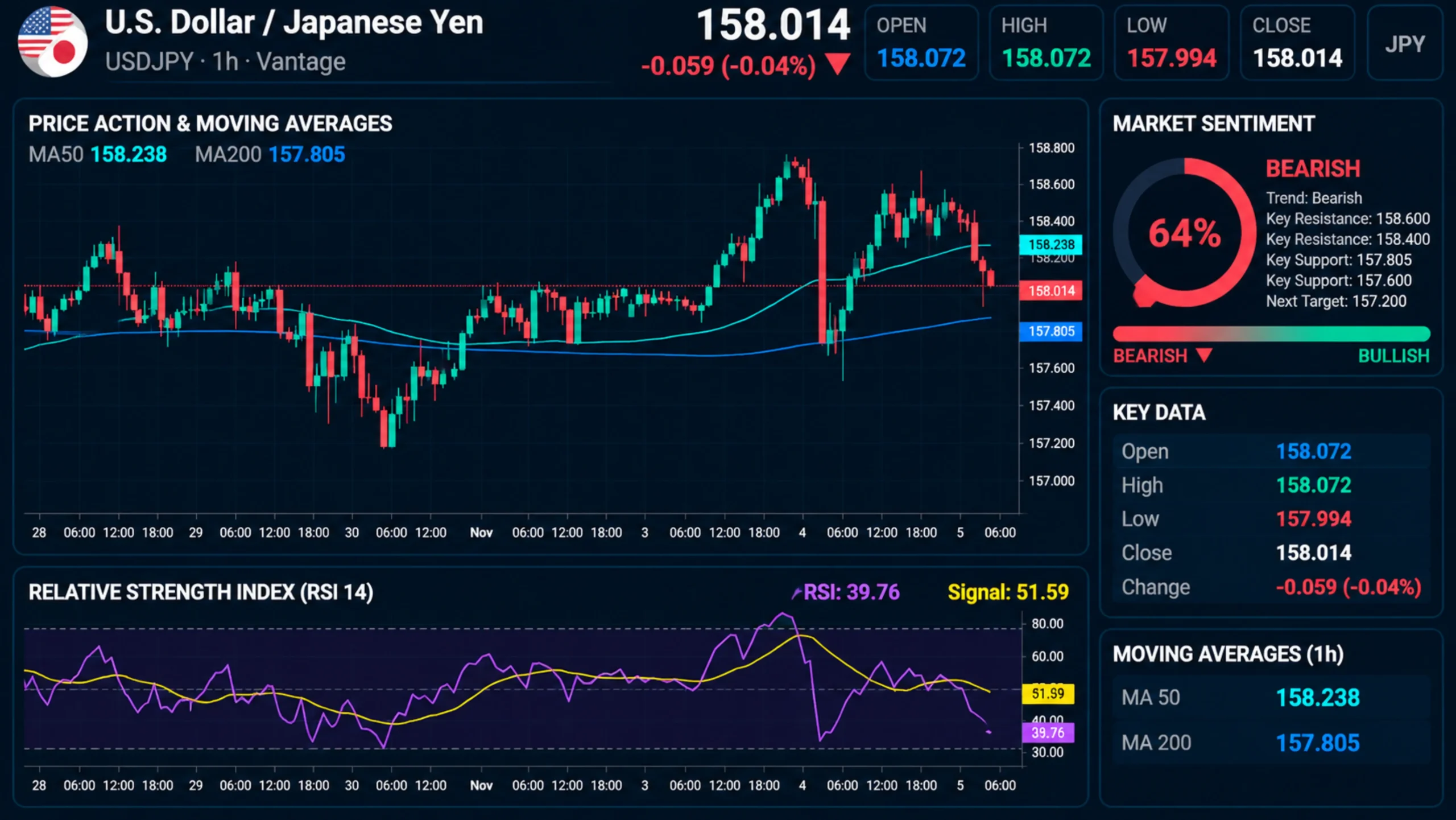
On the H1 chart, price sat below the 50-period moving average near 158.24 and above the 200-period average near 157.81 as of 10:06 (GMT+8). Thursday’s dip stopped just above that slower line; Wednesday’s low briefly undercut it.
The 14-period Relative Strength Index (RSI) read 39.76 on the TradingView setup used for this analysis, below its own moving average at 51.59. It swung from above 70 to near 32 and back within a day, which is a lot of mood for one oscillator. Price held above the 200-period line. Momentum did not hold above 50.
USDJPY Levels Traders Are Watching, as of 10:06 (GMT+8), 5 November 2026
| Level | Price Area | Why It Is on the Chart |
|---|---|---|
| Level 2 Resistance | 158.76 | Pre-results high, about 03:00 (GMT+8) on 4 November |
| Level 1 Resistance | 158.67 | Rebound high, about 23:00 (GMT+8) on 4 November |
| Pivot | 158.24 | 50-period moving average (H1) |
| Level 1 Support | 157.81 | 200-period moving average (H1); Thursday’s dip held near 157.85 |
| Level 2 Support | 157.38 | Election-day low, around midday (GMT+8) on 4 November |
| Level 3 Support | 156.96 | Low on 30 October, the day of the BoJ decision |
Levels read from the Vantage USDJPY H1 chart on TradingView, as of 10:06 (GMT+8) on 5 November 2026. Data indicative, for informational purposes only.
USDJPY Outlook: What Would Change the Read

Rather than a dollar yen forecast or a USDJPY prediction, here are the dated events that could change the read:
- US Nonfarm Payrolls, 6 November, 21:30 (GMT+8): Consensus is 65,000 after 29,000 in September, per FactSet via Morningstar. 14
- Japan Wage Data, Later This Week: The next domestic input for the BoJ. 13
- BoJ Summary of Opinions, 10 November, 07:50 (GMT+8): How the board weighed Takata’s 1.5% proposal. 9
- US CPI for October, 10 November: The other main input before December. 17
- FOMC Minutes, 18 November; Fed Decision, 10 December, 03:00 (GMT+8); BoJ Decision, 18 December: The meetings that set the year-end rate gap. 15,16
My read, that the rate gap rather than the election is framing the USDJPY rate, holds while price stays inside the 157.38 to 158.76 band. It weakens if payrolls or CPI shift Fed expectations for December, if the BoJ points clearly to a December move, or if Tokyo’s wording on the yen hardens.
Each of those dates lands in a different session, and that timing is where the practical risk sits.
Gap Risk Around Payrolls and Tokyo
On Wednesday, a broad dollar slide moved USDJPY for a few hours and then let go. As of 10:06 (GMT+8) on Thursday, the pair traded at 158.01, between its 50-period and 200-period averages, with momentum softer than price. The election question is largely answered; the rate gap question is not, and Friday’s payrolls are the next data point.
Wednesday’s candle showed how leveraged exposure behaves when news lands in a thin hour: the pair moved about 0.55% in 60 minutes, and the next payrolls release arrives at 21:30 (GMT+8) on Friday. A Stop Loss order can limit losses to a planned size in normal conditions, but in fast markets it may be filled at a worse price than the one set, which is known as slippage. Positions held over the weekend also carry gap risk, because the market can open at a different level from Friday’s close.
Leverage magnifies both gains and losses, so a move like Wednesday’s 0.87 yen drop has a proportionally larger effect on account equity in a leveraged USDJPY position. Leverage is double-edged and can lead to losses that exceed expectations. Some traders size positions so that a single adverse move of the size seen this week would affect only a small, pre-set percentage of account equity, and review margin levels before high-impact releases.
USDJPY Questions Traders Are Asking
What Are the USDJPY Support and Resistance Levels Today?
As of 10:06 (GMT+8) on 5 November 2026, the H1 chart showed resistance areas near 158.67 and 158.76, a pivot at the 50-period average near 158.24, and support areas near 157.81, 157.38, and 156.96. These shift as new candles print.
Has Japan Carried Out USDJPY Intervention This Year?
Yes. The Ministry of Finance intervened to support the yen in late April and early May, and again from 30 July, spending more than ¥27 trillion in total. 11,12
Is There a Fixed USDJPY Correlation With US Yields?
No. The US 10-year yield fell as USDJPY dropped on 4 November, 7 yet the pair recovered within the day while the dollar index stayed lower. 6 The correlation, in other words, clocked off early.
Does This Analysis Include a USD/JPY Forecast?
No. This piece does not put a number on a USD/JPY forecast or a broader yen forecast; it covers what happened, the levels in play, and the dates ahead. For background on what moves the pair, see the USDJPY trading guide.
RISK WARNING: CFDs are complex financial instruments and carry a high risk of losing money rapidly due to leverage. You should ensure you fully understand the risks involved and carefully consider whether you can afford to take the high risk of losing your money before trading.
Disclaimer: The information is provided for educational purposes only and doesn’t take into account your personal objectives, financial circumstances, or needs. It does not constitute investment advice. We encourage you to seek independent advice if necessary. The information has not been prepared in accordance with legal requirements designed to promote the independence of investment research. No representation or warranty is given as to the accuracy or completeness of any information contained within. This material may contain historical or past performance figures and should not be relied on. Furthermore estimates, forward-looking statements, and forecasts cannot be guaranteed. The information on this site and the products and services offered are not intended for distribution to any person in any country or jurisdiction where such distribution or use would be contrary to local law or regulation.
References
[1] “Dollar dips with US midterm results in focus – Reuters (via Euronext)” https://live.euronext.com/en/financial-news/dollar-dips-us-midterm-results-focus Accessed on 5 November 2026.
[2] “Dollar Yen Exchange Rate – USD JPY (1971-2026) – Macrotrends” https://www.macrotrends.net/2550/dollar-yen-exchange-rate-historical-chart Accessed on 5 November 2026.
[3] “Asian stocks and dollar fall as Democrats gain ground in US midterms – Euronews” https://www.euronews.com/2026/11/04/asian-stocks-and-dollar-fall-as-democrats-gain-ground-in-us-midterms Accessed on 5 November 2026.
[4] “USD JPY Historical Data – Investing.com” https://www.investing.com/currencies/usd-jpy-historical-data Accessed on 5 November 2026.
[5] “US midterms: What Trump’s defeat means for Europe and global markets – Euronews” https://www.euronews.com/2026/11/04/us-midterms-what-trumps-defeat-means-for-europe-and-global-markets Accessed on 5 November 2026.
[6] “Dollar edges lower as US election outcome cheers global markets – Reuters (syndicated)” https://www.933thedrive.com/2026/11/04/dollar-edges-lower-as-us-election-outcome-cheers-global-markets/ Accessed on 5 November 2026.
[7] “Stock market news for Nov. 4, 2026 – CNBC” https://www.cnbc.com/2026/11/03/stock-market-today-live-updates.html Accessed on 5 November 2026.
[8] “Federal Reserve issues FOMC statement, 28 October 2026 – Federal Reserve” https://www.federalreserve.gov/newsevents/pressreleases/monetary20261028a.htm Accessed on 5 November 2026.
[9] “Statement on Monetary Policy, 30 October 2026 – Bank of Japan” https://www.boj.or.jp/en/mopo/mpmdeci/mpr_2026/k261030a.pdf Accessed on 5 November 2026.
[10] “BOJ board saw the need to keep raising rates, September meeting minutes show – Reuters (via AOL)” https://www.aol.com/articles/boj-board-saw-keep-raising-000511000.html Accessed on 5 November 2026.
[11] “Foreign Exchange Intervention Operations (April – June 2026) – Ministry of Finance Japan” https://www.mof.go.jp/english/policy/international_policy/reference/feio/quarter/2026_2Qe.html Accessed on 5 November 2026.
[12] “Japan spends record ¥15.39 trillion in July-August forex interventions – The Japan Times” https://www.japantimes.co.jp/business/2026/08/29/markets/japan-record-forex-interventions/ Accessed on 5 November 2026.
[13] “Japanese Yen – Quote – Chart – Historical Data – News – Trading Economics” https://tradingeconomics.com/japan/currency Accessed on 5 November 2026.
[14] “October Jobs Report Seen Showing Resilient Labor Market – Morningstar” https://www.morningstar.com/economy/october-jobs-report-seen-showing-resilient-labor-market Accessed on 5 November 2026.
[15] “Monetary Policy – Federal Reserve” https://www.federalreserve.gov/monetarypolicy.htm Accessed on 5 November 2026.
[16] “BOJ raised rates again following June hike – Invesco” https://www.invesco.com/apac/en/institutional/insights/market-outlook/boj-raised-rates-again-following-june-hike.html Accessed on 5 November 2026.
[17] “US Employment Situation (Non-Farm Payrolls) November 2026 – Finance Calendar” https://www.financecalendar.com/?p=1293 Accessed on 5 November 2026.
Key Points In This Article

Latest Financial Market Analysis


Market Analysis Tags
- # USD News
- # USDCAD News
- # USDJPY News
- # USDX News
- # Forex News
- # Forex News Today
- # GBPUSD News
- # EURUSD News
- # Currency Trading News
- # AUDUSD news
Related Articles
- The Trade Desk Stock Climbed as Q3 Earnings Cleared a Lowered Bar – TTD Analysis
- Gold Rose as Oil Slid on US-Iran Peace Hopes – XAUUSD Analysis
- Nasdaq 100 Climbs as Chip Stocks Rebound Without Nvidia – NAS100 Analysis
- Euro Price Recovers as Dollar Eases Before US CPI: What It Means for EURUSD Traders
- How to Read the NFP Report: What the Numbers Actually Mean for Markets
- Brent Crude Fell Faster Than WTI as Iran Peace Bets Built – UKOUSD and USOUSD Analysis
- Dollar Index Slipped as Oil Fell and Hike Bets Rose – USDX Analysis
- S&P 500 Price Falls as Chip Stocks Slide: What It Means for SP500 Traders