Login





Bank Earnings Q3 2026: Four Numbers to Read in the Results

Vantage Editorial Team >
Vantage Editorial Team >
Vantage is a global, multi-asset broker with a team of in-house writers and market analysts who produce educational and insightful trading content for traders of all levels.
 Updated Wed, 2026 October 14 02:51

Clock first. JPMorgan Chase (NYSE:JPM) reports at about 19:00 (GMT+8) today, 13 October 2026, which opens the Q3 earnings season for the big banks. Consensus, as of 7 October, is earnings per share (EPS, a company’s earnings divided by its shares) of $5.94, about 17% above the $5.07 a year earlier.[1] Four numbers decide how these bank earnings read: net interest income, trading and deal fees, credit losses and costs. Q2’s record leaned on trading, deals and one-off gains, not lending.
Net interest income (NII) is what a bank earns on loans and securities minus what it pays on deposits and other funding. Consensus is the average of analyst forecasts, which means the headline number turns up already guessed. So I care less about the headline than about what sits under it: are higher rates helping after the Fed’s September hike, and what do the numbers say about credit and the economy? Our bank earnings this week preview covers the run-up. Data are as of 13:30 (GMT+8) on 13 October 2026; none of it is a forecast.
QUICK ANSWER
Four numbers decide how the banks’ Q3 earnings read: net interest income, trading and deal fees, credit losses and costs. JPMorgan’s Q2 record leaned on trading, deals and one-off gains, not lending, where net interest income rose 10%, so lending is where Q3 gets read.[2]
Your four-number checklist for today
- Net interest income: did full-year guidance hold after the September hike?
- Trading and deal fees: did Markets revenue and deal fees repeat the Q2 base?
- Credit losses: did provisions and charge-offs stay near guidance?
- Costs: did expenses grow more slowly than revenue?
Why a Record Second Quarter Sets the Bar for Today’s Bank Results
Start with one line in JPMorgan’s own release; it changes how I read everything else. Reported net income of $21.2 billion in Q2 was the highest in the bank’s history, Quartz reported, but the figure includes significant items such as a $4.6 billion gain on card-network shares.[2][3] Strip them out and net income was $16.9 billion, up 13%, and EPS was $6.14 rather than $7.70.[2] A record with one-offs inside it is a tall bar.
Across the group, Quartz reported that five of America’s biggest banks earned a combined $49 billion in Q2, up 39% year on year, and attributed it to a boom in stock trading, initial public offerings (IPOs) and a rebound in dealmaking.[4] At JPMorgan, Markets revenue (income from trading shares, bonds, currencies and commodities for clients) was $12.1 billion, up 35%, and investment banking fees (what banks charge for advising on deals and underwriting share and bond sales) rose 30%. NII rose 10%, in line with 10% growth in average loans.[2]
Against that bar, expectations for Q3 look modest. LSEG consensus, as of 7 October 2026, was $5.94 a share for JPMorgan against $5.07 a year earlier.[1] That sits below Q2’s $6.14 excluding significant items, so year on year is the comparison that matters today. The earnings calendar this week, in GMT+8, is below; more sits under our earnings news today tag.
Earnings calendar this week: when each bank reports (GMT+8) and what to read
| Bank | Date and time (GMT+8) | Consensus EPS | Year-ago EPS | One thing to read |
| JPMorgan Chase (NYSE:JPM) | Tue 13 Oct, about 19:00; call 20:30 | $5.94 | $5.07 | NII guidance (about $105.5 billion) and the guided mid-to-high-teens rise in trading and deal fees |
| Wells Fargo (NYSE:WFC) | Tue 13 Oct, about 19:00; call 22:00 | $1.85 | $1.66 | Full-year NII guidance (about $50 billion) |
| Citigroup (NYSE:C) | Tue 13 Oct, about 20:00; call 23:00 | $2.41 | $2.24 | Markets revenue and investment banking fees |
| Goldman Sachs (NYSE:GS) | Tue 13 Oct, about 19:30; call 21:30 | $12.44 | $12.25 | FICC trading against equities trading |
| Bank of America (NYSE:BAC) | Wed 14 Oct, about 18:45; call 20:30 | $1.10 | $1.06 | Investment banking fees (guided down at least 10%) |
| Morgan Stanley (NYSE:MS) | Wed 14 Oct, about 19:30; call 21:30 | $2.94 | $2.80 | Investment banking pipeline |
Source: LSEG estimates as of 7 October 2026, reported by Reuters on 8 October 2026; release and call times from each bank’s investor relations page, converted from US Eastern Time. “About” follows each bank’s own notice. Consensus is a snapshot and moves. [1][5][6][7][8][9][10]
That sets the bar for the earnings season. It does not say which line carries the quarter, and the first candidate is the one rates are supposed to help: net interest income.
Net Interest Income After the September Hike: Do Higher Rates Help Banks?
Here is the part the obvious answer skips. Higher rates lift what banks earn on loans and securities, and they lift what banks pay for deposits too. Think of a tap and a drain: loan income pours in, deposit costs drain out, and NII is the water left in the basin. So higher rates do not automatically lift bank earnings.
Q2’s record leaned on markets, deals and one-off gains, not lending. The lending side is where Q3 gets read.
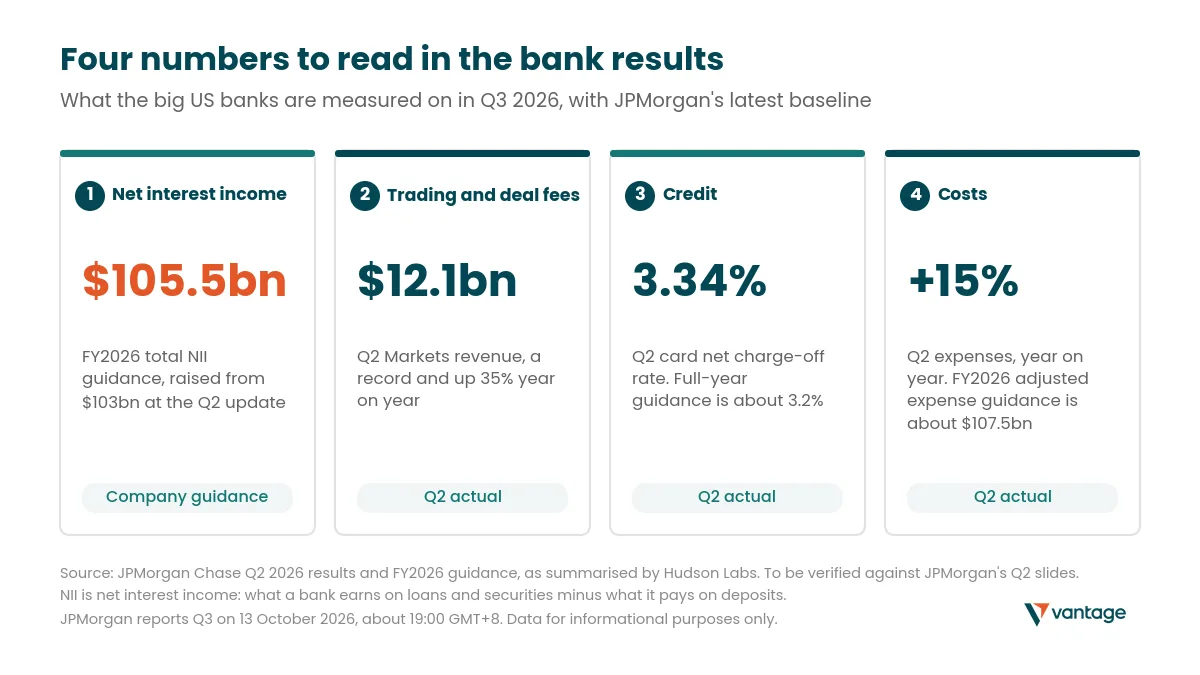
JPMorgan’s Q2 NII was $25.6 billion, up 10%, under a third of the 35% growth in Markets revenue.[2] On the Q2 call, management raised its 2026 NII guidance to about $105.5 billion from about $103 billion, and its NII excluding Markets to about $96.5 billion from about $95 billion.[11][12] Guidance is management’s estimate, not a result.
Wells Fargo (NYSE:WFC) gives a second read on lending. It kept its full-year NII guidance at about $50 billion on its Q2 call while expecting modest margin compression in Q3, so Q3 tests a number that already exists.[13] LSEG consensus, as of 7 October 2026, was $1.85 in earnings per share against $1.66 a year earlier.[1]
The Fed raised its policy range to 3.75% to 4.00% on 16 September 2026.[14] What NII has to show is whether deposit costs stayed contained. Reuters reported that investors are asking whether higher rates will raise deposit costs.[1] If total NII guidance is held or raised after the 10-year yield closed at 5.24% on 9 October,[15] the lending side is coping with higher rates. If it is cut, that read weakens. Our 10-year yield explainer covers the backdrop, and the Federal Reserve news tag follows the policy side.
Lending is the slow number. The fast one is trading, and it is where the second quarter’s record was made.
Trading and Deal Fees: Can the Q2 Record Be Repeated?
Zoom in on one bank. JPMorgan’s Q2 Markets revenue was $12.1 billion, up 35%, with investment banking fees up 30%.[2] For Q3, a JPMorgan co-president said at an investor conference in September that the bank expected both trading revenue and investment banking fees to rise by a mid-to-high-teens percentage year on year, Reuters reported.[1] That is guidance, not a result.
Management also flagged on the Q2 call that large IPOs and an index rebalancing had added to the quarter, per Hudson Labs’ summary.[11] Part of the Q2 base was therefore event-driven, so repeating it is a question about market activity more than rates.
The other banks sent mixed signals. Goldman Sachs’ (NYSE:GS) chief executive said at a conference on 16 September that fixed income, currencies and commodities (FICC, trading in bonds, currencies and commodities) was slightly softer, while equities trading stayed strong, Reuters reported.[16] Bank of America’s (NYSE:BAC) chief executive said it expected investment banking fees to fall by at least 10% in Q3, and Morgan Stanley’s (NYSE:MS) co-president said its investment banking pipeline looked robust.[1] Same quarter, three different ledgers, and none of them a result yet.
That covers income. The next two numbers show what the economy may be costing the banks.
Credit and Costs: Where Unemployment of 4.2% Shows Up
US unemployment was 4.2% in September, and payrolls rose by 29,000, which the Bureau of Labor Statistics said changed little.[17] Credit cards are one place a weaker job market can show up. Provisions are the money a bank sets aside for loans that may go bad, and a charge-off is a loan written off as uncollectable. JPMorgan’s provisions were $2.5 billion in Q2, down 12%, and its card net charge-off rate was 3.34%.[2]
Management guided the 2026 card net charge-off rate to about 3.2%, lowered from about 3.4%, per the Q2 call.[11][12] The New York Fed reported that 6.97% of card balances flowed into serious delinquency (payments 90 days or more overdue, annualised) in Q2 2026, against 6.93% a year earlier.[18] Read together, card credit appears steady rather than sharply better or worse. Jamie Dimon, JPMorgan’s chief executive, said in the Q2 release that the economy showed “notable resiliency this year”.[2]
Costs are the fourth number, and the line nobody puts on a poster. JPMorgan’s noninterest expense was $27.3 billion in Q2, up 15%, against managed revenue up 27% (up 15% excluding significant items).[2] Management lifted its 2026 adjusted expense guidance to about $107.5 billion from about $105 billion.[11][12] The test is whether revenue growth stays ahead of expense growth once one-offs are stripped out.
Four numbers, then. But the last time rates rose this fast, the first of them behaved in a way the headline figures did not show.
How Banks Read the Last Time Rates Rose Fast

To see why NII is not automatic, go back to the last hiking cycle. The Fed raised its policy range 11 times between 17 March 2022 and 27 July 2023, ending at 5.25% to 5.50%.[19] This is history, not a forecast, and it says nothing about this quarter’s results.
At first, US banks’ NII rose. The Federal Deposit Insurance Corporation (FDIC) reported industry NII of $175.7 billion in Q1 2023, up 27.3% on a year earlier.[20] But the margin was already slipping. The net interest margin (NII as a share of earning assets) fell seven basis points in Q1 2023 to 3.31%, as the average cost of deposits rose 43 basis points to 1.42% while loan yields rose 32 basis points to 6.08%.[20] A basis point is one hundredth of a percentage point.
By Q2 2023 the margin was 3.28%, down a further three basis points, and the FDIC said funding costs were rising faster than asset yields.[21] In plain terms, interest income rose, then funding costs caught up. This leaves out differences between banks and the unrealised bond losses of 2023.
That is the cycle the September hike arrives in. Results days carry their own risk for anyone holding exposure.
Earnings-Day Volatility: Gap Risk and Position Sizing
Results arrive at about 19:00 (GMT+8), roughly two and a half hours before the US cash market opens at 21:30 (GMT+8). If you follow bank stocks through share Contract for Difference (CFD) prices, that gap matters: a CFD price can open away from its previous close, which is gap risk. JPMorgan stock, Wells Fargo, Citigroup stock, Goldman Sachs stock, Bank of America stock and Morgan Stanley stock all report within two days, so exposure stacks: positions in several can behave like one when results move together. Our risk management guide covers the basics; stock market news today follows the day.
If you came looking for the JPMorgan stock price or the Wells Fargo stock price, I have left live quotes out on purpose: a price printed at 13:30 is stale by 19:00. That goes for the Citigroup share price, the Goldman Sachs stock price and the Goldman Sachs share price, the Bank of America stock price and the Bank of America share price, and the Morgan Stanley stock price and the Morgan Stanley share price too.
CFDs are leveraged products, and losses can exceed deposits. Leverage applies a price move to the full position rather than to the deposit alone. A Stop Loss is an order that closes a position at a chosen level; it can help limit a loss to a planned size, but a gap can fill it at a worse price. Position sizing is how large a position is relative to account equity. If a planned Stop Loss costs 1% of account equity, a gap through that level can turn the plan into a larger loss.
Which brings the question back to where it started.
So, are higher rates helping the big banks? My answer sits in four numbers, not in the rate. Q2’s record leaned on Markets revenue up 35%, investment banking fees up 30% and one-off gains, against NII up 10%. Today’s JPMorgan earnings and the five reports around them show whether NII guidance held, whether trading and deal fees repeated, whether credit losses stayed near guidance, and whether costs grew more slowly than revenue.
Bank earnings are also a read on the rate and credit cycle behind a 10-year yield that closed at 5.24% on 9 October.[15] What would change the answer is the read, not the price: lower NII guidance alongside higher provisions would weaken the higher-rate read, and steady guidance alongside steady charge-offs would support it. For the same yield backdrop, see how Treasury yields reached their highest since 2002 and our AI bubble debate piece.
What to watch next
- Tue 13 Oct, 19:00 to 23:00: JPMorgan, Wells Fargo, Goldman Sachs and Citigroup (NYSE:C) release between about 19:00 and 20:00, with calls from 20:30.[5][6][7][8]
- Wed 14 Oct, from 18:45: Bank of America (about 18:45) and Morgan Stanley (about 19:30) results,[9][10] and US September Consumer Price Index (CPI) at 20:30.[22]
- Thu 15 Oct, 20:30: US Producer Price Index (PPI).[22]
- Wed 29 Oct, 02:00: Federal Open Market Committee (FOMC) decision at the end of the 27 to 28 October meeting.
- Late October: Mega-cap tech earnings; dates unconfirmed on each company’s investor relations page.
RISK WARNING: CFDs are complex financial instruments and carry a high risk of losing money rapidly due to leverage. You should ensure you fully understand the risks involved and carefully consider whether you can afford to take the high risk of losing your money before trading.
Disclaimer: The information is provided for educational purposes only and doesn’t take into account your personal objectives, financial circumstances, or needs. It does not constitute investment advice. We encourage you to seek independent advice if necessary. The information has not been prepared in accordance with legal requirements designed to promote the independence of investment research. No representation or warranty is given as to the accuracy or completeness of any information contained within. This material may contain historical or past performance figures and should not be relied on. Furthermore estimates, forward-looking statements, and forecasts cannot be guaranteed. The information on this site and the products and services offered are not intended for distribution to any person in any country or jurisdiction where such distribution or use would be contrary to local law or regulation.
References
[1] “US bank investors to focus on impact of higher rates, deals outlook in Q3 earnings By Reuters – Investing.com” https://www.investing.com/news/economy-news/us-bank-investors-to-focus-on-impact-of-higher-rates-deals-outlook-in-q3-earnings-4938365 Accessed on 13 October 2026.
[2] “2Q26 Earnings Press Release – JPMorganChase” https://www.jpmorganchase.com/content/dam/jpmc/jpmorgan-chase-and-co/investor-relations/documents/quarterly-earnings/2026/2nd-quarter/6cded9fd-a164-4e6c-8cff-377357cf105c.pdf Accessed on 13 October 2026.
[3] “JPMorgan Chase Q2 2026 earnings: Record profit on trading surge – Quartz” https://qz.com/jpmorgan-chase-record-profit-q2-2026-earnings-071426 Accessed on 13 October 2026.
[4] “Five of America’s biggest banks reported Q2 2026 earnings (14 July 2026) – Quartz” https://qz.com/jpmorgan-goldman-bank-of-america-citigroup-wells-fargo-record-profits-071426 Accessed on 13 October 2026.
[5] “JPMorganChase to host third quarter 2026 earnings call – JPMorganChase” https://www.jpmorganchase.com/ir/news/2026/jpmc-to-host-third-quarter-2026-earnings-call Accessed on 13 October 2026.
[6] “Wells Fargo Updates 2026 Earnings Release Date Information – Wells Fargo Newsroom” https://newsroom.wf.com/news-releases/news-details/2026/Wells-Fargo-Updates-2026-Earnings-Release-Date-Information/default.aspx Accessed on 13 October 2026.
[7] “For Immediate Release Citigroup Inc. (NYSE: C), third quarter 2026 earnings call – Citigroup” https://www.citigroup.com/global/news/press-release/2026/citi-third-quarter-2026-earnings-call Accessed on 13 October 2026.
[8] “Goldman Sachs Conference Call Dates to Announce 4Q25 and 2026 Earnings Results – Goldman Sachs” https://www.goldmansachs.com/pressroom/press-releases/2025/conference-call-dates-to-announce-4q25-and-2026-earnings-results Accessed on 13 October 2026.
[9] “Bank of America to Report Third Quarter 2026 Financial Results and Host Investor Conference Call on October 14 – Bank of America Newsroom” https://newsroom.bankofamerica.com/content/newsroom/press-releases/2026/09/bank-of-america-to-report-third-quarter-2026-financial-results-a.html Accessed on 13 October 2026.
[10] “Morgan Stanley Third Quarter 2026 Investor Conference Call – Morgan Stanley” https://www.morganstanley.com/about-us-ir/morgan-stanley-third-quarter-2026-investor-conference-call Accessed on 13 October 2026.
[11] “JPMorgan Q3 2026 Earnings Preview: Revenue, Guidance, Outlook – Hudson Labs” https://www.hudson-labs.com/research/jpmorgan-q3-2026-earnings-preview-revenue-guidance-outlook Accessed on 13 October 2026.
[12] “JPMorgan Chase (JPM) Q2 2026 Earnings Call Transcript – Webull” https://www.webull.com/news/15271033854174208 Accessed on 13 October 2026.
[13] “Wells Fargo & Company Q2 Earnings Call Highlights – Yahoo Finance” https://finance.yahoo.com/markets/stocks/articles/wells-fargo-company-q2-earnings-160330819.html Accessed on 13 October 2026.
[14] “Federal Reserve Board – Federal Reserve issues FOMC statement (16 September 2026) – Federal Reserve” https://www.federalreserve.gov/newsevents/pressreleases/monetary20260916a.htm Accessed on 13 October 2026.
[15] “Daily Treasury Par Yield Curve Rates, October 2026 – U.S. Department of the Treasury” https://home.treasury.gov/resource-center/data-chart-center/interest-rates/TextView?type=daily_treasury_yield_curve&field_tdr_date_value_month=202610 Accessed on 13 October 2026.
[16] “Goldman Sachs sees slightly softer fixed income, currencies, commodities business, higher costs – KELO (Reuters)” https://kelo.com/2026/09/16/goldman-ceo-says-fixed-income-currencies-commodities-business-slightly-softer-in-q3/ Accessed on 13 October 2026.
[17] “Employment Situation Summary, September 2026 – U.S. Bureau of Labor Statistics” https://www.bls.gov/news.release/empsit.nr0.htm Accessed on 13 October 2026.
[18] “Household Debt Balances Decreased Slightly; Credit Card Delinquency Transition Rates Remained Steady – Federal Reserve Bank of New York” https://www.newyorkfed.org/newsevents/news/research/2026/20260811 Accessed on 13 October 2026.
[19] “Open Market Operations, policy actions 2022 and 2023 – Federal Reserve” https://www.federalreserve.gov/monetarypolicy/openmarket.htm Accessed on 13 October 2026.
[20] “Quarterly Banking Profile, First Quarter 2023 – FDIC” https://fdic.gov/analysis/quarterly-banking-profile/qbp/2023mar/qbp.pdf Accessed on 13 October 2026.
[21] “Quarterly Banking Profile, Second Quarter 2023 – FDIC” https://fdic.gov/analysis/quarterly-banking-profile/qbp/2023jun/qbp.pdf Accessed on 13 October 2026.
[22] “Schedule of Releases for October 2026 – U.S. Bureau of Labor Statistics” https://www.bls.gov/schedule/2026/10_sched.htm Accessed on 13 October 2026.
The information has been prepared as of the date published and is subject to change thereafter. The information is provided for educational purposes only and doesn't take into account your personal objectives, financial circumstances, or needs. It does not constitute investment advice. We encourage you to seek independent advice if necessary. The information has not been prepared in accordance with legal requirements designed to promote the independence of investment research. No representation or warranty is given as to the accuracy or completeness of any information contained within. This material may contain historical or past performance figures and should not be relied on. Furthermore estimates, forward-looking statements, and forecasts cannot be guaranteed. The information on this site and the products and services offered are not intended for distribution to any person in any country or jurisdiction where such distribution or use would be contrary to local law or regulation.