
CFDs and Spread Bets are complex instruments and come with a high risk of losing money rapidly due to leverage. 72.65% of retail investor accounts lose money when trading CFDs and Spread Bets with this provider. You should consider whether you understand how CFDs and Spread Bets work and whether you can afford to take the high risk of losing your money.


 Login


SEARCH
-
Search query too short. Please enter a full word or phrase.
-

Keywords
Popular Search


SEARCH
-
Search query too short. Please enter a full word or phrase.
-
Keywords
Popular Search



Currency Pairs in Forex Explained: Major, Minor and Exotic Pairs

Vantage Editorial Team >
5 August 2026 | Academy | 45 min read
Vantage Editorial Team >
Vantage is a global, multi-asset broker with a team of in-house writers and market analysts who produce educational and insightful trading content for traders of all levels.

Currency pairs are typically grouped into majors, minors or crosses, and exotics according to market convention, trading activity and liquidity. However, these labels are not universal. The Financial Conduct Authority (FCA) uses a separate regulatory classification consisting only of major and minor foreign-exchange pairs.
In the UK, retail traders commonly gain leveraged exposure to these exchange-rate movements through contracts for difference (CFDs), financial spread bets, and rolling spot forex products. These instruments allow traders to speculate on price movements without owning the underlying currencies. However, these are complex, high-risk products, and losses can occur rapidly because of leverage.
Forex trading remains popular in 2026, with OTC forex turnover reaching $9.6 trillion per day in April 2025 — up 28% from $7.5 trillion three years earlier, according to the Bank for International Settlements’ 2025 Triennial Survey.1
This guide covers 16 widely followed currency pairs, organised using familiar market terminology: seven conventionally recognised US-dollar majors, five cross-currency (minor) pairs, and four emerging-market pairs commonly described as exotics. Each entry also identifies its FCA classification for UK retail-CFD purposes.
The following examples are for illustrative purposes only and do not represent actual trading recommendations.
Key Points
- Learn how currency pairs are structured and how they function as the foundation of forex trading.
- Explore 16 widely followed major, minor, and emerging-market forex pairs, including their market drivers and FCA classification in the UK.
- Understand pip values, correlation between pairs, and how to match a pair to your trading style.
What Is a Currency Pair?
A currency pair shows the exchange rate between two currencies, made up of a base currency and a quote currency. The first currency listed is the base currency; the second is the quote currency, which shows how many units are needed to buy one unit of the base currency. For example, EUR/USD shows how many US dollars are needed to buy one euro.
There is no fixed number of currency pairs, since almost any two currencies can theoretically be paired. In practice, trading activity is concentrated in a smaller group. Market convention commonly discusses seven US-dollar majors, minor cross-currency pairs, and emerging-market or exotic pairs, while the FCA uses only major and minor classifications for UK retail-CFD rules.

Image 1: The Global Landscape of Forex Trading
How Forex Trading Works
Forex trading, or foreign exchange trading, involves buying one currency while selling another, or taking a position based on how one currency is expected to move relative to another. In the UK retail market, this exposure is commonly provided through leveraged CFDs, financial spread bets, or rolling spot forex products, meaning the trader may not own or take delivery of either currency.
The global foreign-exchange market operates predominantly over the counter rather than through one centralised exchange. In the UK, forex transactions are generally entered into with a broker or provider through an online platform, and the provider may act as the trader’s counterparty.
As the world’s largest financial market, forex trading is generally available from Sunday evening until Friday evening, although exact hours, pricing, and liquidity vary between providers, currencies, and public holidays.
Learn more in our detailed forex CFD trading guide.
How to Read Currency Pairs
Currencies covered by the International Organization for Standardisation (ISO) 4217 standard are assigned three-letter alphabetic codes, otherwise known as their currency codes. This normally consists of the first two letters corresponding to the relevant country code, while the third letter corresponds to the first letter of the currency’s name.
For instance, USD represents the US dollar and EUR represents the euro. However, note that this pattern does not apply uniformly to every currency.
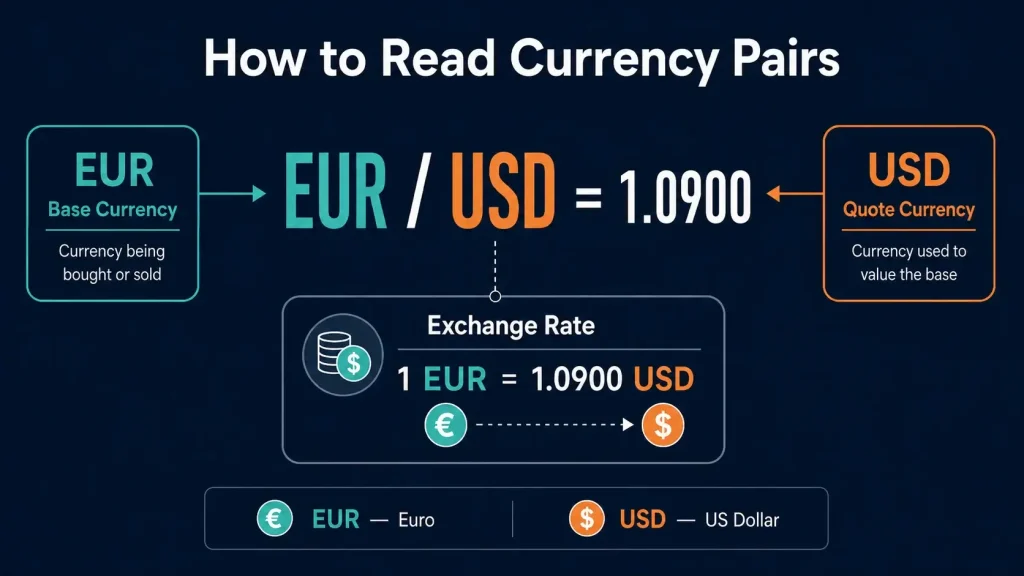
Image 2: Base and quote currency example
Base Currency and Quote Currency
In any currency pair, the first currency listed is the base currency and the second is the quote currency. The exchange rate indicates how many units of the quote currency are needed to buy one unit of the base currency.
Using EUR/USD as an example:
- EUR is the base currency.
- USD is the quote currency.
If the quoted price reads $1.2042, this means that 1.2042 US dollars is needed to buy one euro. The actual price available to a trader may differ depending on whether they are buying or selling, because brokers normally display separate bid and ask prices.
Long and Short Positions
A position refers to a trader’s exposure to movements in a currency pair. An open position remains active until it is closed, expires, or is offset by another position. Its value may rise or fall as the exchange rate changes. In UK retail forex trading, exposure obtained through leveraged CFDs, financial spread bets, or rolling spot forex products generally doesn’t give the trader ownership of the underlying currencies.
Long Position A trader takes a long position when they buy the base currency and sell the quote currency, expecting the base currency to appreciate in value against the quote currency. Example: Going long on EUR/USD if the trader believes the euro will strengthen against the US dollar.
Short Position A trader takes a short position when they sell the base currency and buy the quote currency, anticipating that the base currency will depreciate against the quote currency. Example: Going short on GBP/USD if they expect sterling to fall in value against the US dollar.
If the market moves in the expected direction, the position may gain value. If it moves in the opposite direction, the trader may incur a loss. Leverage magnifies both outcomes.
Worked example: Suppose you exchange €1,000 into US dollars for a holiday when the exchange rate is EUR/USD 1.10. Ignoring spreads and charges, you receive $1,100. If the exchange rate subsequently falls to EUR/USD 1.00, those $1,100 would convert back into €1,100 — a €100 gain before costs, because the US dollar strengthened against the euro while you held dollars. If the exchange rate had moved the other way, converting the dollars back could instead have produced a loss.
Actual consumer exchange rates also include spreads, fees or commissions, and may differ from wholesale market rates. The Bank of England confirms that market exchange rates form the basis of — but are not necessarily identical to — the rates consumers receive from banks and currency-exchange providers.5
Bid Price, Ask Price and the Spread
A tradeable currency pair quotation normally displays two prices:
- Bid Price: The price at which the trader can sell the base currency — or open a short position with a broker.
- Ask Price: The price at which the trader can buy the base currency — or open a long position. In the UK, the ask price is also called the offer price.
| Currency Pair | Bid Price | Ask Price |
| EUR/USD | 1.4745 | 1.4746 |
In this illustrative example:
- A trader looking to go long (buy EUR, sell USD) would do so at the ask price of 1.4746.
- A trader looking to go short (sell EUR, buy USD) would do so at the bid price of 1.4745.
The difference between the bid and ask price is known as the spread. In this example, the spread is 1 pip (0.0001), which represents one component of the overall trading costs. Other potential costs include commission, overnight financing (aka swap fees), currency-conversion charges, and slippage.
Spread size generally varies by currency pair: highly traded, liquid majors such as EUR/USD typically carry some of the tightest bid-ask spreads, while less-liquid pairs — including exotic pairs with thinner trading volume — tend to carry wider spreads. Major news, public holidays, the daily market rollover and quieter trading periods can all affect spreads.
What Is a Pip?
A pip (“percentage in point”) is the standard unit used to measure a change in a currency pair’s exchange rate. For most pairs, one pip is a movement in the fourth decimal place (0.0001) — so if EUR/USD moves from 1.4745 to 1.4755, that’s a 10-pip move. Yen-based pairs are the main exception: because JPY is quoted to two decimal places rather than four, one pip on USD/JPY is a movement in the second decimal place (0.01).
Pip value — how much a one-pip move is worth in monetary terms — depends on the trade size (lot size), the currency pair, and the account’s base currency. Brokers typically display pip value alongside a trade ticket, and most trading platforms include a pip or margin calculator so traders don’t need to calculate it manually. Understanding pip value matters because it directly determines position size and potential profit or loss on a given move.
Major Currency Pairs
| Currency Pair | Description |
| EUR/USD | Policy divergence (Fed vs ECB). Fell below parity in 2022 for the first time in 20 years. FCA classification: major. |
| GBP/USD | Sensitive to Bank of England and Federal Reserve policy expectations, UK and US economic data, and political or fiscal developments. FCA classification: major. |
| USD/JPY | Interest rate gap (Fed vs BoJ). Popular for carry trades when US-Japanese interest rate differentials widen. FCA classification: major. |
| USD/CHF | Swiss franc is widely regarded as a safe-haven currency. May strengthen during periods of heightened uncertainty, but this is not guaranteed. Also influenced by Federal Reserve, Swiss National Bank monetary policy, interest-rate expectations, and broader market conditions. FCA classification: major. |
| AUD/USD | Influenced by commodity prices, especially iron ore, Australia’s terms of trade, Chinese demand, and Reserve Bank of Australia policy. FCA classification: minor. |
| USD/CAD | Influenced by oil and other commodity prices, as well as Federal Reserve and Bank of Canada policy. Higher oil prices may support the CAD, but the relationship isn’t guaranteed. FCA classification: major. |
| NZD/USD | Influenced by New Zealand’s export outlook, including dairy prices, as well as Reserve Bank of New Zealand (RBNZ) policy, overseas demand, and global risk sentiment. FCA classification: minor. |
Under common market convention, the seven major currency pairs combine the US dollar with the euro, pound sterling, Japanese yen, Swiss franc, Australian dollar, Canadian dollar or New Zealand dollar. They are generally among the most actively traded forex pairs and often have relatively tight spreads, although actual spreads vary by provider and market conditions.
For UK retail-CFD rules, a major foreign-exchange pair is any pair formed from two currencies in the FCA’s six-currency list: USD, EUR, JPY, GBP, CAD and CHF. All other currency pairs are minor. Consequently, AUD/USD and NZD/USD are FCA minor pairs, even though market publications commonly include them among the seven majors. FCA rules require a minimum opening margin of 3.33% for major FX pairs and 5% for minor FX pairs.4
According to the Bank for International Settlements (BIS), the US dollar was on one side of 89.2% of all global FX trades in April 2025. The euro and Japanese yen accounted for 28.9% and 16.8% of turnover respectively, while sterling’s share slipped to 10.2%.1 The figures indicate each currency’s role in global trading but do not, by themselves, determine how individual pairs will perform.
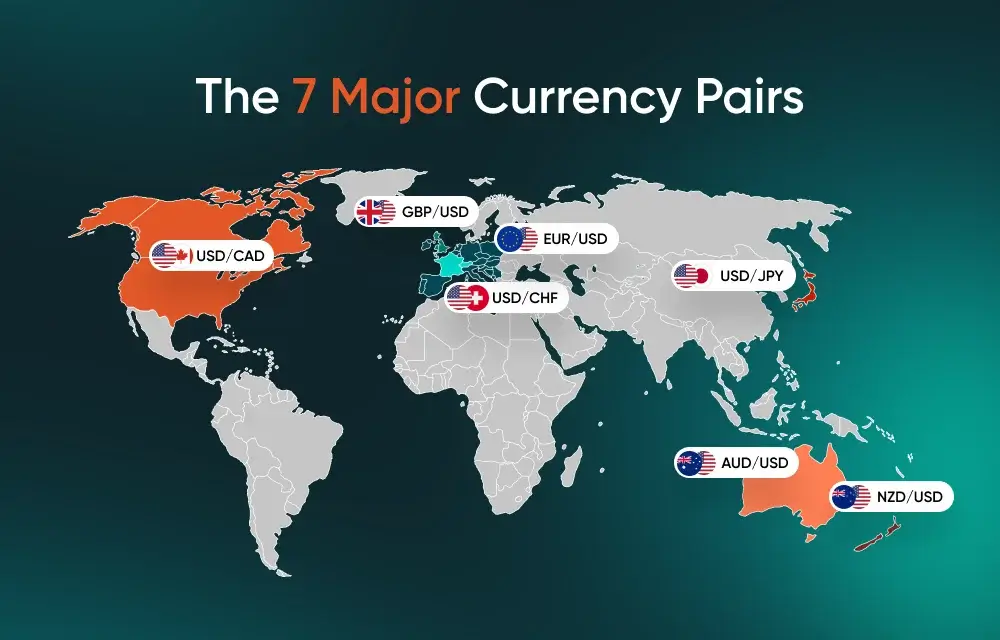
Image 4: Major currency pairs
1. EUR/USD
The EUR/USD reflects the exchange rate between the euro (the official currency of the eurozone) and the US dollar (the world’s leading reserve currency). It was the world’s most traded currency pair in the BIS’s April 2025 survey, accounting for 21.2% of global OTC FX turnover. Traders sometimes refer to it informally as “Fiber.”
Its high trading activity generally supports deep liquidity and relatively tight bid-ask spreads, although actual spreads, commissions, financing charges, and execution quality vary between brokers and market conditions.
Relative monetary-policy expectations for the Federal Reserve and European Central Bank are key drivers of EUR/USD. For example, in 2022, the Fed began raising rates earlier and more rapidly than the ECB. Together with euro-area energy and growth concerns, this widening policy gap contributed to the euro’s depreciation, and the pair fell below parity for the first time since 2002.2
Major economic data releases, such as US employment data and Eurozone inflation figures, can cause short-term volatility. Additionally, EUR/USD is often particularly active during the overlap between London and New York trading hours, although activity and spreads can fluctuate with market conditions.
2. GBP/USD
The GBP/USD pair, often referred to as “Cable,” represents the exchange rate between the pound sterling and the US dollar. It was the fourth-most-traded currency pair in the BIS’s April 2025 survey, accounting for 7.6% of global OTC FX turnover.
This pair can experience larger price movements than EUR/USD, although volatility varies over time.
Its principal influences include Bank of England (BoE) and Federal Reserve expectations, UK and US economic data, and broader market sentiment. UK employment figures, retail sales, and inflation reports can affect sterling, while comparable US releases can influence the dollar side of the pair. Events such as Brexit negotiations, UK fiscal announcements, and periods of political uncertainty have also previously produced notable price swings in GBP/USD.
3. USD/JPY
The USD/JPY currency pair represents the exchange rate between the US dollar and Japanese yen. It was the world’s second-most-traded currency pair in April 2025, accounting for 14.3% of global OTC FX turnover.
Relative Federal Reserve and Bank of Japan policy expectations — and the resulting difference between US and Japanese interest rates — are important influences on the pair. Japan’s historically very low and, until March 2024, negative policy rates helped establish the yen as a common funding currency for carry trades.
During 2022 to 2023, rapid Fed rate increases contrasted with the BoJ’s continued dovish stance, contributing to a wider yield differential and multi-decade highs in USD/JPY. Japan’s policy position has since changed: the BoJ ended negative rates in 2024 and raised its policy rate to around 1.0% in June 2026.
A positive interest-rate differential may generate financing income in some positions, but the amount depends on the product and provider. For retail CFDs, spread bets and rolling spot forex products in the UK, financing adjustments may differ substantially from central-bank policy rates.
Carry trades also involve significant risk. Exchange-rate movements can exceed any financing return, particularly when leverage is used. Carry-trade unwinding can also produce rapid yen appreciation. Although the yen has historically displayed safe-haven characteristics, it does not strengthen during every period of uncertainty; monetary policy, energy prices, capital flows, and possible official intervention can outweigh changes in risk sentiment.
4. USD/CHF
The USD/CHF tracks the exchange rate between the US dollar and the Swiss franc, sometimes referred to as the “Swissie.” It was among the most actively traded currency pairs in April 2025, accounting for approximately 4.9% of global OTC foreign-exchange turnover.
The Swiss franc is widely regarded as a safe-haven currency, supported by factors including Switzerland’s long-standing political and economic stability as well as historically low inflation. It may therefore attract demand during periods of heightened uncertainty, although this relationship isn’t consistent nor guaranteed.
USD/CHF is also influenced by monetary-policy expectations for the Swiss National Bank (SNB) and the US Federal Reserve. If markets expect US interest rates to remain higher than Swiss rates, this may support the dollar relative to the franc. However, economic data, risk sentiment, and possible SNB foreign-exchange intervention can outweigh the interest-rate differential and produce rapid price movements.
5. AUD/USD
Commonly referred to as the “Aussie,” the AUD/USD currency pair represents the exchange rate between the Australian dollar and the US dollar. It accounted for approximately 4.9% of global OTC FX turnover in April 2025.
Australia is a major exporter of commodities, including iron ore, gold, coal, and liquefied natural gas. Rising commodity prices — particularly iron ore and gold — and changes in Australia’s terms of trade can therefore influence the Australian dollar. Rising export prices may support the AUD, while falling prices may weigh on it, although this relationship isn’t automatic.
Relative monetary-policy expectations for the Reserve Bank of Australia and Federal Reserve are another important influence. A shift towards higher expected Australian interest rates relative to US rates may support AUD/USD, but economic growth, inflation, capital flows and wider market sentiment also affect the pair.
Due to Australia’s close trade links with China, AUD/USD is sometimes viewed as an indicator of Chinese demand and global risk appetite. It should not, however, be considered a reliable proxy for the entire Asia-Pacific economy.
6. USD/CAD
The USD/CAD currency pair represents the exchange rate between the US dollar and the Canadian dollar, often referred to as the “Loonie.” It’s heavily influenced by movements in commodity prices, as oil and other natural resources are among Canada’s most significant exports.
When oil and commodity prices rise, the Canadian dollar may strengthen, which then generally exerts downward pressure on USD/CAD. When prices fall, the CAD may weaken, causing the pair to rise. This relationship is not fixed: monetary policy, economic data, trade flows, and global risk sentiment can sometimes have a greater influence.
The pair is also sensitive to employment, inflation, and GDP data from Canada and the US, as well as relative policy expectations for the Bank of Canada (BoC) and the Federal Reserve. For example, if the BoC adopts a more hawkish tone while the Fed pauses rate hikes, this may support the Canadian dollar but does not guarantee that USD/CAD will fall.
In early 2016, oil prices slumped to decade lows and WTI crude traded below $30 per barrel amid high inventories, excess supply, and concerns about weakened demand. The oil decline contributed to pressure on the Canadian dollar, while USD/CAD briefly traded around 1.46 Canadian dollars per US dollar — the pair’s highest level since 2003. Oil was an important factor, but not the pair’s only driver.3
7. NZD/USD
The NZD/USD currency pair measures the value of the New Zealand dollar (often known as the “Kiwi”) against the US dollar.
New Zealand’s export-driven economy relies heavily on dairy products as a share of national exports. As such, fluctuations in global dairy prices, overseas demand, and broader commodity-market conditions can affect the NZD’s performance, although their effects vary over time.
In addition to trade dynamics, monetary policy from the Reserve Bank of New Zealand (RBNZ) and Federal Reserve plays a key role. New Zealand became the first country in the modern era to formally adopt inflation targeting in 1990. During periods when New Zealand has relatively higher interest rates, the NZD has sometimes been used as the higher-yielding currency in carry trade strategies. However, this has not always involved NZD/USD specifically, and New Zealand rates are not consistently higher than those of other economies.
Carry-trade demand can support NZD during stable market conditions, but such positions may be reversed rapidly when risk sentiment deteriorates. For UK CFDs, spread bets, and rolling spot forex products, any financing return also depends on the provider’s charges and adjustments rather than simply equalling the difference between central-bank policy rates.
Minor Currency Pairs (Cross-Currency Pairs)
| Currency Pair | Description |
| EUR/GBP | Influenced by relative ECB & BoE policy expectations, Brexit trade talks, economic data, and euro-area political or trade developments. FCA classification: major. |
| GBP/JPY | Can experience substantial volatility. Impacted by BoE–BoJ policy expectations, interest rate differentials, carry trade activity, and global risk sentiment. FCA classification: major. |
| EUR/AUD | Influenced by ECB and Reserve Bank of Australia policy, euro-area and Australian data, as well as Chinese demand and Australia’s terms of trade — particularly iron ore prices. FCA classification: minor. |
| GBP/CAD | Influenced by BoE and Bank of Canada policy, UK and Canadian data, and commodity prices, especially crude oil, although the oil relationship is not guaranteed. FCA classification: major. |
| EUR/CHF | Impacted by ECB and SNB policy, European economic conditions, demand for the franc during uncertainty, and possible SNB foreign-exchange intervention. FCA classification: major. |
These pairs — sometimes called minor currency pairs or cross-currency pairs — do not include the US dollar, and their liquidity, volatility and spreads vary considerably by pair, provider and market conditions.
Under UK retail-CFD rules, EUR/GBP, GBP/JPY, GBP/CAD, and EUR/CHF are considered major pairs because both currencies in each pair appear in the FCA’s six-currency list. EUR/AUD is an FCA minor pair because the Australian dollar is outside that list.4 In this section, we follow conventional market naming and refer to the five pairs below as minor (cross-currency) pairs.

Image 5: Key cross-currency (minor) pairs
8. EUR/GBP
The EUR/GBP currency pair reflects the value of the euro relative to the British pound.
For those looking to compare the relative economic strength of the eurozone versus the United Kingdom without direct exposure to the US dollar, EUR/GBP is a commonly followed cross-currency pair. Movements in this pair are often more subdued compared to others, making it suitable for traders who prefer lower volatility and more range-bound behaviour.
While the pair is influenced by interest rate expectations from the European Central Bank (ECB) and the Bank of England (BoE), it also reacts strongly to evolving political developments. In particular, the post-Brexit trade and regulatory discussions between the UK and EU continue to influence sentiment and direction.
In essence, any movement on financial services alignment, customs cooperation, and trade frameworks can cause fluctuations in the pair — even in the absence of major economic data.
9. GBP/JPY
The GBP/JPY pair is one of the more volatile currency crosses in the forex market, combining the British pound’s sensitivity to news with the Japanese yen’s role as a global safe haven. Its volatility has made it a closely followed pair among traders interested in shorter-term price movements and wider trading ranges.
This currency pair is heavily influenced by changes in interest rate differentials between the BoE and the Bank of Japan (BoJ), as well as fluctuations in market sentiment. When investors are optimistic, the yen often weakens and GBP/JPY rises. During market uncertainty, capital may flow into the yen, sending the pair’s valuation lower.
10. EUR/AUD
The EUR/AUD currency pair pits the euro against the Australian dollar, offering traders a lens into the contrasting dynamics of a service-based European economy and a commodity-dependent Australia.
As previously mentioned, the Australian dollar is closely tied to the export performance of key raw materials — particularly iron ore, coal, and gold — which means global commodity price fluctuations often influence EUR/AUD.
Case in point: a surge in iron ore prices, driven by increased demand from China, can boost the Australian dollar, pushing EUR/AUD lower. Conversely, a drop in gold prices or weakening demand for natural resources may weigh on the AUD, causing the pair to rise.
11. GBP/CAD
The GBP/CAD currency pair tracks the exchange rate between the British pound and the Canadian dollar, offering insight into the economic interplay between a service-oriented UK and a resource-driven Canada. One of the major influences on the Canadian dollar is the price of crude oil, as Canada is one of the world’s largest oil exporters.
Hence, GBP/CAD is often reactive to changes in global energy demand, OPEC+ decisions, and oil price volatility. For instance, a sharp rise in crude oil prices — triggered by supply cuts or geopolitical tensions — can strengthen the Canadian dollar, causing GBP/CAD to fall.
Conversely, falling oil prices due to oversupply or slowing global demand can weaken CAD, pushing the pair higher.
12. EUR/CHF
The EUR/CHF currency pair reflects the close financial and geographical relationship between the eurozone and Switzerland.
While this pair tends to move within relatively narrow ranges due to strong economic ties, it can react sharply to shifts in eurozone confidence or unexpected market shocks. The Swiss franc’s reputation as a safe-haven currency means that during periods of political or financial stress, capital often flows into the franc, causing EUR/CHF to fall.
Traders often use this pair to gauge risk sentiment within Europe, particularly when seeking low-volatility setups or looking for early signals of market tension in the region. Central bank interventions, particularly from the Swiss National Bank (SNB), can also have an outsized impact due to Switzerland’s history of managing franc strength.
Exotic Currency Pairs
| Currency Pair | Description |
| USD/MXN | Influenced by Federal Reserve and Banco de México policy expectations, US-Mexico trade, inflation, and global risk sentiment. FCA classification: minor. |
| USD/PLN | Influenced by Federal Reserve and NBP policy expectations, Polish and euro-area data, inflation, energy markets, and regional risk sentiment. FCA classification: minor. |
| EUR/TRY | The Turkish lira can react sharply to inflation, domestic policy, political developments, and central-bank credibility. FCA classification: minor. |
| GBP/ZAR | Pound sterling versus the South African rand. Influenced by BoE and SARB policy, commodity markets, domestic conditions, and global risk sentiment. FCA classification: minor. |
The four pairs above combine a widely traded currency with an emerging-market currency. Brokers and market publications commonly describe such combinations as exotic pairs.
“Exotic” is an informal market label rather than an FCA regulatory category. Under the FCA definition, USD/MXN, USD/PLN, EUR/TRY, and GBP/ZAR are all minor currency pairs because MXN, PLN, TRY and ZAR are outside the FCA’s six-currency list.4
These pairs may have wider or more variable spreads, lower liquidity, and larger price movements than heavily traded major pairs, but the pattern is not universal. Trading conditions depend on the particular pair, provider, session, and market environment.

Image 6: Key emerging-market and exotic currency pairs
13. USD/MXN
USD/MXN represents the number of Mexican pesos needed to buy one US dollar. It’s among the more actively traded emerging-market currency pairs, although trading activity and spreads vary by venue, provider, and market conditions.
Important influences include relative Federal Reserve and Banco de México policy expectations, inflation, US-Mexico trade and economic activity, fiscal or political developments, and global risk sentiment. Forex traders should be aware that no single factor determines the pair’s direction, and periods of market stress can produce rapid moves in the peso.6
14. USD/PLN
USD/PLN represents the number of Polish zloty needed to buy one US dollar. It combines the dollar with an emerging European currency and is formally an FCA minor pair for UK retail-CFD rules.
The pair is influenced by relative Federal Reserve and Narodowy Bank Polski (NBP) policy expectations, as well as inflation and economic data in the United States and Poland. Given that Poland trades extensively with the rest of Europe, euro-area conditions can also affect the zloty.7
Energy prices, regional geopolitical developments, and changes in global risk appetite may also affect USD/PLN. These relationships are not fixed, and liquidity and spreads can change around major announcements or during quieter trading periods.
15. EUR/TRY
The EUR/TRY currency pair compares the euro with the Turkish lira, offering high volatility due to the contrast between the euro’s relative stability and the lira’s exposure to emerging-market risks.
The Turkish lira is highly sensitive to both internal and external factors such as inflation, political instability, and central bank credibility — often resulting in sharp and unpredictable price movements. As a result, EUR/TRY is often monitored by traders interested in high-volatility market conditions.
The euro side of the pair offers some degree of stability, given that it’s anchored by the economic weight and monetary policy of the European Central Bank (ECB). As a result, EUR/TRY is frequently used to trade on regional geopolitical developments, including tensions in the Middle East or shifts in EU-Turkey relations.
Traders should exercise caution: while large price movements can create opportunities, they can also magnify potential losses, particularly when leverage is used.
16. GBP/ZAR
GBP/ZAR — the rate between the British pound and the South African rand — is an exotic currency pair known for its high volatility and exposure to commodity market fluctuations.
Given that South Africa is a leading exporter of gold, platinum, and other minerals, the rand is particularly sensitive to global demand and pricing in the resource sector. As a result, shifts in commodity prices can drive significant movements in GBP/ZAR.
Summary: All 16 Currency Pairs at a Glance
| Pair | Category | FCA Classification | Nickname |
| EUR/USD | Major | Major | Fiber |
| GBP/USD | Major | Major | Cable |
| USD/JPY | Major | Major | — |
| USD/CHF | Major | Major | Swissie |
| AUD/USD | Major | Minor | Aussie |
| USD/CAD | Major | Major | Loonie |
| NZD/USD | Major | Minor | Kiwi |
| EUR/GBP | Minor (cross) | Major | — |
| GBP/JPY | Minor (cross) | Major | — |
| EUR/AUD | Minor (cross) | Minor | — |
| GBP/CAD | Minor (cross) | Major | — |
| EUR/CHF | Minor (cross) | Major | — |
| USD/MXN | Exotic | Minor | — |
| USD/PLN | Exotic | Minor | — |
| EUR/TRY | Exotic | Minor | — |
| GBP/ZAR | Exotic | Minor | — |
Category reflects common market convention; FCA classification reflects the regulatory definition used for UK retail-CFD margin rules, which can differ from market convention (see “Major Currency Pairs” above). Volatility and typical trading-session activity vary by pair, provider, and market conditions rather than following a fixed pattern, so they are not scored here.
Currency Pair Correlation
Currency pairs rarely move in isolation. Because many pairs share a common currency or overlapping economic drivers, their price movements can be correlated — meaning they tend to move in the same direction (positive correlation) or in opposite directions (negative correlation) over a given period.
For example, EUR/USD and GBP/USD often show a positive correlation, since both pairs have the US dollar as the quote currency and can react similarly to broad dollar strength or weakness. USD/JPY, by contrast, can sometimes move inversely to EUR/USD during periods of broad-based dollar moves, though this relationship is not fixed and can shift with market conditions.
Correlation matters for risk management: holding two positively correlated pairs in the same direction effectively doubles exposure to the same underlying driver, while holding negatively correlated pairs can offset risk (or unintentionally cancel out a trading idea). Correlation between any two pairs is not static — it can strengthen, weaken, or reverse depending on which economic or policy driver is dominant at the time, so it’s worth checking periodically rather than assuming it holds indefinitely.
How to Choose Which Currency Pairs to Trade
Understanding currency pairs is foundational to navigating the forex market. The 16 pairs in this guide range from heavily traded US-dollar pairs to cross-currency pairs like EUR/GBP to emerging-market pairs such as EUR/TRY. Contrary to popular misconception, there’s no single pair that suits every trader. A more useful question is which pair’s behaviour matches your trading style, risk tolerance, and the time you have available to follow the market.
Scalping
Scalpers hold positions for seconds to minutes, aiming to capture small, frequent price movements. This style generally favours highly liquid major pairs — such as EUR/USD or USD/JPY — where tight spreads keep transaction costs low relative to the small moves being targeted. Scalping demands close, sustained attention to the screen and is generally considered a higher-intensity, higher-risk approach.
Swing Trading
Swing traders hold positions from several days to a few weeks, aiming to capture medium-term price swings tied to economic data, central-bank decisions, or shifting sentiment. Pairs with wider, clearer trading ranges — such as GBP/USD or AUD/USD — are often favoured for this style, since swing traders rely less on split-second execution and more on technical and fundamental analysis over a longer horizon.
Position Trading
Position traders hold trades for weeks to months, focusing on longer-term macro themes such as interest-rate cycles or structural shifts in trade flows. Pairs like USD/CAD or EUR/CHF, which are closely tied to identifiable macro drivers (oil prices, safe-haven flows), can suit this approach. Position trading generally requires more capital resilience to withstand short-term volatility while a longer-term thesis plays out.
It’s generally easier to start with one or two pairs, build familiarity with their behaviour, and expand from there as experience grows. If you’re a forex trader interested in potential setups, consider opening a Vantage Demo Account to practise your trades in a simulated environment, or use a Vantage Live Account to explore market opportunities in real time.
Currency Pair Nicknames
Traders often use informal nicknames for the more heavily traded currency pairs. These are market slang, not official terminology, and are not used by the FCA or in regulatory documentation.
| Pair | Common Nickname |
| GBP/USD | Cable |
| EUR/USD | Fiber |
| USD/CHF | Swissie |
| AUD/USD | Aussie |
| USD/CAD | Loonie |
| NZD/USD | Kiwi |
The origins vary — “Cable” reportedly dates back to the transatlantic telegraph cable once used to transmit GBP/USD exchange rate information between London and New York — but the nicknames themselves have no bearing on how a pair is priced, classified, or regulated.
Frequently Asked Questions
How Many Currency Pairs Are There in Forex?
There is no fixed number, since many currencies can be paired with one another. In practice, trading activity is concentrated in a smaller group. Market convention commonly discusses seven US-dollar majors, minor crosses, and emerging-market or exotic pairs, while the FCA uses only major and minor classifications for UK retail-CFD rules.
How Many Major Currency Pairs Are There?
Under common market convention, seven pairs are usually called majors: EUR/USD, USD/JPY, GBP/USD, USD/CHF, AUD/USD, USD/CAD, and NZD/USD. Under the FCA definition used for UK retail-CFD rules, however, a major pair is any pair formed from two of USD, EUR, JPY, GBP, CAD and CHF. This means AUD/USD and NZD/USD are FCA minor pairs, while crosses such as EUR/GBP and GBP/JPY are FCA major pairs.4
What Is the Difference Between a Major and Minor Currency Pair?
Under common market terminology, major pairs generally refer to the seven leading US-dollar pairs, minor (cross) pairs generally combine widely traded currencies without the US dollar, and exotic pairs pair a widely traded currency with an emerging-market or smaller-economy currency. The FCA, however, defines a major pair as any pair formed from two of USD, EUR, JPY, GBP, CAD and CHF, and defines every other FX pair as minor — which is why market convention and FCA classification don’t always line up for the same pair.4
What Are Currency Pair Nicknames, and Where Do They Come From?
Nicknames like Cable (GBP/USD), Fiber (EUR/USD), Loonie (USD/CAD), Kiwi (NZD/USD), Aussie (AUD/USD), and Swissie (USD/CHF) are informal market slang used by traders and financial media rather than official or regulatory terms. Many have historical origins — “Cable,” for instance, is linked to the transatlantic telegraph cable once used to relay GBP/USD rates between London and New York.
Why Trade Currency Pairs?
Forex offers traders exposure to some of the most liquid and diverse financial instruments in the world, with a $9.6 trillion daily turnover in 2025.1 Retail traders can access the forex market with low minimum deposits, often using leverage, which can magnify both gains and losses. They can also diversify across different economies while trading around the clock across major trading sessions, from London to New York to Tokyo.
How Do You Choose Which Currency Pairs to Trade?
The right pair often depends on your trading style, risk tolerance, and market outlook. Swing traders often favour GBP/USD or AUD/USD for wider ranges and clearer technical patterns, while position traders may look to longer-term macro themes in pairs such as USD/CAD or EUR/CHF. See “How to Choose Which Currency Pairs to Trade” above for a fuller breakdown by trading style.
Which Currency Pairs Are Best for Beginners?
Beginners are often encouraged to prioritise currency pairs that combine stability, high liquidity, and low trading costs. EUR/USD is the most liquid pair with extensive data and news coverage; USD/JPY is known for consistent trends and relatively lower volatility; and GBP/USD offers more movement for those ready for slightly higher risk. These pairs tend to react predictably to economic releases, helping new traders learn without being overwhelmed by the erratic price swings often seen in exotic pairs.
Which Currency Pairs Are Most Volatile?
Emerging-market pairs such as EUR/TRY and GBP/ZAR can experience substantial volatility linked to inflation, policy uncertainty, political risk, and fluctuating liquidity. Among the conventionally recognised majors and crosses, GBP/JPY can also be volatile because it responds to both interest-rate differentials and changes in risk sentiment. Volatility varies over time and raises the risk of larger and faster price movements.
What Time of Day Are Currency Pairs Most Active?
Forex trades around the clock across overlapping sessions — broadly Sydney, Tokyo, London, and New York. Activity and liquidity are generally highest during session overlaps, particularly the London–New York overlap (which affects EUR/USD and GBP/USD heavily) and the Tokyo–London overlap (relevant to USD/JPY and other yen pairs). Outside these overlaps, and during major public holidays in the relevant regions, liquidity and spreads can vary more than usual.
Why Are Currencies Always Traded in Pairs?
A currency’s value only has meaning relative to another currency — there’s no single, universal “price” for a currency on its own. Quoting currencies in pairs (e.g., EUR/USD) expresses how much of one currency is needed to buy a unit of the other, which is why forex trading is inherently a pairs-based market rather than one where individual currencies are bought or sold in isolation.
What Are Some Other Currency Pairs Worth Watching?
While this guide focuses on 16 pairs, some traders also monitor USD/CNH, EUR/JPY, AUD/JPY, USD/SEK, and USD/NOK. These pairs have different levels of liquidity, volatility, and trading cost. Their market labels may differ between sources, so UK retail clients should distinguish informal broker terminology from the FCA classification that applies to retail-CFD margin rules.
What Should You Look for When Choosing a Broker to Trade Currency Pairs?
Forex traders commonly consider factors such as spreads and other costs on the pairs they plan to trade, the provider’s product range, its regulatory status in the relevant jurisdiction, and the trading platforms available. UK retail clients should also check the provider’s margin requirements and whether a pair is treated as major or minor under applicable FCA rules. Execution quality and risk-management tools, such as stop-loss orders, may also be relevant. This is general information only and does not constitute a personal recommendation.
How Can You Start Trading Currency Pairs?
UK retail traders may access currency-pair price movements through forex CFDs, financial spread bets, or rolling spot forex products offered on platforms such as MetaTrader 4 (MT4), MetaTrader 5 (MT5), and the Vantage UK App. Product availability, trading costs, margin, and platform features vary by provider and instrument. Educational resources, market analysis, and webinars can help traders understand these products, but leveraged forex products remain complex and high-risk.
Disclaimer: The information is provided for educational purposes only and doesn’t take into account your personal objectives, financial circumstances, or needs. It does not constitute investment advice. We encourage you to seek independent advice if necessary. The information has not been prepared in accordance with legal requirements designed to promote the independence of investment research. No representation or warranty is given as to the accuracy or completeness of any information contained within. This material may contain historical or past performance figures and should not be relied on. Furthermore, estimates, forward-looking statements, and forecasts cannot be guaranteed. The information on this site and the products and services offered are not intended for distribution to any person in any country or jurisdiction where such distribution or use would be contrary to local law or regulation.
References
- “OTC foreign exchange turnover in April 2025 – BIS” https://www.bis.org/statistics/rpfx25_fx.htm Accessed 16 Oct 2025
- “Currency Pair: EUR/USD (Euro/U.S. Dollar) Definition and History – Investopedia” https://www.investopedia.com/terms/forex/e/eur-usd-euro-us-dollar-currency-pair.asp. Accessed on 20 May 2025.
- “Trading the USD/CAD Currency Pair – Investopedia” https://www.investopedia.com/terms/forex/u/usd-cad-us-dollar-canadian-dollar-currency-pair.asp. Accessed on 20 May 2025.
- “Conduct of Business (Contracts for Difference) Instrument 2019 – Financial Conduct Authority” https://www.handbook.fca.org.uk/instrument/2019/FCA_2019_78.pdf. Accessed on 2 August 2026.
- “Who sets exchange rates? – Bank of England” https://www.bankofengland.co.uk/explainers/who-sets-exchange-rates. Accessed on 2 August 2026.
- “Monetary policy announcements – Banco de México” https://www.banxico.org.mx/publications-and-press/announcements-of-monetary-policy-decisions/monetary-policy-announcements.html. Accessed on 2 August 2026.
- “Monetary Policy – Narodowy Bank Polski” https://nbp.pl/en/monetary-policy. Accessed on 2 August 2026.
Key Points In This Article

Latest Academy Articles


Market News Tags
- # Asian Markets News Today
- # Crude Oil News Today
- # Earnings News Today
- # Economic News Today
- # Featured News
- # Federal Reserve News
- # Commodity Market News
- # Interest Rate News
- # Financial News
- # Forex News Today
- # Gold News Today
- # Market News Today
Related Articles
- Forex CFDs: Overview, How it Works, and How to Trade
- How to Trade Forex and Avoid Common Mistakes
- 10 Forex Trading Strategies Explained: How to Choose Yours
- Forex Trading Signals Explained: How They Work and Risks
- Forex Trading vs. Futures: Which is Better? (A 2026 Guide)
- How to Learn Forex Trading: The Complete Step-by-Step Guide
- NFP Forex Trading: What It Is and How It Works
- Is the Dollar Losing Its Grip? An Analysis of How Greenback Shifts Affect Global Trade and Investment