

 Login
Login


 Updated
The forex market is the largest financial market in the world, with average daily turnover reaching $9.6 trillion in April 2025 [1]. Its size means the forex market is widely studied across different countries, from those comparing major currency pairs to those learning how global economic events affect exchange rates.
Before placing a first trade, it is important to understand how forex trading works, what products are available to you, and whether the broker or platform you use is authorised to offer those services.
Forex trading rules differ across jurisdictions. Whether you are trading from your home country, living abroad, or comparing platforms across regions, you should check local regulations, broker authorisation, product availability, costs, and the risks linked to leveraged trading.
Key Points
- Forex trading rules vary by country, so traders should check local regulations, broker authorisation, and product availability before opening an account.
- A structured process can help beginners understand currency pairs, market drivers, platform features, order types, and key trading risks.
- Risk management is central to forex trading because volatility, liquidity, leverage and market events can all affect trading outcomes.
How to Start Forex Trading
Getting started in forex trading is less about rushing into the market and more about building a clear process. Here is a breakdown of how to get started:
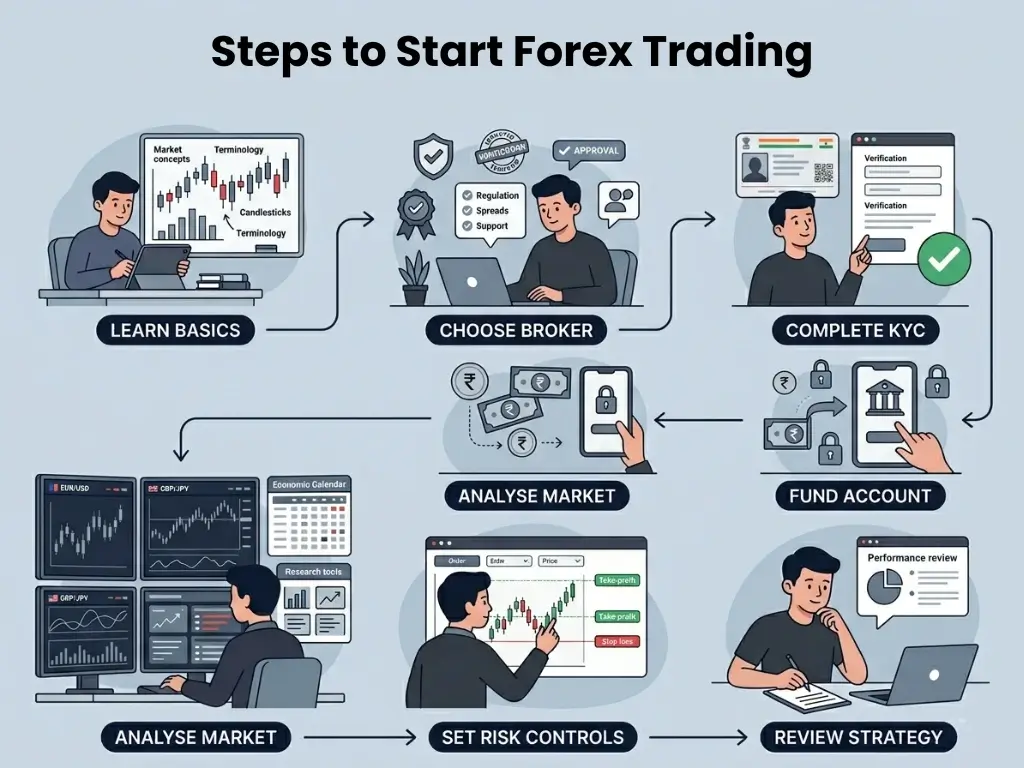
Step 1: Learn the Fundamentals
It can help to understand how currency pairs move, what affects exchange rates, and how leverage can increase both gains and losses. Many traders also take time to learn how to read candlestick charts and to explore common tools such as support and resistance, moving averages, RSI, and MACD – though no tool or indicator can remove the risk of loss.
Forex markets are influenced by a wide range of factors, including central bank policy, inflation data, interest rate expectations, employment reports, commodity prices, and geopolitical developments.
A solid understanding of the basics may help you avoid common beginner mistakes. It’s worth taking time over this step rather than rushing to start trading.
Step 2: Choose A Regulated Broker
Choose a broker that is authorised to offer you forex or forex CFD products. Broker rules, account access, product availability, leverage limits, and payment methods can vary depending on the broker.
In the UK, forex CFD trading is regulated by the Financial Conduct Authority (FCA). Before opening an account, check that the broker is listed on the FCA Register. Depending on your situation, using an FCA-authorised broker may give you access to UK regulatory protections, such as the Financial Services Compensation Scheme (FSCS) and the Financial Ombudsman Service.
When comparing brokers, users commonly review:
- Trading Costs: Spreads, commissions, overnight fees, and other account charges.
- Platform Quality: Access to platforms such as MetaTrader 4, MetaTrader 5, web trading, or mobile apps.
- Market Access: The currency pairs and CFD products available under the relevant broker entity.
- Risk Tools: Stop-loss orders, margin alerts, price alerts, and account monitoring features.
- Support And Education: Customer support availability, platform guides, and educational resources.
Before opening an account, check the broker’s legal documents, regulatory details, and official website. Where possible, compare those details with the FCA Register or other relevant public registers.
Step 3: Complete Account Verification
After that, you will likely need to complete its KYC and account verification process before you can begin trading. This may involve submitting identity documents, proof of address, and account-related information.
The exact requirements can vary by broker entity, and account type. In some cases, additional checks may apply before certain products or features become available.
Step 4: Fund Your Account
Fund your account with a conservative amount that fits your budget and risk tolerance. The minimum deposit and margin required will vary by broker, product type, and market conditions.
Only use funds you can afford to put at risk.
Step 5: Select Your Currency Pair and Analyse the Market
Many traders begin with major currency pairs because they tend to have higher liquidity and tighter spreads. Common examples include EUR/USD, GBP/USD, USD/JPY, AUD/USD, and USD/CAD, although availability depends on the broker and jurisdiction.
Market analysis usually combines both technical and fundamental factors:
- Technical: Moving averages, RSI, MACD, candlestick patterns, support and resistance
- Fundamental: Central bank decisions, inflation data (CPI), US Non-Farm Payrolls, economic growth figures, commodity prices, and geopolitical developments.
Many traders check an economic calendar daily. Volatility around major data releases can move currency pairs sharply, and entering a position without knowing what announcements are scheduled is a common and potentially costly oversight.
Step 6: Place Your Trade with a Stop-Loss and Take-Profit Order
Before entering a trade, many traders define three things:
- Entry price
- Stop-loss level
- Take-profit target
Some traders commonly risk around 1%–2% of their total trading capital on a single trade as part of their risk management approach. As part of forex risk management, traders may place stop-losses at a logical technical level, such as below support for a buy trade or above resistance for a sell trade.
A risk-to-reward ratio of around 1:1.5 to 1:2 is often used by traders as a general reference, depending on strategy and market conditions. Once the trade is live, let your orders manage the outcome. Changing your stop-loss after entering the trade can lead to larger losses than you originally planned for.
Step 7: Review, Journal, and Refine Your Strategy
After each trading session, record the key details of every trade, including your entry and exit price, position size, reasoning, and outcome.
Reviewing your journal regularly can help you spot patterns in your decisions, including what worked well and what needs improvement.
Use this record to adjust your strategy based on your own trading results rather than instinct or outside opinions. As market conditions change over time, regular review can help you keep your approach relevant and consistent.
Over time, a structured trading plan can help turn these review habits into a more disciplined and repeatable approach.
Which Currency Pairs Can You Trade?
The currency pairs available to traders depend on the broker, platform, account type, and local regulations. Some brokers offer major, minor, and exotic currency pairs, while others may provide a more limited selection based on local rules.
Common major currency pairs include:
- EUR/USD (Euro / US dollar)
- GBP/USD (British pound / US dollar)
- USD/JPY (US dollar / Japanese yen)
- USD/CHF (US dollar / Swiss franc)
- AUD/USD (Australian dollar / US dollar)
- USD/CAD (US dollar / Canadian dollar)
- NZD/USD (New Zealand dollar / US dollar)
Major pairs are usually more actively traded than minor or exotic pairs. This may be associated with deeper liquidity, although spreads and execution quality can still vary by market conditions and broker infrastructure.
Before trading any currency pair, users should check whether the product is available in their country and whether it is offered as spot forex, exchange-traded currency derivatives, or forex CFDs.
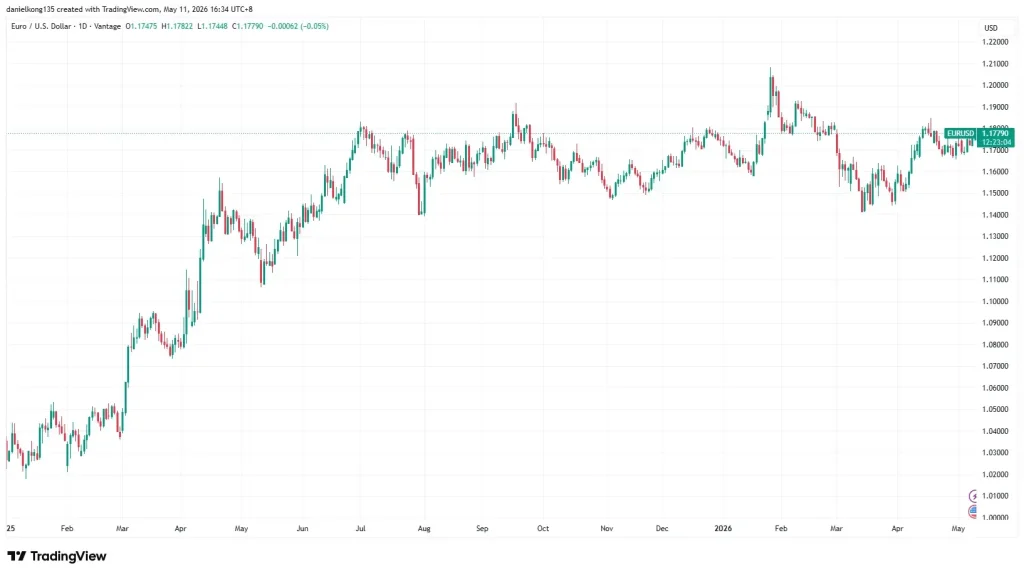
EUR/USD moved in a broad upward trend from early 2025, rising from around 1.03 to a peak above 1.20 in early 2026. After that move, the pair pulled back and traded within a wider consolidation range, with price action mostly holding between the 1.14 and 1.18 areas.
More recently, EUR/USD recovered from its March lows and traded near 1.1780. The pair was testing the upper side of its recent range, although momentum appeared more mixed after the April rebound. Price levels around 1.18 may be monitored by market participants in the context of broader momentum and resistance areas, depending on prevailing market conditions. This information is provided for general market commentary only and does not constitute investment advice or a recommendation to trade.
How Forex Trading Is Regulated?
Forex trading is regulated differently across countries. In some jurisdictions, retail traders can access forex through regulated CFD brokers. In others, forex may only be available through exchange-listed currency products, domestic brokers, or specific approved platforms.
In the UK, the Financial Conduct Authority (FCA) is the regulator for forex and CFD brokers offering services to retail clients. Traders based in the UK should verify that any broker they use holds a valid FCA authorisation.
Regulators may set rules around:
- Broker licensing and authorisation
- Client fund protection
- Leverage limits
- Risk disclosures
- Product availability
- Marketing and advertising
- Complaints and dispute resolution
Because the rules vary by region, traders should check the regulator or financial authority that applies in their country, and the relevant regulatory requirements and protections that apply. They should also review the broker entity they are opening an account with, as larger brokers may operate through different entities in different jurisdictions.
Popular Forex Trading Strategies
Not all traders approach the forex market in the same way. The method used often depends on factors such as trading experience, available time, risk tolerance, market conditions, and personal objectives.
- Day Trading: This involves opening and closing positions within the same trading day. It usually requires close market monitoring, faster decision-making, and disciplined risk controls.
- Swing Trading: This approach involves holding positions for several days or weeks to study broader market moves. Swing traders often monitor technical levels alongside macroeconomic data, central bank policy, and market sentiment.
- Position Trading: This longer-term approach focuses on broader market trends. It may involve holding positions over weeks or months and requires close attention to interest rate expectations, economic cycles, and major geopolitical developments.
- Range Trading: This approach studies markets that move between defined support and resistance levels. It is commonly used when prices show limited directional momentum.
These are only a few of the ways traders approach the forex market. The characteristics, risks, and suitability of any trading approach will depend on an individual’s objectives, financial circumstances, and risk tolerance.
For a broader overview of other methods and styles, read our article on 10 Forex Trading Strategies For Different Trading Styles.
Key Risks Of Forex Trading
Before trading forex, it helps to understand that risk does not come from price movement alone. Market conditions, leverage, liquidity, regulation, timing, and trader behaviour can all affect trading outcomes.
| Risk | What It Means | Why It Matters |
| Leverage risk | Margin trading increases both gains and losses. Even a small move against your position can lead to a much larger loss relative to your deposit. | This is one of the main reasons traders can lose money quickly in the forex market. |
| Liquidity risk | Some currency pairs are easier to buy or sell than others, especially during active market hours. Outside peak hours or near contract expiry, liquidity may fall. | Lower liquidity can make it harder to exit a trade at the expected price, which may lead to slippage. |
| Event risk | Prices can move sharply around central bank decisions, inflation data, employment reports, or geopolitical developments. | Sudden volatility can lead to larger-than-expected price swings. |
| Regulatory risk | Forex rules can differ by country and may change over time. | Changes may affect product availability, leverage limits, broker access, or payment methods. |
| Psychological risk | Emotions can affect decision-making, especially after losses or during periods of volatility. | Emotional responses to market movements may influence trading decisions and risk-taking behaviour, which may be associated with overtrading, chasing losses, etc. |
| Counterparty risk | On unauthorised offshore platforms, there may be no local regulatory protection if the broker delays withdrawals, shuts down, or acts unfairly. | This adds another layer of risk beyond the trade itself. |
Taken together, these risks show that forex trading involves more than choosing a currency pair. Factors such as regulation, product access, platform quality, and trading discipline can all play an important role in affecting trading outcomes.
A More Disciplined Approach To Forex Trading
Forex trading is available in certain jurisdictions through regulated platforms, but access does not mean the rules are the same everywhere. In the UK, the starting point is to confirm that a broker holds a valid FCA authorisation.
For beginners, the focus is often less on finding the “perfect” trade and more on building a clear process. Learning the basics, reviewing risk, checking broker details, and keeping a trading journal can support a more structured approach over time.
Frequently Asked Questions
Is forex trading legal?
Forex trading is legal in many countries, but the rules vary by jurisdiction. In the UK, forex and forex CFD trading is permitted through brokers authorised by the Financial Conduct Authority (FCA).
Some countries allow forex or forex CFD trading through regulated brokers, while others restrict certain products, platforms, leverage levels, or offshore access. Users should check the rules that apply in their home country before using a forex trading platform.
What is the best time to trade forex?
Forex market activity can vary throughout the trading day. The most active forex trading times often occur when major market sessions overlap, such as the London and New York sessions. The London session runs from 8:00 AM to 5:00 PM UK time (GMT in winter, BST in summer), and the New York session runs from 1:00 PM to 10:00 PM UK time.
Their overlap between 1:00 PM and 5:00 PM UK time is often associated with increased market activity and liquidity, although market conditions can vary. However, the most suitable trading time can depend on the currency pair, trading strategy, market conditions, and the trader’s schedule.
How is forex trading taxed?
Forex trading tax treatment varies by country and may depend on whether the activity is classified as investment income, business income, capital gains, or another category. In the UK, forex and CFD trading profits may be subject to Capital Gains Tax or, in some cases, Income Tax, depending on how HMRC classifies the activity. Tax treatment may change over time. Traders should check the tax rules that apply in their country and seek independent tax guidance where needed.
What Should You Look For In A Forex Trading App?
A forex trading app can be compared based on regulation, platform stability, charting tools, order types, execution features, account management, funding options, and risk-management tools. In the UK, check that the app or platform is provided by an FCA-authorised firm. Product availability may vary by country, broker entity, and account type.
Can I trade EUR/USD?
EUR/USD is one of the most actively traded currency pairs globally. In the UK, retail traders can typically access EUR/USD through FCA-authorised forex CFD brokers. However, whether it is available to a specific trader depends on the broker, product type, account entity, and local regulations. Some users may access EUR/USD through forex CFDs, while others may be limited to exchange-traded currency products or locally approved instruments.
What happens if I trade on an unauthorised forex platform?
Using an unauthorised forex platform may expose users to legal, financial, and operational risks. These can include limited complaint channels, reduced regulatory protection, withdrawal issues, or restricted access to dispute resolution. In the UK, trading with an unauthorised firm means you will not have access to the Financial Services Compensation Scheme (FSCS) or the Financial Ombudsman Service. Users should check whether a broker is authorised by the FCA before opening an account.
Do I need a separate account for forex trading?
This depends on the broker and the products available in your country. Some brokers allow users to access forex, commodities, indices, and share CFDs from one account. Others may require separate account permissions, platform access, or product approvals.
Reference
- Global FX trading hits $9.6 trillion per day in April 2025 and OTC interest rate derivatives surge to $7.9 trillion: Triennial Survey – BIS” https://www.bis.org/press/p250930.htm Accessed 21 April 2026
The information has been prepared as of the date published and is subject to change thereafter. The information is provided for educational purposes only and doesn't take into account your personal objectives, financial circumstances, or needs. It does not constitute investment advice. We encourage you to seek independent advice if necessary. The information has not been prepared in accordance with legal requirements designed to promote the independence of investment research. No representation or warranty is given as to the accuracy or completeness of any information contained within. This material may contain historical or past performance figures and should not be relied on. Furthermore estimates, forward-looking statements, and forecasts cannot be guaranteed. The information on this site and the products and services offered are not intended for distribution to any person in any country or jurisdiction where such distribution or use would be contrary to local law or regulation.