
CFDs and Spread Bets are complex instruments and come with a high risk of losing money rapidly due to leverage. 72.65% of retail investor accounts lose money when trading CFDs and Spread Bets with this provider. You should consider whether you understand how CFDs and Spread Bets work and whether you can afford to take the high risk of losing your money.


 Login


SEARCH
-
Search query too short. Please enter a full word or phrase.
-

Keywords
Popular Search


SEARCH
-
Search query too short. Please enter a full word or phrase.
-
Keywords
Popular Search



CFD Trading Explained: What It Is and How to Trade CFDs in the UK

Vantage Editorial Team >
10 November 2026 | Academy | 16 min read
Vantage Editorial Team >
Vantage is a global, multi-asset broker with a team of in-house writers and market analysts who produce educational and insightful trading content for traders of all levels.
Last updated: 4 November 2026
CFD trading is a way to trade on the price of shares, indices, currencies, and commodities without owning them. A CFD, or contract for difference, is an agreement with a broker to exchange the difference in an asset’s price between when you open and close a trade1. If the price moves your way, you gain the difference. If it moves against you, you pay it.
CFDs are leveraged products, so you only put down a fraction of a trade’s value as margin. That makes them flexible, but it also means losses can build quickly. In the UK, CFDs sold to retail clients follow rules set by the Financial Conduct Authority (FCA), and this guide explains how those rules affect you.
CFDs and Spread Bets are complex instruments and come with a high risk of losing money rapidly due to leverage. 72.65% of retail investor accounts lose money when trading CFDs and Spread Bets with this provider. You should consider whether you understand how CFDs and Spread Bets work and whether you can afford to take the high risk of losing your money.
Key Points
- A CFD lets you go long or short on a market without owning it, and your result is the price difference multiplied by your position size. Because CFDs are leveraged, losses can build quickly.
- Rules for retail clients cap leverage at between 30:1 and 5:1 depending on the market, make providers start to close positions when an account drops to 50% of required margin, and stop retail balances from going negative.
- CFD gains may be subject to Capital Gains Tax in the UK, unlike most spread bets. CFDs carry no Stamp Duty, and CFD losses may be set against other gains. Tax treatment depends on individual circumstances and may change in future.
What Is a CFD?
A contract for difference (CFD) is a derivative: its value comes from an underlying market, such as the FTSE 100, GBP/USD, or a UK share like BP. When you trade a CFD, you never own the underlying asset. You only take a position on whether its price will rise or fall1.
That is the core of the CFD meaning: you and the broker agree to settle the difference in price. Because you do not own the asset, you have no voting rights in a company, and you do not pay Stamp Duty on UK share CFDs.9 Tax treatment depends on individual circumstances and may change in future.
What Is a CFD in Trading Terms?
In practice, a CFD is a trade with five parts: the market, the direction (buy or sell), the size, the entry price, and the exit price. Your result is the change in price multiplied by your size, minus trading costs such as the spread, commission, and overnight funding.
How Does CFD Trading Work? 4 CFD Trading Basics
Here is CFD trading explained in four ideas.
1. Going Long or Short
You buy (go long) if you expect the price to rise and sell (go short) if you expect it to fall. Being able to sell first is one of the main differences between CFDs and buying shares.
2. Margin and Leverage
Margin is the deposit needed to open a trade. For example, if the margin rate is 5%, you need £500 to open a position worth £10,000. That is 20:1 leverage. Leverage is a double-edged sword: it magnifies losses in the same way as gains, and both are calculated on the full position size, not on your deposit.
3. The Buy and Sell Price
Every CFD has a buy price and a sell price. The gap between them is the spread, which is the main cost of most CFD trades. You can compare costs on our spreads page.
4. Overnight Funding
If you keep a CFD open past the daily cut-off, a financing charge (often called swap) is usually added or deducted. These charges add up on longer trades, so check the swap rates before holding a position for weeks.
CFD Trading Examples: 2 Trades in Pounds
Here are two hypothetical trades, one long and one short, worked through in pounds so you can see how margin and leverage change the result.
Example 1: Going Long on the FTSE 100
The FTSE 100 closed at about 10,730 on 30 October 20262. Suppose you buy 2 CFDs on the index at that level, and in this hypothetical example each CFD is worth £1 per index point.
| Step | Hypothetical figures |
| Position size | 2 CFDs x £1 per point x 10,730 = £21,460 of exposure |
| Margin at 5% (20:1) | £21,460 x 5% = £1,073 |
| If the index rises 100 points to 10,830 | +£200 before costs, about 18.6% of the margin |
| If the index falls 100 points to 10,630 | -£200 before costs, about 18.6% of the margin |
| If the index falls about 537 points (5%) | -£1,074 before costs, roughly the whole margin for this trade |
Table 1: Hypothetical FTSE 100 index CFD example, using the 30 October 2026 close as the entry level. For illustration only; figures are before spreads, commission, and overnight funding.
A 100-point move is less than 1% on the index, but it changes the trade’s value by almost a fifth of the money you put down. In practice, the 50% margin close-out rule could close the position before a 5% fall, depending on the other funds in your account.
Contract sizes differ by broker and instrument, so always check the specification in your platform before you trade. These figures are hypothetical and before spreads, commission, and overnight funding, which would reduce a gain or increase a loss. Past performance is not a reliable indicator of future results.
Example 2: Going Short on a UK Share
Now suppose a UK share trades at £5.00 and you expect it to fall. You sell 1,000 share CFDs, each matching one share, so your exposure is £5,000. Individual shares carry a 20% margin for retail clients (5:1)3, so the margin is £1,000. (These figures are hypothetical.)
| If the share price moves to | Hypothetical result before costs |
| £4.80 (down 4%) | +£200, about 20% of the margin |
| £5.20 (up 4%) | -£200, about 20% of the margin |
Table 2: Hypothetical short UK share CFD example. For illustration only; figures are before commission, spreads, overnight funding, and any dividend adjustment.
Share CFDs usually also carry a commission on each trade, so check our commission page. If the company pays a dividend while you are short, an adjustment is normally deducted from your account. These costs would reduce a gain or increase a loss.
Understanding CFD Trading Markets: What Can You Trade?
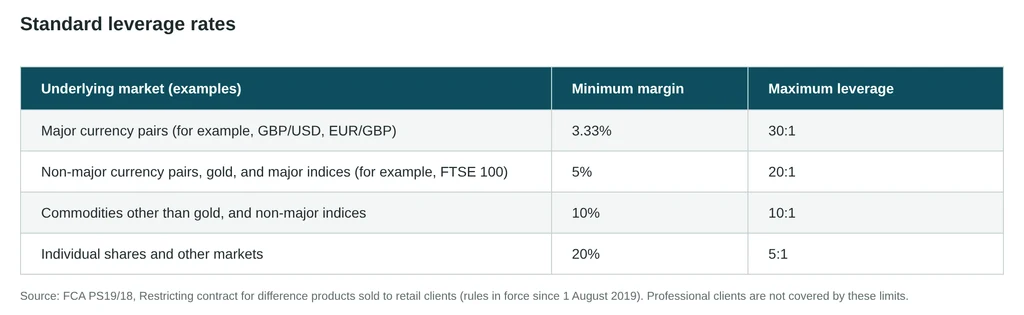
UK traders can use CFDs on most major asset classes. Each one has a different maximum leverage for retail clients under FCA rules3.
- Indices: The FTSE 100, the DAX, and other major global indices, through index CFDs.
- Shares: UK shares such as AstraZeneca, Unilever, and BP, plus international shares. Read more in our guide to stock CFDs.
- Forex: Currency pairs such as GBP/USD and EUR/GBP. See forex trading and our forex CFDs guide.
- Commodities: Gold, oil, and soft commodities such as coffee, through commodity CFDs.
What Is a CFD Trading Account?
A CFD trading account is the account you hold with a broker to open and close CFD positions. It holds your deposit, shows your open trades and margin, and applies the costs and rules for the account type you choose.
At Vantage UK, retail clients can choose between account types such as the Standard STP and Raw ECN accounts, which differ in how spreads and commission are charged. You can also open a demo account to practise with virtual funds. A demo account is simulated, so prices and fills can differ from live trading.
CFD Trading for Professionals
Professional client status is a separate client classification, and it removes several retail protections. At Vantage UK, you may be eligible for a professional account if you meet at least two of these three tests4:
- At least one year of experience in the financial sector, in a professional role that requires knowledge of leveraged OTC derivatives.
- Trading leveraged derivatives in significant sizes over the last four quarters.
- A financial portfolio above EUR500,000.
Professional clients have fewer FCA protections than retail clients. They may lose negative balance protection (so losses can exceed deposits), access to the Financial Ombudsman Service, and FSCS cover. The retail leverage limits do not apply, so the risk of losing money rapidly due to leverage is higher4.
CFDs vs Spread Betting vs Buying Shares
In the UK, CFDs sit alongside two other common ways to trade: spread betting and buying shares directly.
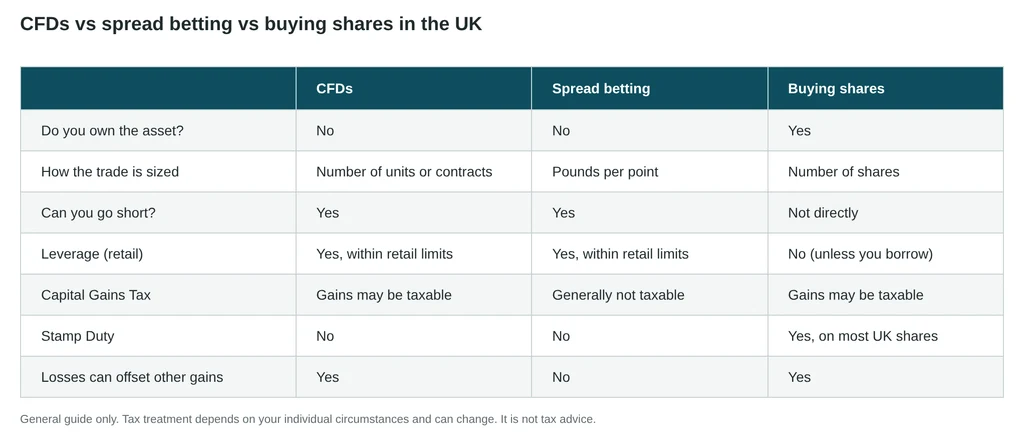
A spread bet is sized in pounds per point and is taxed differently from a CFD. Like CFDs, spread bets are leveraged, so losses can build quickly and can exceed the margin you put up for a position. Tax treatment depends on individual circumstances and may change in future.
The table below shows the main differences between CFDs, spread betting, and buying shares:
For a closer look, read spread betting vs CFDs and CFDs vs stocks, shares, and equities.
CFD Tax UK: How Are CFDs Taxed?
Gains from CFD trading may be subject to Capital Gains Tax (CGT). For the 2026 to 2027 tax year, the annual tax-free allowance is £3,000, and the rates on gains above it are 18% within the basic rate band and 24% above it6. CFD losses may be allowable losses that can be set against other chargeable gains, although in some cases CFD profits are taxed as trading income instead10.
You do not pay Stamp Duty on CFDs, because you never buy the underlying shares.9 Spread betting gains are generally not subject to CGT11, as our guide “Is spread betting tax-free in the UK?” explains. Tax treatment depends on individual circumstances and may change in future, so this is not tax advice. Speak to a qualified adviser if you are unsure.
How to Start CFD Trading in the UK: 6 Steps
- Learn the basics: Understand margin, leverage, and costs before placing a trade.
- Practise on a demo: A demo account lets you test your approach with virtual funds. Demo conditions are simulated and can differ from live trading.
- Choose a market and platform: Trade on MetaTrader 5, TradingView, or the Vantage UK app.
- Size the trade and set a stop-loss: Decide how much you are prepared to lose before you enter. A stop-loss can limit losses, but it does not guarantee your exit price in fast or gapping markets7,8.
- Monitor margin and costs: Watch your margin level, especially when holding positions overnight or around news such as Bank of England decisions.
For ideas on how traders approach different market conditions, read our CFD trading strategies guide and our article on risk management techniques.
Pros and Cons of CFD Trading
| Pros | Cons |
| Trade rising and falling markets | Leverage magnifies losses as well as gains |
| Access many markets from one account | Overnight funding can make long holds costly |
| No Stamp Duty on UK share CFDs | Gains may be subject to CGT |
| Negative balance protection for retail clients (a regulatory requirement) | Fast markets can cause slippage and margin close-outs |
| Most retail accounts lose money |
Table 3: Pros and cons of CFD trading in the UK. Tax treatment depends on individual circumstances and may change in future.
Explore CFD Trading in the UK Now
CFD trading gives UK traders a flexible way to trade shares, indices, forex, and commodities in either direction, within the limits set for retail clients. The same leverage that makes CFDs flexible also makes losses build quickly, so it helps to understand margin, costs, and tax before you trade.
See our markets, compare commission and spreads, or practise first with a demo account. A demo account is simulated, so prices and fills can differ from live trading.
FAQs
Here are short answers to common questions about CFD trading in the UK.
1. What Is CFD Trading in Simple Terms?
CFD trading means agreeing with a broker to exchange the difference in an asset’s price between when you open and close a trade. You never own the asset, and you can trade rising or falling prices.
2. Is CFD Trading Legal in the UK?
Yes. CFD trading is legal in the UK, and firms offering CFDs to UK clients must be authorised by the FCA. Vantage is a trading name of Vantage Global Prime LLP, which is authorised and regulated by the Financial Conduct Authority (FRN 590299).
3. Can You Lose More Than You Deposit With CFDs?
Not as a retail client. FCA rules require negative balance protection, so you cannot lose more than the funds in your CFD account. You can still lose all of those funds5.
4. Do You Pay Tax on CFD Trading in the UK?
CFD gains may be subject to Capital Gains Tax, and there is no Stamp Duty on CFDs6. Tax treatment depends on individual circumstances and may change in future, so check with a tax adviser if you are unsure.
5. Is CFD Trading for Beginners?
CFDs are complex and leveraged, and most retail accounts lose money. If you are new, learn how margin and leverage work, practise on a demo account, and only trade with money you can afford to lose. A demo account is simulated, so prices and fills can differ from live trading.
6. What Is the Difference Between a CFD and a Spread Bet?
Both let you trade price movements without owning the asset. A spread bet is sized in pounds per point and its gains are generally free of CGT, while a CFD is sized in units or contracts and its gains may be taxable. Tax treatment depends on individual circumstances and may change in future.
7. Which CFD Trading Accounts Does Vantage UK Offer?
Vantage UK offers CFD accounts such as the Standard STP and Raw ECN accounts, which differ in how spreads and commission are charged, and a separate Spread Betting account. You can also practise on a demo account, which is simulated, so prices and fills can differ from live trading.
8. What Changes If You Become a Professional Client?
The retail leverage limits no longer apply, and professional clients may also lose negative balance protection, access to the Financial Ombudsman Service, and FSCS cover. That means losses can build faster and can exceed the funds in the account4.
RISK WARNING: CFDs and Spread Bets are complex instruments and come with a high risk of losing money rapidly due to leverage. 72.65% of retail investor accounts lose money when trading CFDs and Spread Bets with this provider. You should consider whether you understand how CFDs and Spread Bets work and whether you can afford to take the high risk of losing your money.
Disclaimer: The information is provided for educational purposes only and doesn’t take into account your personal objectives, financial circumstances, or needs. It does not constitute investment advice. We encourage you to seek independent advice if necessary. The information has not been prepared in accordance with legal requirements designed to promote the independence of investment research. No representation or warranty is given as to the accuracy or completeness of any information contained within. This material may contain historical or past performance figures and should not be relied on. Furthermore, estimates, forward-looking statements, and forecasts cannot be guaranteed. The information on this site and the products and services offered are not intended for distribution to any person in any country or jurisdiction where such distribution or use would be contrary to local law or regulation.
References
- “Understanding Contracts for Difference (CFDs): Uses and Examples – Investopedia” https://www.investopedia.com/terms/c/contractfordifferences.asp. Accessed on 4 November 2026.
- “FTSE 100 edges up but tech woe rocks New York – MarketScreener” https://www.marketscreener.com/news/ftse-100-edges-up-but-tech-woe-rocks-new-york-ce785fdbde81f325. Accessed on 8 November 2026.
- “PS19/18: Restricting contract for difference products sold to retail clients – Financial Conduct Authority” https://www.fca.org.uk/publication/policy/ps19-18.pdf. Accessed on 4 November 2026.
- “Vantage PRO ECN Account – Vantage UK” https://www.vantagemarkets.co.uk/trading/accounts/professional/. Accessed on 4 November 2026.
- “FCA confirms permanent restrictions on the sale of CFDs and CFD-like options to retail consumers – Financial Conduct Authority” https://www.fca.org.uk/news/press-releases/fca-confirms-permanent-restrictions-sale-cfds-and-cfd-options-retail-consumers. Accessed on 4 November 2026.
- “Capital Gains Tax: what you pay it on, rates and allowances – GOV.UK” https://www.gov.uk/capital-gains-tax/rates. Accessed on 4 November 2026.
- “How Stop-Loss Orders Help Limit Investment Losses and Risk – Investopedia” https://www.investopedia.com/terms/s/stop-lossorder.asp. Accessed on 4 November 2026.
- “Understanding Slippage in Finance: Key Insights and Examples – Investopedia” https://www.investopedia.com/terms/s/slippage.asp. Accessed on 4 November 2026.
- “STSM118040 – Derivatives: introduction to contracts for difference: contracts for difference – stamp implications – HMRC internal manual – GOV.UK” https://www.gov.uk/hmrc-internal-manuals/stamp-taxes-shares-manual/stsm118040. Accessed on 8 November 2026.
- “CG56100 – Futures: financial futures: contracts for differences – HMRC internal manual – GOV.UK” https://www.gov.uk/hmrc-internal-manuals/capital-gains-manual/cg56100. Accessed on 8 November 2026.
- “CG56105 – Futures: financial futures: financial spread betting – HMRC internal manual – GOV.UK” https://www.gov.uk/hmrc-internal-manuals/capital-gains-manual/cg56105. Accessed on 8 November 2026.
Key Points In This Article

Latest Academy Articles


Market News Tags
- # Asian Markets News Today
- # Crude Oil News Today
- # Earnings News Today
- # Economic News Today
- # Featured News
- # Federal Reserve News
- # Commodity Market News
- # Interest Rate News
- # Financial News
- # Forex News Today
- # Gold News Today
- # Market News Today
Related Articles
- 5 Bank Stocks in Focus for 2026: Sector Outlook, Key Themes, and Market Drivers
- Dell Stock Overview: A Look at Dell Technologies Inc
- Swipe Right And Discover 3 Dating App Stocks in the UK
- Trading Central Bank Announcements in Forex: Capitalising on Market Reactions
- AI Bubble or Healthy Correction? What UK Traders Should Watch Into 2027
- NVIDIA (NASDAQ: NVDA) Stock Outlook for UK Traders: Latest Earnings, Analyst Ratings, and Trading Hours
- Herd Mentality in Trading: Worked Examples and How to Avoid It
- How to Calculate Gold Pips (XAUUSD) in the UK: Pip Value Guide With Examples