
CFDs and Spread Bets are complex instruments and come with a high risk of losing money rapidly due to leverage. 72.65% of retail investor accounts lose money when trading CFDs and Spread Bets with this provider. You should consider whether you understand how CFDs and Spread Bets work and whether you can afford to take the high risk of losing your money.


 Login
Login

SEARCH
-
Search query too short. Please enter a full word or phrase.
-

Keywords
Popular Search


SEARCH
-
Search query too short. Please enter a full word or phrase.
-
Keywords
Popular Search



Gold Trading Signals in 2026: A Guide to Finding & Using Them

Vantage Editorial Team >
3 June 2026 | Academy | 30 min read
Vantage Editorial Team >
Vantage is a global, multi-asset broker with a team of in-house writers and market analysts who produce educational and insightful trading content for traders of all levels.
Key Takeaways
- Gold trading signals are real time or scheduled alerts that suggest potential buy or sell opportunities in XAU/USD.
- Signals can come from broker integrated tools, standalone apps, messaging channels, or subscription-based services.
- Not all signal providers are reliable. Knowing how to evaluate them is as important as the signal itself.
- CFD trading on gold involves significant risk. Signals are one of the many tools that may be used as a part of your strategy, not replace it – and signals do not guarantee outcomes.
Gold trading signals are real-time or scheduled alerts that flag potential buy or sell opportunities in the XAU/USD market. For traders looking to sharpen their approach to gold CFDs, understanding how to find, evaluate, and apply these signals effectively can make a meaningful difference to their trading process.
This guide covers: what gold signals are, where to find them, how to assess their quality, and four key strategies for putting them to work in your trading. Whether you are exploring free gold trading signals or researching premium providers, the information here will help you make more informed decisions.
What Are Gold Trading Signals?
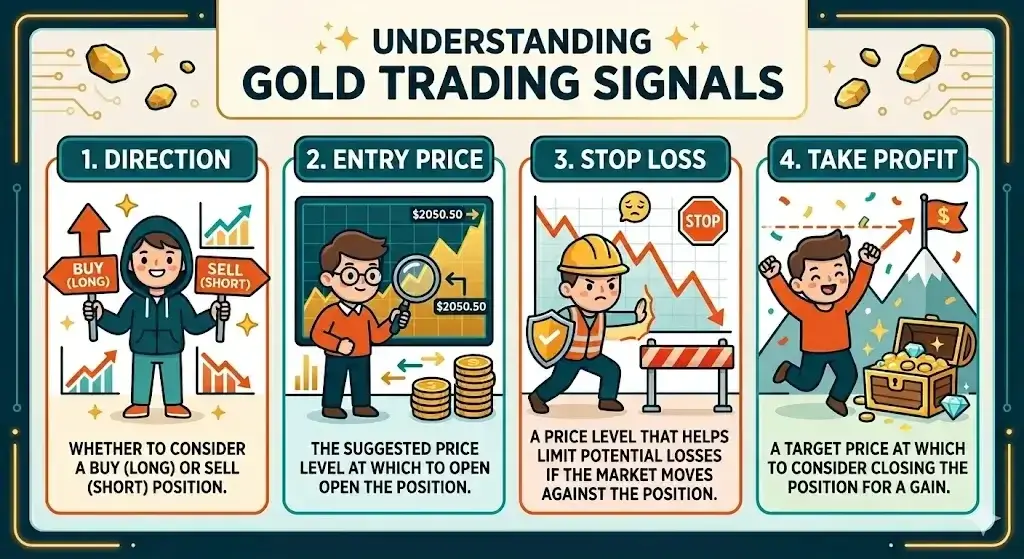
A gold trading signal is an alert, typically generated by technical analysis, algorithmic systems, or experienced market analysts, that suggests a potential action in the XAU/USD market. Most signals include:
- Direction: Whether to consider a buy (long) or sell (short) position
- Entry price: The suggested price level at which to open the position
- Stop loss: A price level that helps limit potential losses if the market moves against the position
- Take profit: A target price at which to consider closing the position for a gain
Signals can be generated manually by analysts who combine macroeconomic research with chart reading, or automatically by algorithmic systems that identify patterns based on historical data. The delivery method varies too: some arrive by push notification through a trading app, others via email, messaging channels, or directly within a broker’s platform.
It is important to understand that no signal is infallible. Even the most accurate signal provider will have losing trades. Signals are a tool to inform your decision making, not a guarantee of outcome.
Why Traders Use Gold Signals
Gold (XAU/USD) is one of the most actively traded instruments in the world. Its price is influenced by a complex mix of factors including US dollar strength, interest rate expectations, geopolitical tensions, central bank demand, and inflation data. This complexity is part of why some traders look to signals as one source of market information.
Gold signals may help traders to:
- Save time on analysis by distilling multiple data points into a single actionable alert
- Stay disciplined by providing pre-defined entry, stop loss, and take profit levels
- Identify opportunities they may have missed through their own analysis
- Learn from experienced analysts by studying the rationale behind each signal
However, using signals without understanding the underlying reasoning carries its own risks. Traders who rely solely on signals without developing their own market knowledge may find it difficult to manage open positions if market conditions shift unexpectedly.
Where to Find Gold Trading Signals
One of the most common questions from new and intermediate traders is simply: where do I get gold signals? The answer depends on your trading style, budget, and how hands on you want to be. Below are the main sources traders use today.
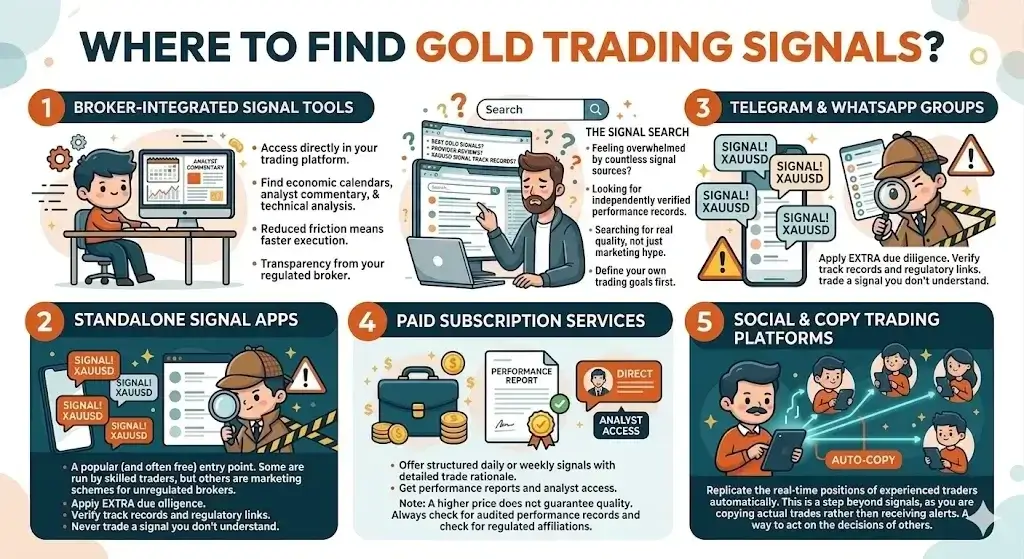
1. Broker-Integrated Signal Tools
Many regulated brokers, offer access to signal tools and market analysis directly within their trading platforms. These may include economic calendars, analyst commentary, and technical analysis dashboards on gold and other major instruments. Because they sit within the platform you are already trading on, they reduce friction and allow for faster execution when you spot an opportunity.
Broker-integrated tools also tend to be more transparent. You know who is behind the analysis, the broker has regulatory obligations around the information it provides, and the context of the signal is clearly framed within the platform.
2. Standalone Signal Apps
A number of independent applications provide live gold trading signals as their core product. These apps typically use algorithmic or AI-driven analysis to scan the XAU/USD market and push alerts to subscribers. Some of the better known platforms in this space offer performance histories and transparency around their methodology, which makes them easier to evaluate.
When using standalone apps, it is worth verifying whether the signals are based on real-time data or are delayed, and whether the provider has a verifiable track record rather than just a marketing claim of high win rates.
3. Groups on Messaging Channels
Free gold signals via messaging channels such as Telegram and WhatsApp are widely circulated and are often accessed by retail traders. Some of these groups are run by genuinely experienced traders or analysts who share their analysis publicly. Many others, however, are used as marketing funnels for unregulated brokers or signal selling schemes. Therefore it is important to note that the quality, reliability, and oversight of these channels can vary significantly.
If you choose to use signals from these channels, apply extra due diligence. Check for a verifiable track record, assess whether the group or channel is associated with any regulated entity, and never commit to trading a signal you do not understand.
4. Paid Subscription Services
Premium signal services may offer a more structured product: daily or weekly signals, detailed trade rationale, performance reports, and sometimes direct access to the analyst via a members community. Costs vary widely, from modest monthly fees to high-ticket subscriptions.
As with any financial service, a higher price does not automatically mean higher quality. Always look for independently audited performance records and check whether the provider is associated with any regulated financial service.
5. Social Trading and Copy Trading Platforms
Social trading platforms allow traders to observe or automatically replicate the positions of more experienced traders in real time. While this is technically a step beyond signals (you are copying actual trades rather than receiving an alert), it functions similarly for traders who want to act on the decisions of others.
These platforms typically display detailed performance statistics for each trader you can follow, which makes comparison easier. As with any form of following another person’s trading activity, past performance is not a reliable indicator of future results.
Types of Gold Signal Providers: A Quick Comparison
| Provider Type | Signal Delivery | Pros | Cons |
| Broker-integrated tools | In-platform / Email | Regulated, convenient, no extra cost | Scope and methodology may vary by provider; May be less specialised |
| Standalone signal apps | Push notification / App | May provide real-time alerts, algorithm driven, scalable | Quality varies widely; require verification |
| Telegram / WhatsApp groups | Instant message | Often free, accessible, community driven | High risk of scams; no regulatory oversight |
| Paid subscription services | Email / Dashboard | May provide detailed rationale with market commentary and analysis, dedicated support | Cost; no guarantee of accuracy |
| Social / Copy trading | Automatic replication | Allows users to observe the trading activity of others | You are following others, not learning yourself; Trading outcomes remain uncertain and may not reflect future performance |
How to Evaluate a Gold Signal Provider
Given the volume of signal providers available today, the ability to critically assess their quality is one of the most valuable skills a trader can develop. The following checklist covers the key criteria to consider.
Transparency of Methodology
A credible signal provider should be able to explain how their signals are generated. Whether it is based on moving average crossovers, RSI divergence, AI pattern recognition, or fundamental analysis, the methodology should be clearly stated. Vague claims like ‘proprietary AI’ with no further detail should be treated with caution.
Verified Performance Record
Past performance is not a guarantee of future results, but a verifiable track record is still more valuable than a claimed one. Look for providers who publish results that can be independently verified, whether through a third-party auditing service, a public trading account with a recognised platform, or another transparent mechanism. Be particularly sceptical of win rate claims above 80-90% with no context around risk-to-reward ratios.
Risk Management Information
Signal information may include entry levels, stop-loss levels, and take-profit levels, which provide additional context regarding the underlying market view and risk assumptions.
Providers who issue only directional calls (‘buy gold now’) without any risk parameters are not giving you a tradeable signal; they are giving you a market opinion. A signal without defined risk parameters is incomplete.
Regulatory Status
If a signal provider is also offering financial advice or managing funds, they may be subject to regulatory requirements depending on their jurisdiction. In the UK, the Financial Conduct Authority (FCA) regulates financial service providers offering investment signals, and traders should check whether any service they use is appropriately authorised.
In other jurisdictions, equivalent bodies perform a similar role. Using services associated with regulated entities generally offers more recourse if something goes wrong.
User Reviews and Community Reputation
Independent community discussions on platforms like Reddit’s r/Forex or trading focused forums can provide useful real world perspectives on a signal provider. Look for specific, detailed accounts from traders with a posting history, rather than generic five-star reviews with no substance.
Refund and Cancellation Policy
For paid services, a clear and fair cancellation policy is a basic indicator of a legitimate business. Services that make it difficult to cancel or that do not offer any form of trial period should be approached carefully.
Signal Provider Evaluation Checklist
| Criterion | What to Look For | Red Flag |
| Methodology | Clear explanation of how signals are generated | Vague ‘proprietary algorithm’ with no detail |
| Track record | Audited or third-party verified performance history | Unsubstantiated win rate claims (e.g. ‘95% accuracy’) |
| Risk parameters | Inclusion of risk management parameters such as stop loss and take profit with every signal | Directional calls only, limited to no information regarding downside risks or risk management |
| Regulatory status | Regulatory oversight where applicable | Unclear regulatory status or limited information regarding the provider |
| Transparency | Named analysts or verifiable provider identity | Anonymous with no traceable credentials; Limited information regarding ownership, identity, or operations |
| Community reviews | Specific reviews on independent forums (Reddit, etc.) | Feedback that appears repetitive, unverifiable, lacking detail, or nly reviews on the provider’s own website instead of independent forums |
| Fees and Terms | Free trial period or clear refund terms | Unclear fees; no trial; aggressive upselling; no cancellation path |
Four Strategies for When Reviewing Gold Signals
Receiving a signal is only part of the process. How you act on it, and the broader strategy you apply around it, determines the result. Below are four approaches that traders may use when incorporating gold signals into their trading.
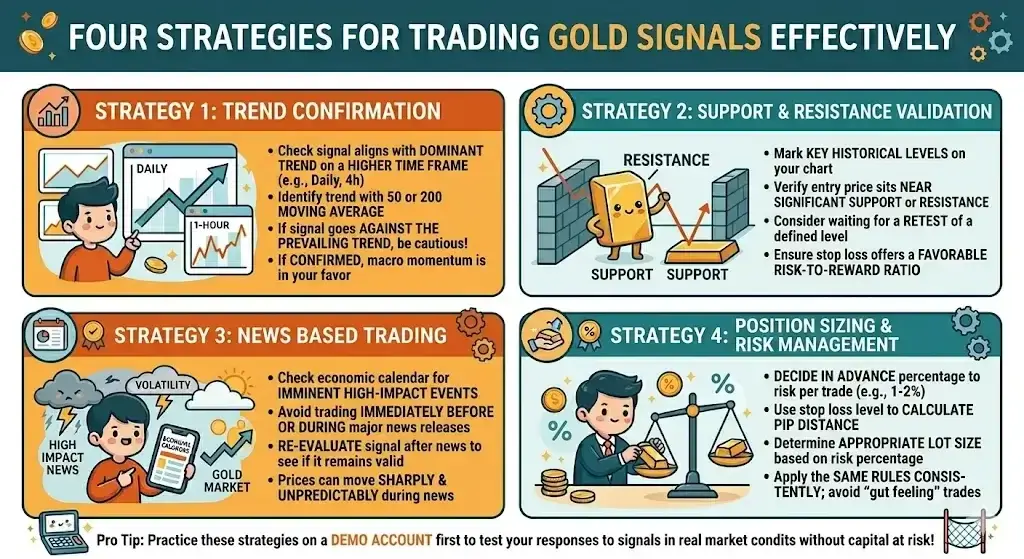
Strategy 1: Trend Confirmation
Before acting on a signal, check whether it aligns with the dominant trend on a higher time frame. If the daily chart shows XAU/USD in a clear uptrend (a series of higher highs and higher lows), a buy signal on the 1-hour chart is more likely to have the macro momentum in its favour. Conversely, a sell signal that goes against the prevailing trend may face more resistance.
- Identify the higher time frame trend using a 50 or 200 period moving average on the daily or 4-hour chart.
- Check whether the signal direction aligns with that trend.
- If the signal is counter trend, apply greater scrutiny or reduce your position size.
- If confirmed, apply the signal’s stop loss and take profit levels as specified.
Strategy 2: Support and Resistance Validation
Some traders review technical levels before entering on a signal, and verify whether the entry price sits near a meaningful support or resistance level.
- Mark key historical support and resistance zones on your chart.
- Check whether the signal’s entry price is near, or recently bounced from, one of these zones.
- If the entry is away from any significant level, consider waiting for a retest that brings price closer to a more defined level.
- Use the signal’s stop loss placement as a guide to assessing whether the trade offers a favourable risk-to-reward ratio.
Strategy 3: News Based Trading
Gold is sensitive to macroeconomic data, particularly US inflation figures, employment data, and Federal Reserve communications. Trading a gold signal immediately before or during a major news release significantly increases risk, as prices can move sharply and unpredictably.
- Before acting on a signal, check an economic calendar for any high impact events within the next hour.
- If a significant release is imminent, consider whether the potential volatility aligns with the signal’s stop loss parameters.
- After the news event, re-evaluate whether the signal’s original premise remains valid.
- Avoid holding positions open through consistently high-impact events unless you have clearly defined risk parameters in place.
Strategy 4: Position Sizing and Risk Management
A gold signal tells you where to consider entering. It does not tell you how much to risk. Applying consistent position sizing is arguably more important than the quality of any individual signal.
- Decide in advance what percentage of your account balance you are prepared to risk per trade (some traders consider using 1-2%, but this is for general information only and not a personal recommendation).
- Use the signal’s entry price and stop loss level to calculate the pip distance.
- Work backwards from your risk percentage to determine the appropriate lot size for the trade.
- Do not adjust your position size upward simply because a signal ‘feels’ more confident. Apply the same rules consistently.
Practising these strategies on a demo account before applying them to a live account is a sensible step for any trader. A demo account allows you to test how you respond to signals in real market conditions without any capital at risk.
Live Gold Trading Signals: What to Expect in Real Time
Live gold trading signals are alerts delivered in real time, or as close to it as possible, based on current market conditions. Given the speed at which XAU/USD can move during key economic releases (such as US Non-Farm Payrolls, CPI data, or Federal Reserve announcements), the timing of a live signal may materially affect its value.
When evaluating a live signal service, consider:
- Latency: How quickly does the signal arrive after a trigger condition is met? A delayed signal in a fast-moving market may already be invalidated by the time it reaches you.
- Context: Does the signal provider explain what is driving the alert? A signal issued during a high-impact news event carries different risks than one issued in a quiet, range-bound session.
- Frequency: High frequency signal services may create pressure to act constantly, which some individuals may find difficult to assess or manage consistently and may even lead to overtrading. Consider whether the frequency of signals aligns with your own trading style and schedule.
The key trading sessions for gold also affect the quality and relevance of live signals. The London and New York sessions, which overlap for several hours each trading day, typically produce the highest liquidity and volatility in XAU/USD and tend to be when the most actionable signals arise.
Key XAU/USD Trading Sessions
| Session | Time (GMT) | Characteristics | Signal Relevance |
| Sydney | 22:00 – 06:00 | Low volatility, thin liquidity | May be associated with lower signal activity; watch for Asian central bank news |
| Tokyo | 00:00 – 09:00 | Moderate activity; yen related moves can affect gold | May be relevant if JPY or Asian macro news is in focus |
| London | 08:00 – 17:00 | High liquidity; European economic data | Often associated with increased market activity and more active signal environment; watch for UK/EU data releases |
| New York | 13:00 – 22:00 | Highest volatility; US economic releases dominate | Most impactful session for gold signals; Fed events key |
| London/NY Overlap | 13:00 – 17:00 | Peak liquidity and volume across both markets | Prime window for live gold signals; highest activity |
Note: The information above is provided for general informational and educational purposes only. The characteristics of different trading sessions may vary depending on market conditions and are not intended as a recommendation or indication that trading opportunities will arise during any particular period.
Free Gold Trading Signals: Pros, Cons, and How to Vet Them
Free gold trading signals are widely available, and the appeal is obvious. However, free does not always mean useful, and it rarely means low-risk. The quality, methodology, and reliability of such signals can vary significantly. Understanding the potential benefits and limitations of free signals is an important part of evaluating any information source. Here is how to think about them.
The Case for Free Signals
Not all free signal providers are low quality. Some experienced traders share their analysis publicly as a way of building a community or as part of a broader educational offering. Educational platforms affiliated with regulated brokers may also provide free signals or market commentary as part of their academy content. In these cases, free signals can be a genuine learning resource.
The Risks of Free Signals
The most significant risk with free gold signals, particularly those distributed via messaging channels or social media, is the lack of accountability. Anyone can claim to be a gold trading expert and issue signals online. Without a verifiable track record, regulatory backing, or any accountability mechanism, there is no way to assess whether the signals are based on genuine analysis or are designed to manipulate market participants.
In some cases, free signal channels are used to artificially move prices in illiquid instruments or to funnel users toward unregulated brokers offering high leverage with insufficient risk disclosures. Users should independently assess any products, services, or providers referenced in connection with a signal service.
How to Vet Free Signal Sources
- Look for provider that makes historical signals or performance information publicly available, for example, consider at least a minimum of 3 months of public, timestamped signal history before the current date.
- Check whether the provider also offers educational content, explains the methodology, assumptions, or analysis underlying its signals, which suggests a genuine interest in teaching rather than just selling.
- Search for the provider name on independent trading communities and financial watchdog sites.
- Check whether the signals are associated with a regulated broker or financial entity.
- Never deposit funds with a broker recommended by a free signal provider without conducting independent due diligence on that broker’s regulatory status.
Applying Gold Signals in a CFD Trading Environment
Once you have identified a signal source you trust, the next practical question is how the mechanics of your trading environment affect the way you act on it. For a number of retail traders, gold is accessed through Contracts for Difference (CFDs) rather than the physical commodity or futures markets. Understanding how CFDs work is therefore a prerequisite for using signals effectively, not an afterthought.
A gold CFD allows you to take a view on the price of XAU/USD, up or down, without owning the underlying metal. The position is opened and closed entirely within your broker’s platform, and any profit or loss is settled in cash. This flexibility is one reason CFDs are commonly used for short-term trading strategies, including signal-based trading: you can act quickly in either direction, and position sizes can be scaled to match your risk tolerance.
That said, the same features that make CFDs accessible also introduce variables that a signal alone will not account for. Before placing a trade based on any alert, it is worth understanding how the following factors interact with the signal you have received:
- Leverage: CFDs are leveraged products, meaning your margin deposit controls a position larger than its face value. A signal may identify a particular market review, but leverage means that even a modest move against your position can result in a loss that exceeds your initial margin. Always size your position relative to your account, not the signal’s implied confidence. Users should also ensure they understand the impact of leverage and associated risks before trading CFDs.
- Overnight financing (swap rates): Signals that suggest holding a position for more than one trading session could incur overnight swap charges. On longer-duration signals, these costs can meaningfully affect the net outcome of a trade that otherwise hits its take profit target. Check your platform’s swap rates for XAU/USD before holding positions overnight.
- Execution and spreads: A signal’s entry price is indicative only. In live market conditions, your actual fill price will depend on prevailing spreads and available liquidity at the moment you place the order. During periods of high volatility, such as around major US data releases, spreads on gold can widen temporarily. This is worth factoring in when assessing whether a signal’s risk-to-reward ratio remains intact at the time of execution.
- Margin requirements: Open positions require maintained margin. If the market moves against you before hitting a stop loss, your broker may issue a margin call or may even close out one or more of your open positions. Keeping a clear view of your overall exposure relative to your account balance is as important as the quality of any individual signal. Understanding margin requirements and overall account exposure is an important aspect of CFD trading.
Traders interested in gold CFD trading may wish to review the trading platforms, market information, educational materials, and risk disclosures made available by their chosen provider.
How to Stay Updated with Gold Signals Today
For traders who want to stay informed on a daily basis, building a routine around gold market analysis is more reliable than depending on any single signal provider. A well-structured daily process might include:
- Morning review: Check the previous session’s price action on the XAU/USD daily and 4-hour chart. Note any key levels tested overnight.
- Economic calendar check: Identify any high impact US or global data releases scheduled for the day.
- Signal review: If using a signal service, review any alerts issued during the Asian session for context.
- Position assessment: If holding open positions, review whether the original trade thesis remains valid given overnight developments.
- End of day notes: Record what happened, how signals performed, and what you would do differently. A trading journal is one of the most under utilised tools in a retail trader’s kit.
Staying current with gold market drivers, US dollar strength, central bank policy, geopolitical risk, and inflation data, gives you a framework to contextualise any signal you receive rather than acting on it in isolation.
Frequently Asked Questions (FAQ) about Gold Trading Signals
Where can I find reliable gold trading signals?
Reliable gold signals can be found through several channels: broker-integrated analysis tools, reputable standalone signal apps with verified track records, and vetted paid subscription services from analysts with publicly audited performance histories.
When assessing any provider, it would be useful to consider factors such as transparency of methodology, clear risk parameters (stop loss and take profit), and verifiable past performance over marketing claims.
Are free gold trading signals legitimate?
Some free gold signals are genuinely produced by experienced traders who share their analysis publicly. Many others, however, may be associated with marketing funnels, unregulated brokers, or speculative social media accounts with no verifiable track record. The quality and reliability of free gold trading signals can vary significantly depending on the provider.
Free signals can be a useful supplementary resource but should never be your sole source of market intelligence. Always vet the source as rigorously as you would a paid service, and never deposit funds with a broker recommended by a free signal channel without independently verifying that broker’s regulatory credentials.
What is the difference between a gold signal and a gold trading strategy?
A signal is a specific, time-bound alert suggesting a potential trade action: direction, entry price, stop loss, and take profit. A strategy is a broader framework that defines how and when you trade, including position sizing, risk management rules, and the conditions under which you act on or ignore signals. Signals are most effective when applied within a consistent strategy, rather than acted on in isolation.
How accurate are gold trading signals?
Accuracy varies significantly between providers and over time. No signal provider has a perfect record, and headline win rate figures can be misleading without context around risk-to-reward ratios. A provider with a 60% win rate but a consistent 1:2 risk-to-reward ratio may deliver better long-term results than one claiming 90% accuracy with poor risk management.
Always assess performance in terms of net outcome over a statistically meaningful sample size, not just the percentage of winning trades. Always keep in mind that past performance is not a reliable indicator of future results.
Can I use gold signals on a demo account?
Many signal services can be used alongside a demo trading account, depending on the platform and provider involved, and doing so is recommended before applying any signal strategy to a live account.
Trading signals on a demo account allows you to assess their quality, test your execution process, and refine your position sizing approach without risking real capital. Vantage Markets also offers a demo trading account that mirrors live market conditions using virtual funds.
Are gold trading signals regulated?
The provision of investment signals can be subject to regulation depending on the jurisdiction and the nature of the service. In the UK, the Financial Conduct Authority (FCA) regulates financial service providers, including those offering investment signals.
Many signal services, particularly those operating via messaging channels or social media, are not regulated and operate in a legal grey area. In other jurisdictions, equivalent regulators perform a similar role. Where possible, choose signals or analysis that come from, or are associated with, a regulated financial entity.
What is the best time of day to use gold trading signals?
It is important to note that market conditions can vary significantly, and no particular trading session guarantees trading opportunities or outcomes. The relevance of any signal will depend on prevailing market conditions at the time it is issued.
The London session (08:00-17:00 GMT) and the New York session (13:00-22:00 GMT), particularly their overlap between 13:00 and 17:00 GMT, offer the highest liquidity and volatility for XAU/USD. Signals issued during these windows tend to have tighter spreads and more reliable execution conditions. Signals issued during the low-liquidity Sydney and Tokyo sessions may be valid but carry a higher risk of slippage and price gaps.
Key Points In This Article

Latest Academy Articles


Market News Tags
- # Asian Markets News Today
- # Crude Oil News Today
- # Earnings News Today
- # Economic News Today
- # Featured News
- # Federal Reserve News
- # Commodity Market News
- # Interest Rate News
- # Financial News
- # Forex News Today
- # Gold News Today
- # Market News Today
Related Articles
- XAU/USD Trading Strategies: Why Gold Does Not Always Rise in a Crisis
- How to Calculate Gold Pips (XAUUSD): Pip Value & Calculator Guide
- 7 Gold Trading Platforms & Brokers to Check Out in 2026
- Gold as a Safe Haven: Timeless Truth or Outdated Myth?
- Is Gold Trading Profitable? What You Need to Know Before You Start
- How to Trade Gold and Silver: Strategies, Analysis and Market Mechanics
- 10 Best Gold ETFs for Global Investors in 2026
- How to Trade Gold