

 Login
Login



 Updated
Key Takeaways
- Gold is one of the world’s most actively traded commodities, with price movements driven by clear, trackable macroeconomic forces.
- There are several ways to trade gold — from physical ownership to ETFs — but CFDs offer the most flexibility for active traders looking to act on both rising and falling prices.
- Profitability is never guaranteed. Gold trading carries significant risk, and a large proportion of retail traders lose money.
- Understanding how your chosen instrument works — including how leverage operates — is the essential first step.
- The right starting point for most new traders is a demo account with small, carefully managed positions built on a clear strategy.
Is Gold Actually Worth Trading?
Gold has captured the attention of traders and investors for centuries, and in today’s market, that interest is as strong as ever. Every week, millions of people search for answers to a simple but important question: can you actually make money trading gold?
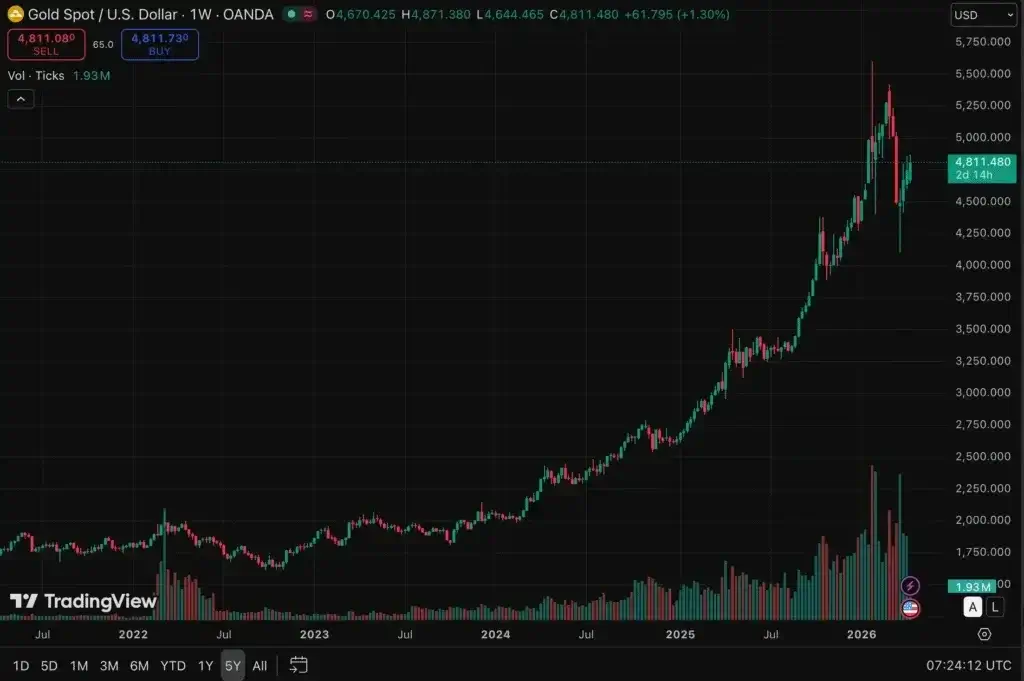
Yes, gold trading can lead to potential returns, but it also carries significant risk. Outcomes depend on several factors, including market conditions, trading knowledge, platform tools, risk management, and how a trader responds to volatility. Without a structured approach, losses can occur quickly.
This guide is written for those who are still learning how gold trading works. It explains what may influence gold prices, how different trading methods work, and why the chosen instrument can matter as much as the strategy used to analyse the market.
How Do People Trade Gold?
Before asking whether gold trading is profitable, it’s worth understanding the different ways traders gain exposure to gold. Each has its own risk profile, cost structure, and flexibility, and the differences matter.
Physical Gold
Buying gold bars or coins is the oldest and most straightforward form of gold ownership. You own something tangible, and its value rises and falls with the gold price. However, this is investing rather than active trading. There’s no ability to profit from falling prices, storage and insurance costs apply, and it offers very limited flexibility for short-term traders.
Gold ETFs
Exchange-traded funds that track the gold price are popular with longer-term investors. They are generally easy to buy through a standard brokerage account, although risk levels can vary, especially for leveraged ETFs or products that may magnify both gains and losses. However, they are designed for investors with a longer time horizon, not active traders looking to capitalise on day-to-day price movements.
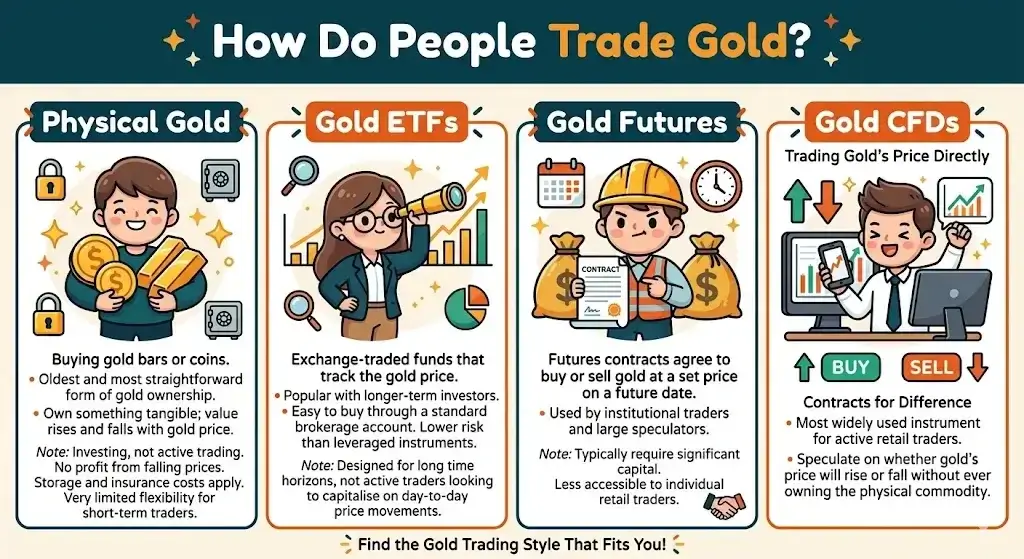
Gold Futures
Futures contracts allow traders to agree to buy or sell gold at a set price on a future date. They’re used by institutional traders and large speculators, but they typically require significant capital and are less accessible to individual retail traders.
Gold CFDs — Trading Gold’s Price Directly
For active retail traders, Contracts for Difference (CFDs) have become the most widely used instrument for trading gold. A gold CFD allows you to speculate on whether gold’s price will rise or fall — without ever owning the physical commodity.
What makes CFDs particularly suited to active gold traders:
- Two-directional trading: You can go long (buy) if you believe gold’s price will rise, or go short (sell) if you think it will fall. Physical gold and most ETFs only allow you to profit from rising prices.
- Access to leverage: CFDs are leveraged products, which means you can control a larger position with a smaller upfront deposit (known as margin). This amplifies both potential gains and potential losses.
- No ownership costs: Trading gold via CFDs does not involve physical storage, insurance, or custody costs. However, CFD trading may involve other fees, such as spreads, overnight financing charges, or commissions, depending on the provider and account type.
- Flexible position sizes: CFDs allow you to size positions precisely according to your risk tolerance and account balance.
- Nearly 24-hour market access: Gold CFDs trade almost around the clock on weekdays, enabling traders to react to global news events as they happen.
It’s this combination of flexibility and accessibility that has made CFD trading the go-to method for retail traders who want active exposure to gold’s price movements — rather than simply holding it as a long-term investment.
What Drives the Gold Price?
Understanding what moves gold is fundamental to trading it profitably. Gold’s price is not random — it responds to a relatively small set of well-understood macroeconomic forces, which is one of the reasons many traders are drawn to it.
The US Dollar
Gold is priced globally in US dollars. As a general rule, when the dollar weakens, gold becomes cheaper for international buyers — demand rises, and the price typically follows. When the dollar strengthens, gold can face downward pressure. Tracking the DXY (US Dollar Index) is a foundational part of most gold traders’ daily routine.
Interest Rates
Gold does not pay interest or dividends. When interest rates rise, the opportunity cost of holding gold increases — money can earn more in savings accounts or bonds, making gold comparatively less attractive. When rates fall or are expected to fall, gold often becomes more appealing to investors and traders alike.
This is why Federal Reserve meetings and central bank policy statements are among the most closely watched events in the gold market.
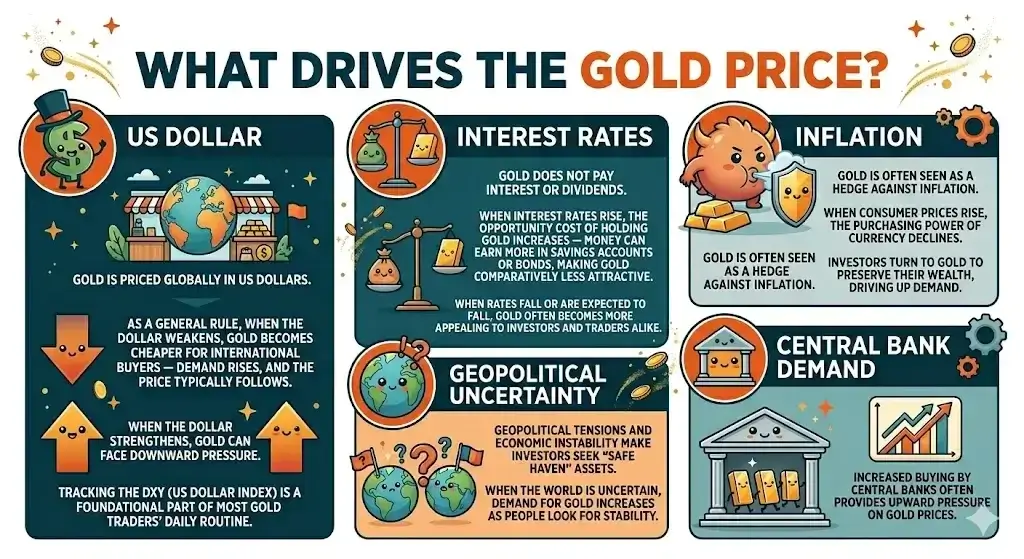
Inflation
Gold has a long-standing reputation as a hedge against inflation. When the purchasing power of fiat currencies is eroding, demand for gold as a store of value tends to rise. High or rising inflation data often provides a bullish catalyst for gold prices.
Geopolitical Uncertainty
Gold is widely considered a safe-haven asset. During periods of geopolitical instability — conflicts, trade disputes, or systemic financial stress — investors and traders tend to move capital into gold, driving its price higher. This is what traders refer to as “risk-off” sentiment.
Central Bank Demand
Large-scale gold purchases by central banks — particularly those of emerging market economies diversifying away from dollar reserves — can have a meaningful impact on longer-term price direction.
For CFD traders, understanding these drivers is not just academic. It’s what allows you to build a rational thesis for a trade, rather than simply guessing at price direction.
The Real Profitability Picture: Opportunity and Risk
Gold trading presents genuine profit potential — but it also carries genuine risk. Any honest assessment has to hold both truths at once.
Where the Opportunity Lies
Gold moves. Unlike some assets that trade in tight ranges for extended periods, gold frequently offers defined trends, clear reactions to macroeconomic events, and predictable technical patterns that experienced traders can work with. Its high liquidity ensures that orders are filled efficiently and spreads remain competitive. With CFDs, traders can pursue profitability in rising and falling markets — a significant advantage over instruments that only allow long exposure. And with leverage, even relatively modest price moves can translate into meaningful returns on the capital deployed.
Where the Risk Lives
Leverage is the same force that amplifies profits — and it amplifies losses with equal precision. A 2% adverse move in gold’s price can result in a far larger percentage loss on your margin if leverage is applied aggressively and position sizes are not managed carefully.
Gold is also sensitive to sudden, unpredictable events. A surprise interest rate decision, an unexpected geopolitical development, or a sharp shift in risk sentiment can trigger rapid price moves that exceed planned stop-loss levels.
Regulated brokers in the UK are required by their licensing authorities to disclose the percentage of retail client accounts that lose money when trading CFDs. The reality is that a significant proportion of retail traders lose money, which is why education and preparation are not optional extras — they are prerequisites.
Why the Method You Choose Shapes Your Results
One of the most overlooked decisions a new gold trader makes is how to trade gold — not just whether to trade it. This choice directly affects what strategies you can use, how much capital you need, and what your risk exposure looks like.
Consider the core differences through the lens of a trader who believes gold’s price will fall over the next two weeks in response to rising interest rate expectations:
- Physical gold holder: Cannot easily profit from a falling price. They can only wait or sell — and re-buying involves transaction costs.
- Gold ETF investor: Limited ability to profit from short-side moves, and ETF structures are not designed for this type of short-term strategic positioning.
- Gold CFD trader: Can open a short position directly, sized precisely to their risk tolerance, with a defined stop-loss and target profit level. If the view is correct, they profit from the price decline. If wrong, the stop-loss limits the damage.
This flexibility — particularly the ability to trade both directions and to precisely manage risk — is why CFD trading has become the instrument of choice for active retail traders who want to engage with gold’s price movements dynamically, not just passively hold exposure.
Gold CFDs vs. Other Ways to Trade Gold: A Direct Comparison
| Gold CFDs | Gold ETFs | Gold Futures | Physical Gold | |
| Profit from falling prices | ✅ Yes | ⚠️ Limited | ✅ Yes | ❌ No |
| Trade with Leverage | ✅ Yes | ❌ No | ✅ Yes | ❌ No |
| Accessible to retail traders | ✅ Very | ✅ Yes | ⚠️ Complex | ✅ Yes |
| Flexible position sizing | ✅ Yes | ⚠️ Limited | ❌ Fixed contracts | ❌ No |
| 24hr weekday access | ✅ Yes | ❌ Exchange Hours | ⚠️ Session-based | ❌ No |
| Risk level | High | Low-Medium | High | Low |
For traders who want to actively engage with gold’s price movements — in both directions, with flexible sizing, and at almost any hour — CFDs offer a combination of features that no other instrument matches at the retail level.
What Separates Profitable Gold Traders from the Rest
Gold traders who take a more structured approach tend to share several common habits. These habits do not guarantee positive results, but they may help traders make more consistent and considered decisions.
- A Defined Strategy, Not a Feeling: Some traders may use pre-defined criteria to guide their entries and exits. This may include a technical setup, a macroeconomic catalyst, or a specific price level, rather than reacting to short-term market noise.
- Risk Management as a Core Practice: Profitable traders tend to consider their maximum risk amount before placing a trade. This may involve using stop-loss orders, setting position sizes carefully, and reviewing the risk-to-reward profile in advance.
- Selectivity: Some traders choose not to trade every day. Instead, they may wait for setups that align with their strategy and avoid trades that fall outside their plan.
- Emotional Discipline: Staying consistent with a trading plan can be difficult, especially when price moves against a position. A structured process may help reduce impulsive decisions during volatile market conditions.
- Continuous Review: Some traders keep records of their trades and review their decisions regularly. This can help them identify recurring patterns, assess their process, and make adjustments over time.
These principles apply regardless of the instrument used — but they are especially critical in leveraged markets like gold CFDs, where the margin for undisciplined trading is slim.
Is Gold CFD Trading Profitable for Beginners?
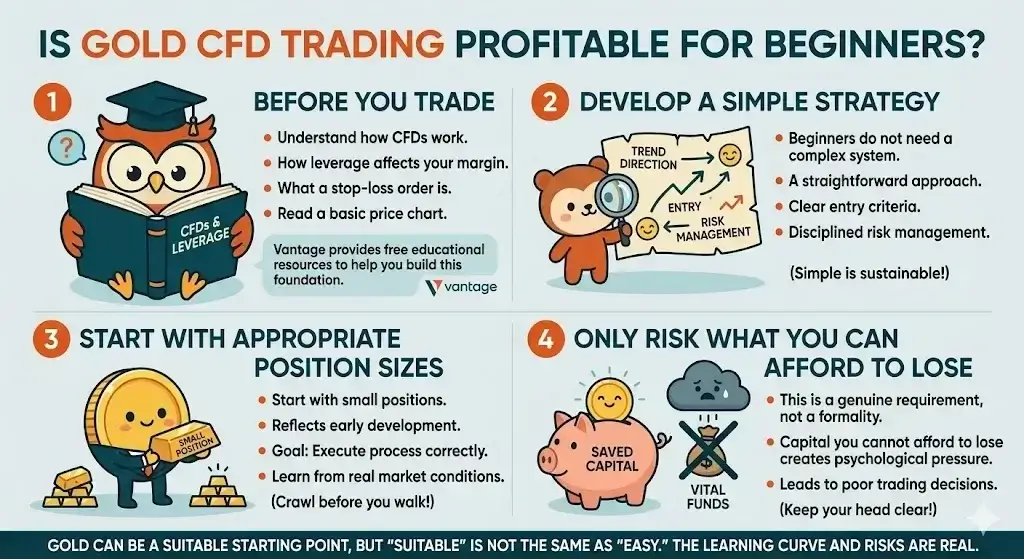
Gold CFD trading can lead to potential returns, but it also carries a high level of risk, particularly for beginners. “Accessible” does not mean “easy”. The learning curve is real, and losses can occur quickly when leverage is used without proper risk awareness.
For beginners, a more structured approach to learning gold CFD trading may include the following:
- Learn before you trade. Understand how gold trading with CFDs work, how leverage affects your margin, what a stop-loss order is, and how to read a basic price chart. Vantage provides free educational resources to help you build this foundation.
- Practise on a Demo Account First: A demo account allows beginners to explore gold CFD trading in a simulated market environment without using real funds. This can help traders become more familiar with platform features, order types, price movements, and basic risk management before considering a live account.
- Develop a simple strategy. Beginners do not need a complex system. A straightforward approach based on trend direction, a clear entry criteria, and disciplined risk management is more effective — and more sustainable — than sophisticated strategies applied inconsistently.
- Start with appropriate position sizes. When transitioning to a live account, begin with small positions that reflect the early stage of your trading development. Your goal at first is not to make large profits — it is to execute your process correctly and learn from real market conditions.
- Only risk what you can afford to lose. This is a genuine requirement, not a formality. Capital you cannot afford to lose creates psychological pressure that leads directly to poor trading decisions.
Start Trading Gold with Vantage
Gold CFDs can provide access to gold price movements without owning the physical asset. Through Vantage, traders can access gold (XAUUSD) and a wide range of other CFD markets, supported by trading platforms, real-time pricing, charting tools, and an economic calendar for tracking key market events.
To get started, you can choose to practise first with demo trading, or open a live account when you are ready.
Frequently Asked Questions (FAQ)
Can you make money in gold trading?
Yes — gold trading can generate profits for disciplined traders with a clear strategy and sound risk management. However, it is not guaranteed, and a significant proportion of retail CFD traders lose money. The key is preparation, not speculation.
Is trading in gold risky?
Yes. All trading involves risk, and leveraged products like gold CFDs carry a high degree of risk. Gold’s price can move sharply and unexpectedly in response to macroeconomic events. Using stop-losses, managing position sizes carefully, and trading only with capital you can afford to lose are essential practices.
Why trade gold via CFDs rather than buying physical gold?
CFDs allow you to trade both rising and falling gold prices, use flexible position sizes, and access the market almost 24 hours a day — without the storage and custody costs of owning physical gold. For active traders seeking to capitalise on gold’s price movements, this flexibility is a meaningful advantage.
Is gold trading profitable for beginners?
Gold trading can lead to potential returns, but beginners face a steep learning curve and a high risk of loss, especially when trading leveraged products such as Contracts for Difference (CFDs). Education, a clear trading plan, suitable position sizing, and careful use of leverage can help traders approach the market with more structure, but they do not guarantee positive results.
How does leverage work in gold CFD trading?
Leverage allows you to control a larger position than your deposit alone would cover. For example, 20:1 leverage means a £1,000 margin deposit controls a £20,000 position. A 1% move in gold’s price then represents a 20% gain or loss on your margin. Leverage is a powerful tool that must be used with care — it amplifies both gains and losses equally.
The information has been prepared as of the date published and is subject to change thereafter. The information is provided for educational purposes only and doesn't take into account your personal objectives, financial circumstances, or needs. It does not constitute investment advice. We encourage you to seek independent advice if necessary. The information has not been prepared in accordance with legal requirements designed to promote the independence of investment research. No representation or warranty is given as to the accuracy or completeness of any information contained within. This material may contain historical or past performance figures and should not be relied on. Furthermore estimates, forward-looking statements, and forecasts cannot be guaranteed. The information on this site and the products and services offered are not intended for distribution to any person in any country or jurisdiction where such distribution or use would be contrary to local law or regulation.